
Liposuction Vs Tummy Tuck: Which Problems Do They Address?
Key Takeaways:
- Liposuction only takes away fat. Loose skin, stretch marks and slack muscles stay exactly as they were, and the NHS says it works best on skin that is still firm and elastic.
- A tummy tuck cuts away loose skin below the belly button, with some fat. The full version also stitches the stomach muscles back together. The price is a scar across the lower tummy.
- The NHS doesn’t recommend either one for people who are overweight.
- Lots of women have a gap between their stomach muscles after pregnancy. A year on, up to a third still do. Try physio before anyone mentions surgery.
- Recovery isn’t in the same league. After a small liposuction many people are up and about within a few days, while a tummy tuck usually means 4 to 6 weeks away from work and the gym.
Which one’s better? That’s how most people come at this, as if they were two versions of the same product.
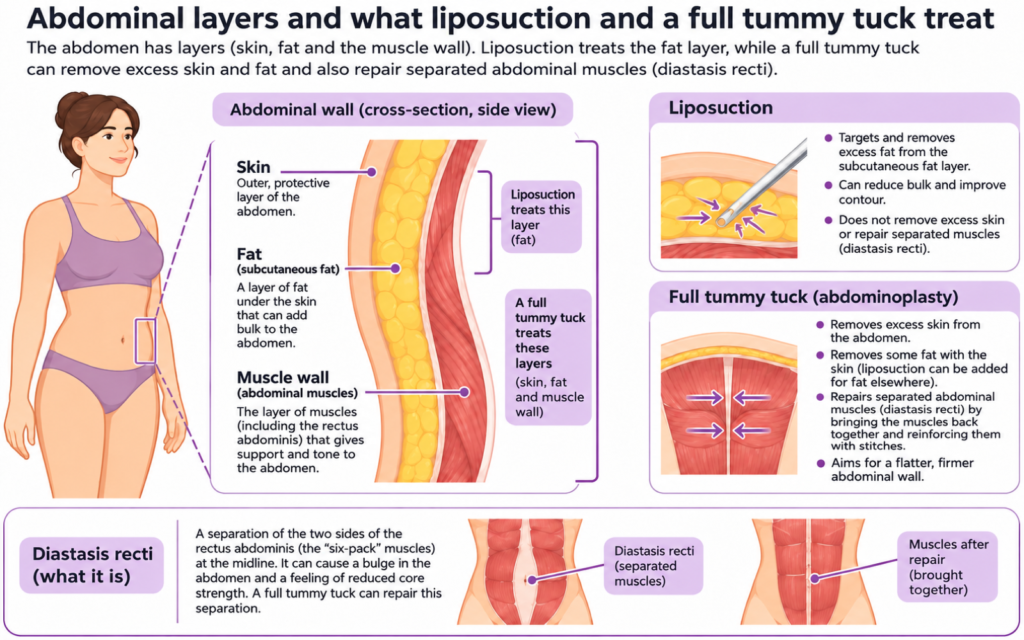
Most tummies are a mix. There’s fat, there’s skin, and under both there’s a muscle wall that may or may not have held up. Lipo works on one layer, a tummy tuck on the others. Match the operation to your problem and the choice gets easy. Get it wrong, say lipo on a tummy that’s mostly loose skin, and you can end up flatter but somehow worse. The fat that filled the skin out has gone. The skin hasn’t.
What Does Each Procedure Change?
Through a few small cuts, liposuction sucks fat out with a thin metal tube and changes the contour. That’s all it does. A tummy tuck is a much bigger job. The surgeon opens up the lower tummy and cuts away a strip of loose skin and fat. In the full version they also tighten the muscles and move the belly button. The NHS sums the tummy tuck up as removing excess loose skin, fat and stretch marks, and tightening the abdominal muscles.
| Feature | Liposuction | Tummy tuck |
|---|---|---|
| What it removes | Fat | Loose skin, some fat, and the stretch marks on the skin removed |
| What it does not address | Loose skin, stretch marks, separated muscles | Fat outside the area treated, such as the flanks |
| Muscle tightening | No | Yes, in a full tummy tuck |
| Best suited to | Firm, elastic skin with fat that won't shift with diet and exercise | Loose skin after pregnancy or large weight loss |
| Scar | Several small scars | A scar across the lower tummy, hip to hip in a full tummy tuck |
| Time off work | A few days for small areas, up to 10 days for larger ones | About 4 to 6 weeks |
| Not a treatment for | Obesity, cellulite or stretch marks | Being overweight |
There are 2 kinds of tummy tuck, and it’s worth knowing which one you’re being offered. In a partial (or “mini”) tummy tuck, skin and fat below the belly button come out through a cut across the lower tummy, and that’s it. The full operation goes further. The cut runs from hip to hip, the belly button is freed and given a new opening, and the abdominal muscles are pulled back into line. Only the full version does anything about the muscle wall.
How Do Fat And Loose Skin Differ?
You can pinch fat, and it goes up and down with your weight. Loose skin is skin that has been stretched past the point where it recovers, most often by pregnancy or by losing a lot of weight. The NHS describes a tummy tuck as being for “excess skin on the tummy that cannot be removed through exercise”. Liposuction removes no skin whatsoever.
Why Skin Quality Decides The Operation
Liposuction quietly depends on the skin shrinking back over the new shape. That’s why the NHS says it works best “in areas where the skin is firm and elastic”. Once skin has lost that snap, emptying out the fat underneath doesn’t tighten it. If anything it hangs a bit more. Our guide to loose skin after liposuction goes into why, and what the options are afterwards.
Stretch Marks
On stretch marks the NHS doesn’t hedge: NHS 111 Wales says liposuction will not remove them. With a tummy tuck, whatever marks are on the strip of skin being cut away go with it. For a lot of women that means most of the marks below the belly button. The ones higher up stay put.
What You See In The Mirror
Stand up and look at the waistband of your trousers. An apron of skin that folds over it, and that didn’t budge when you last lost weight, suggests skin. A firm, rounded fullness that grows and shrinks with your weight suggests fat. Most people see a bit of both, which is the whole reason this needs a surgeon’s hands on your tummy and not an online quiz.
Where Does The Abdominal Wall Fit?
Underneath the fat and skin is the muscle wall. Pregnancy can leave the two halves of the main stomach muscle stretched apart, a condition called diastasis recti, and the result is a bulge down the middle that dieting won’t flatten and liposuction can’t reach. Of the two operations, only a full tummy tuck repairs the muscle.
It’s common, and plenty of women see it improve without any operation. According to Leeds Teaching Hospitals, up to a third of women still have some separation a year after giving birth, although for most the gap closes up within 8 weeks. If yours hasn’t, the NHS route is your GP, then a pelvic health physiotherapist with a proper exercise programme.
Fixing the gap surgically, on its own, is another matter. In Cheshire and Merseyside, for example, the NHS doesn’t routinely fund diastasis repair. Its policy points out that nobody has run a randomised trial of the surgery, and that the studies we do have report plenty of complications, seroma, infection and recurrence among them.
A Bulge Down The Middle Isn’t Always Fat
Lie flat, then sit up. Does your tummy dome forward down the middle? That’s often a muscle gap, not fat. Lipo only takes fat from in front of the muscle, and with that gone the bulge can look even bigger. Get the muscle wall assessed first, and in most cases give specialist physiotherapy a proper go, before choosing between operations.
There’s one more thing that can hide in the same spot: a hernia. That changes the plan completely, and it’s a job for your GP or surgeon to rule in or out, not something to guess at from a comparison article.
When Are Combined Procedures Discussed?
People with loose skin low down and fat elsewhere, usually the flanks or upper tummy, often get offered both. The tummy tuck sorts the skin and muscle. Lipo tidies the shape
around it. Is doing both right for you? That’s partly about the look you’re after and partly about safety.
2 procedures at once means longer under anaesthetic, with more of you healing at the same time. Some surgeons are happy to combine them in one session for the right person, while others would rather split them into two. Neither is automatically the right call. What you’re owed is an explanation of why your surgeon prefers one approach for you.
Then there’s 360 liposuction, which treats fat all the way round the waist and sometimes gets pitched as an alternative to a tummy tuck. It isn’t one. Loose skin and separated muscles are untouched. Our guide to 360 liposuction explains what it does cover.
If someone suggests a combined plan, these are fair questions:
- Which part of my shape is each procedure meant to fix?
- Why one session and not two, or the other way round?
- What does combining them do to my recovery and my risk?
- What’s being done to cut my risk of blood clots?
- When will I be safe to fly home?
How Do Scars And Recovery Differ?
The tummy tuck is the bigger undertaking by some distance. The NHS says most people stay in hospital for a few nights, need about 4 to 6 weeks off work and exercise, and wear a corset or support pants for 6 weeks. With liposuction the scars are smaller and you’re back on your feet sooner, though the bruising and swelling can hang around for months.
| Feature | Liposuction | Tummy tuck |
|---|---|---|
| Hospital stay | Depends on how much is treated; ask your clinic | A few nights for most people (NHS) |
| Drains | Ask your clinic | One or two, removed once the fluid slows, usually before going home |
| Support garment | Worn constantly for several weeks (NHS) | Corset or support pants for about 6 weeks (NHS) |
| Back to work | A few days to 10 days, depending on area (James Paget) | About 4 to 6 weeks (NHS) |
| Exercise | Gentle at 3 to 4 weeks; no strenuous activity for 10 to 12 weeks (NHS) | Moderate exercise from weeks 6 to 8 |
| Driving | Ask your surgeon | Not for a few weeks (NHS); UHCW advises 6 weeks |
| Scar | Small scars at the entry points | A lower-tummy scar, red and raised at first, fading over 12 to 18 months (NHS) |
| Settled result | Up to 6 months for swelling to go (NHS) | Full recovery at about 6 weeks (NHS), with the scar still maturing |
What you’re really trading is skin for scar. Normal clothing usually covers it, but it’s long and it’s there for good. UHCW’s leaflet says the scar is red and raised for the first 6 weeks, fading to white over roughly the next 6 months, and warns that in some people it stays red and lumpy.
The Risks Aren’t The Same Either
For a tummy tuck, the NHS mentions thick scars, wounds that won’t heal, fluid or blood pooling under the skin, numbness or pain, and breathing problems, all as occasional risks. It also admits that some people don’t get the look they wanted and end up wanting a second operation. UHCW adds a less obvious one: numb outer thighs, which now and then doesn’t recover. Liposuction’s list on the NHS site opens with lumpy or uneven results and goes on to bleeding under the skin, blood clots and, very rarely, injury to internal organs. We cover these properly in liposuction risks and complications.
Like any surgery, both come with a chance of a clot in a vein. Is redness spreading from the wound? Is it hot or swollen, or does it smell? Got a fever, or pain that keeps getting worse? Ring your surgical team that day. Chest pain, suddenly struggling to breathe, a hot swollen calf: that’s 999.
In the UK, in an emergency: call 999 or attend the nearest A&E.
If your procedure was arranged through Longevita, contact your clinician’s support team (contact details are in your Appointment Schedule). Longevita doesn’t carry out surgery; independent clinicians do. So anything urgent goes to a clinician, NHS 111 or A&E first.
What Should A Clinician Assess First?
A surgeon should look at you before suggesting anything. That means your skin, your fat and your muscle wall, plus questions about how your weight has gone up and down. What bothers you? What do you want to change? Expect to be asked both. It’s the examination that picks the operation. If a clinic has recommended one before anyone has looked at you, that’s a sales conversation.
A proper assessment covers:
- Skin quality: How much loose skin is there, and where? Has it got enough snap left for lipo to work?
- Where the fat is: Fat just under the skin can be reached with liposuction. Fat packed inside the abdomen, around the organs, can’t.
- The muscle wall: Whether there’s a gap down the middle or a hernia, and whether you’ve already tried physiotherapy.
- Your weight: The NHS says a tummy tuck is normally only offered at a healthy body mass index, and that liposuction works best in people who aren’t overweight. Our guide to BMI and plastic surgery explains why surgeons care.
- Your plans: Another pregnancy or a lot more weight loss can undo part of the result, so say so if either is on the cards.
- Your health and habits: Smoking, medicines that affect bleeding and anything that slows healing all shift the risk.
Weight First, Surgery Second
Neither operation is a way to lose weight, and the NHS says as much. Liposuction works best in people who aren’t overweight, and a tummy tuck is normally only offered to people at a healthy body mass index. If you’re still losing weight, your skin and fat will keep changing, and an operation planned around today’s body might not suit the one you have next year.
UK rules require the doctor doing a cosmetic procedure to take your consent in person and to ask what you’re hoping for (GMC). The Royal College of Surgeons also recommends giving you at least 2 weeks to think before you sign. Surgeons working abroad aren’t bound by either, so it’s worth asking any clinic how it handles them. For how a treatment plan is put together, see liposuction in Turkey and tummy tuck in Turkey.
Myths And Facts
| Myth | Facts |
|---|---|
| “Liposuction is just the less invasive version of a tummy tuck.” | They work on different layers. A smaller operation is only the better choice if it fixes the problem you actually have. |
| “Lipo will tighten my skin.” | The NHS says it works best where the skin is already firm. It removes no skin at all. |
| “A tummy tuck gets rid of all my stretch marks.” | Only the ones on the skin that's cut away, which are mostly below the belly button. |
| “A tummy tuck is a way to lose weight.” | The NHS says it isn't suitable for people who are overweight. |
| “Any bulge can be fixed with lipo.” | Not if it's a muscle gap or a hernia. Those won't respond and can look worse afterwards. |
| “Lipo 360 is a tummy tuck without the scar.” | It only treats fat around the waist. Loose skin and separated muscles are left alone. |
Frequently Asked Questions
Is a tummy tuck better than liposuction?
Not in general. It depends which problem you’re trying to solve. Firm skin with stubborn fat might only need lipo. Loose skin or separated muscles won’t be fixed by it.
Can liposuction get rid of loose skin?
No. It takes fat out and leaves the skin to shrink back on its own. Skin that’s lost its stretch won’t, and can end up looser.
Can I have liposuction and a tummy tuck together?
In some cases. It’s a common pairing when there’s loose lower skin plus fat elsewhere. Your surgeon decides if it suits you, and whether to do it in one go or two, after examining you.
Will a tummy tuck fix my muscle gap after pregnancy?
A full tummy tuck can stitch the muscles back together. But the gap often closes by itself, and specialist physio comes first. Have it checked before surgery is even on the table.
Which has the bigger scar?
The tummy tuck, by a long way. Its scar runs across the lower tummy, from hip to hip in the full version, and the NHS says it fades over 12 to 18 months. Lipo leaves a handful of small marks.
Is either available on the NHS?
Hardly ever, if the reason is cosmetic. The NHS treats a tummy tuck as cosmetic surgery and says it isn’t usually available.
- Last Updated:

Dr. Mustafa Ekrem Güleş
Specialist in plastic, reconstructive and aesthetic surgery · Member of the Turkish Society of Plastic, Reconstructive and Aesthetic Surgeons
Last reviewed
Dr. Mustafa Ekrem Güleş is a highly experienced independent Specialist in Plastic, Reconstructive and Aesthetic Surgery, with a strong focus on breast and body contouring procedures. With extensive clinical training and international exposure, he is known for his precise, patient-focused approach and commitment to achieving natural-looking results tailored to individual goals. Dr Ekrem performs his procedures in Istanbul.
Request A Callback For A Discovery Call
With Longevita, you have the option to discuss your goals with us from the comfort of your couch.
- A UK-registered medical tourism facilitator
- Trusted by over 150,000 clients
- A free, no-obligation discovery call