
What is A DHI Hair Transplant?
DHI is a variant of the traditional FUE surgery. Both involve extracting grafts or follicular units (FUs) from the back of the scalp (donor area), but they differ in the implantation phase of the surgery.
Choi pens can simultaneously make incisions in the balding areas of the scalp and place FUs there, allowing for precise placement while eliminating the need for pre-made incisions. However, in regular FUE, slit-making is a separate step of the surgery, which precedes graft placement and is done manually.
Although both FUE and DHI are effective hair transplantation techniques, DHI has certain advantages that make it more appealing.
As an important part of self-expression and identity, hair loss can negatively affect self-esteem, confidence, and body image. But while being bald may not be a choice, modern hair restoration treatments offer you the choice to regain a full head of hair.
With direct hair implantation (DHI) surgery, many people are able to restore their hair without having to shave your entire head and achieve dense and natural-looking results.
In the 1990s, a Korean doctor, Yung Chul Choi, developed the Choi implanter pen, which not only provided more protection to the scalp but also spared the grafts of traumatic injury from forceps. Because these pens can mitigate the risk of damage to the skinny and delicate grafts obtained from follicular unit extraction (FUE) surgery, their usage has become quite popular.
How Much Does a DHI Hair Transplant Cost?
Direct hair implantation’s prices can depend on where you decide to have it. A Turkish hair transplant cost for DHI may be around £2,000, while in the UK, it may exceed £4,000.
Since DHI uses multiple specialised Choi pens and requires advanced skills and knowledge, as well as extra staff for loading the implanter pens, all these factors can add to the cost of this surgery, making it slightly more expensive than regular FUE.
Because DHI is a highly personalised technique, there is no fixed, one-size-fits-all price. The total cost depends on the the precision needed during implantation, and what is included in your individual DHI treatment plan.
Many people choose to travel abroad for their DHI hair transplant, as treatment plans in Turkey can offer competitive pricing while independent clinicians operate to recognised clinical standards — individual results vary.
You can explore how DHI costs vary internationally on our Average Cost of Hair Transplant in Turkey and Hair Transplant Cost Comparison by Country pages.
Want a personalised Hair Transplant estimate?
Use our Price Calculator to get an estimate of how much your hair transplant, or any other treatments you’re interested in might cost. This quick tool helps you plan your treatment and budget with confidence before booking a consultation.
Select your treatment location
Select your treatment
Estimated Cost
All prices are estimates. Final cost may vary.
What’s included
DISCLAIMER
This is a price estimate only for budgeting purposes however it cannot be used as a substitute for a formal price quote that can only be given after a consultation with a qualified medical professional.
Optional additional treatments
Let's Turn Your Estimate Into a Plan
Complete the form and our team will reach out with everything you need to move forward.
Get a Free DHI Hair Transplant Consultation
Fill out the form to receive a callback and book a consultation to receive your Free, no-obligation hair transplant treatment plan tailored specifically for your hair loss requirements.
 4.8Top Rated Serviceverified by TrustindexTrustindex verifies that the company has a review score above 4.5, based on reviews collected on Google over the past 12 months, qualifying it to receive the Top Rated Certificate.

Who Is A Good Candidate for DHI Hair Transplant?
Anyone who is eligible for a traditional follicular unit extraction can also undergo a direct hair implantation procedure. The following might be particularly suitable for DHI, however:
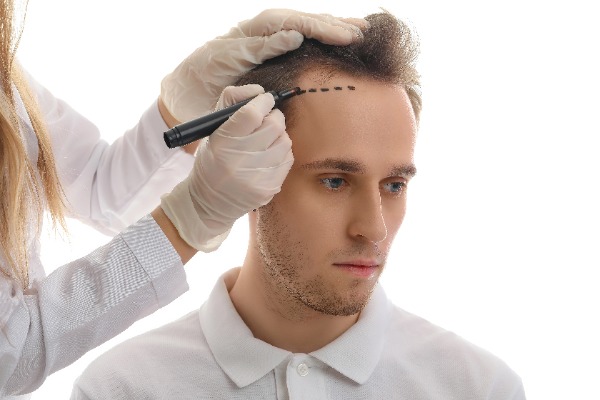
DHI Without Shaving
If you’re not looking to shave your entire scalp for a hair transplant, DHI can be ideal since you don’t have to trim your recipient areas. The donor area will still be shaved as grafts need to be extracted, but it may provide more discretion, especially for those with long hair.
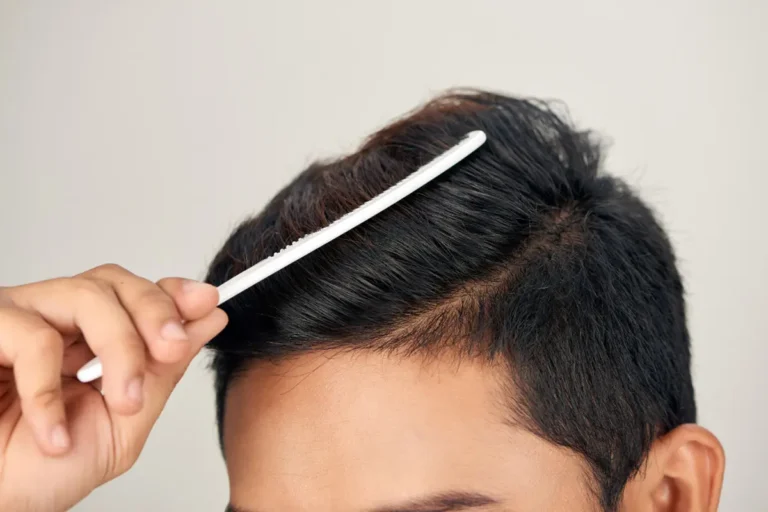
Increasing Hair Density with DHI
If you’ve had a previous hair transplant and want to further increase the density (follicular units per cm2) in an area, DHI can implant newer grafts without causing any damage to the originally transplanted grafts.
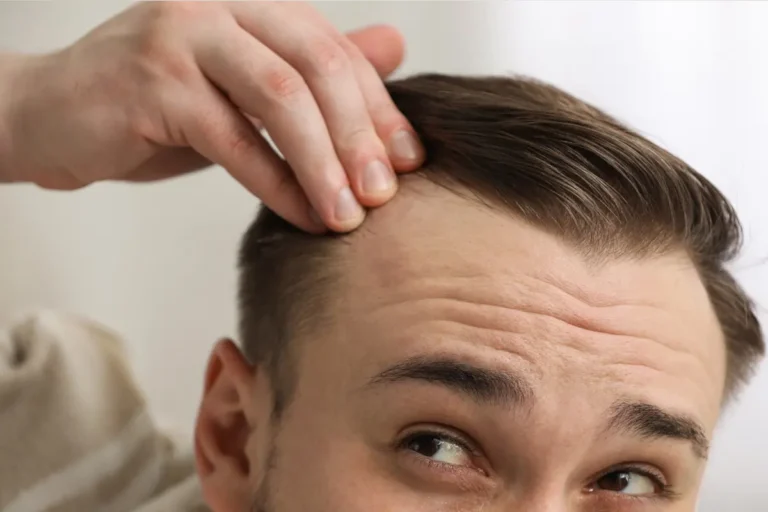
DHI for Smaller Areas
If you require 3,000 grafts or fewer, DHI can be recommended since it offers greater precision, better graft survival and a faster recovery time compared to traditional FUE.
What Is A Choi Implanter Pen?
A Choi implanter is a mechanical pen-like device with a hollowed needle and a bevel – opening at the sloped side of the needle’s tip.
There are two ways to place the grafts into the balding areas of the scalp.
A Choi pen both pierces the skin to open a channel in the recipient area and places the graft into the said channel using the stick-and-place technique.
However, before the graft can be implanted, trained technicians carefully load each follicular unit into the pen with the help of forceps, making sure that it is directed the right way and placed completely within the needle so it’s not damaged.
Around 6 to 7 Choi pens are used per surgery, with 3 technicians loading the grafts into the pen and the surgeon placing the grafts. Each pen transplants a single graft, and once it has been emptied, it goes back into the circulation to be loaded and used again. In the meantime, the surgeon is handed a new pen to keep the implantation process going.
Choi implanters with different diameters ranging from 0.8 to 1.2 mm are available, and their usage varies according to the type of graft being inserted. Generally, 0.6-0.9 mm can be used for 1-hair follicular units, about 1 mm for follicular units with 2 hairs, and up to 1.2 mm for those that can have 3 to 4 hairs in them.
What Are Pre-Made Incisions?
Pre-made incisions, in which the surgeon makes the incisions before grafts are placed into them.
What Is the Stick-and-Place Method?
Stick-and-place method where making of the incision and graft placement is immediate and simultaneous.
How Is a DHI Hair Transplant Performed?
Direct hair implantation surgery begins with extracting hair grafts from the safe donor area at the back and sides of the scalp. It is done under local anaesthesia for a painless experience.
Once the relevant number of grafts have been extracted, sorted (by the number of hairs in each graft) and stored in a special chilled solution to ensure their survival, the “direct hair implantation” part of the surgery begins.
For this, the recipient area is separately anaesthetised and then tumesced (swollen up) with a solution of isotonic water and adrenaline to reduce bleeding while improving the view of the recipient area.
Starting at the hairline, the Choi pen is loaded with a graft, angled at around 15-20 degrees, following which the needle pierces the skin (at the same depth as the length of the graft) to create the slit. Afterwards, the plunger is pushed to take out the needle from the scalp, with the graft now left in its new place.
This process is repeated for each graft, although, of course, the depth of incision, angulation and the type of grafts used can vary according to each region. For instance, where 1-2 hair grafts are used for the hairline, 3-4 hair ones are used for the centre and 4-2 for the crown.
Angling can also vary throughout the scalp, reaching up to 40 degrees in the mid-scalp and 45 degrees in the crown but less than 10 degrees in the temporal area. However, the advantage of using a Choi pen is that it’s easier to control the angles, especially when they’re acute.
One thing about DHI is that the number of grafts that can be safely implanted in each session is limited to 3,000 due to the time involved in loading each Choi pen (this surgery can take 6-8 hours, depending on the graft number). Because of this, it is more commonly used for specific areas, such as the hairline or crown or for an improvement in the overall density.
What Are the Benefits of DHI Hair Transplant?
In addition to DHI surgery being unshaven, it has several other advantages:
How DHI Reduces Trauma
Why DHI Offers Quicker Recovery
Because Choi pens are less traumatic for the scalp, they can also shorten your hair transplant recovery period.
Ensuring Graft Survival with DHI
Implanter pens can protect the grafts from getting bent or crushed, which can then ensure better graft survival and hair growth after the procedure. Moreover, because it combines slit-making with graft placement, grafts don’t have to stay out for too long.
Enhanced Surgeon Control in DHI
Choi pens can allow for more precision when it comes to making incisions. The surgeon can easily determine the angle, depth and direction of the graft, and an added benefit is that in DHI, both incision-making and graft placement are completely done by the surgeon.
Achieving Natural High-Density Results
Better angling, graft survival, less trauma, and other benefits of Choi pens can all contribute positively to the final results. With DHI, there is the potential to achieve even more natural-looking results while getting high-density.
What Are The Limitations Of A DHI Transplant?
The DHI method has a few limitations, one of which is the relatively finite number of grafts that can be implanted.
An unshaven DHI is only possible if you need 3,000 grafts or less because the process of loading the pens, even with three technicians involved, can still be quite time-consuming. For this reason, larger sessions – involving around 4,000 grafts or so – are not possible with it.
In addition, DHI may not be recommended for those who have curled hair roots; instead, traditional FUE is considered preferable. That’s because when putting the graft through the tip of the pen, it can end up getting damaged.
Keep in mind that DHI hair transplants can still be performed on patients with Afro hair, but the surgeon will first need to assess your hair.
DHI Hair Transplants Before-And-After Photos
You can expect to see the final results of your DHI surgery in 12 to 18 months. Results can vary between people, depending on factors such as donor area, balding area size, health status, and aftercare.
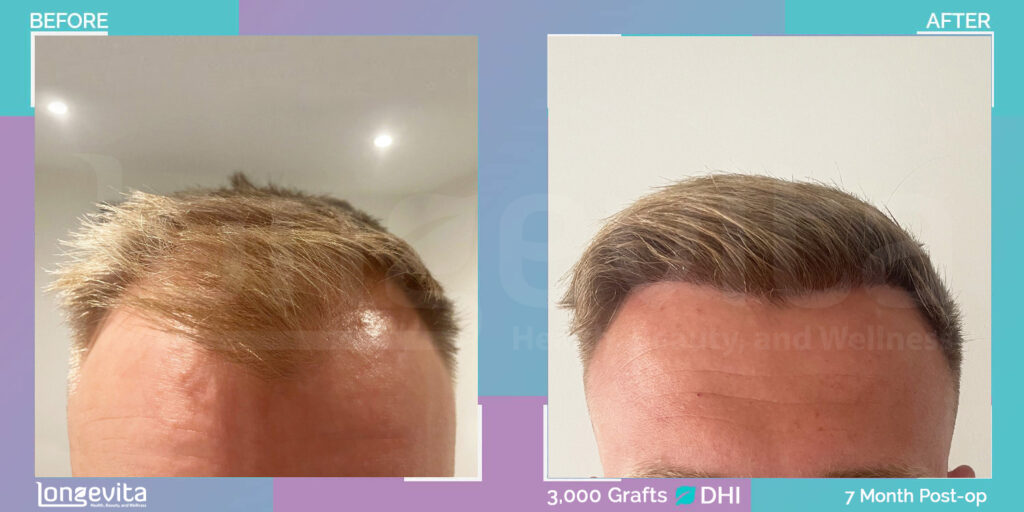
- Age: 23
- DHI
- 3,000 grafts
- 7 Months
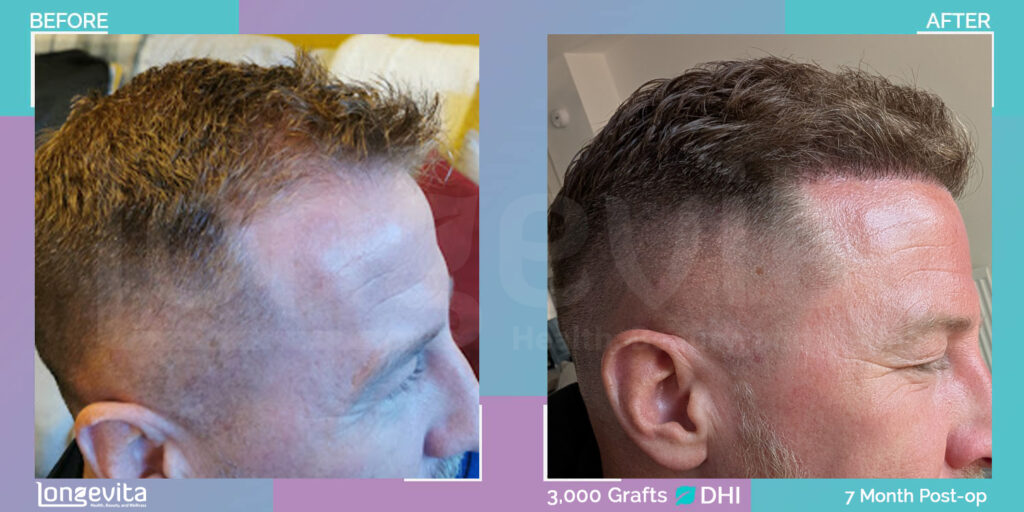
- Age: 36
- DHI
- 3,000 grafts
- 7 Months
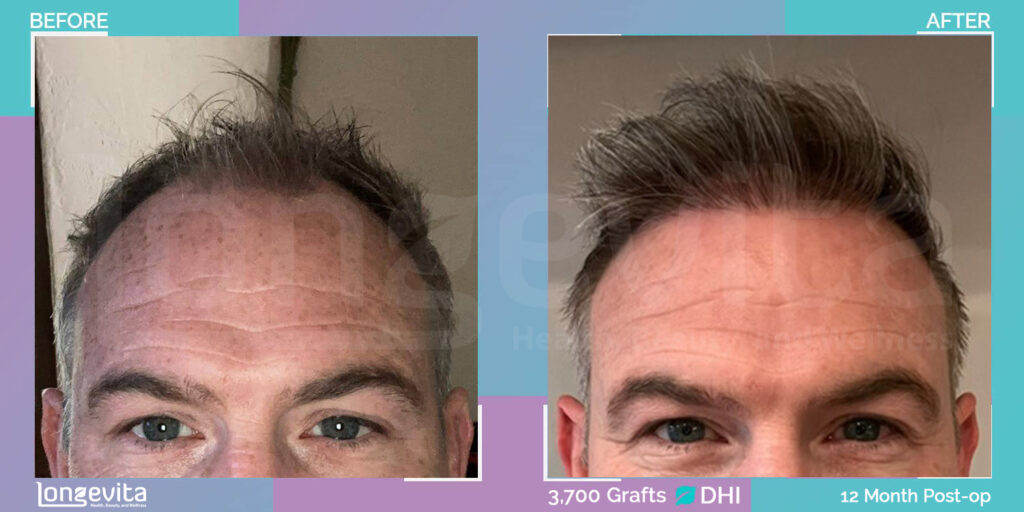
- Age: 40
- DHI
- 3,700 grafts
- 12 Months
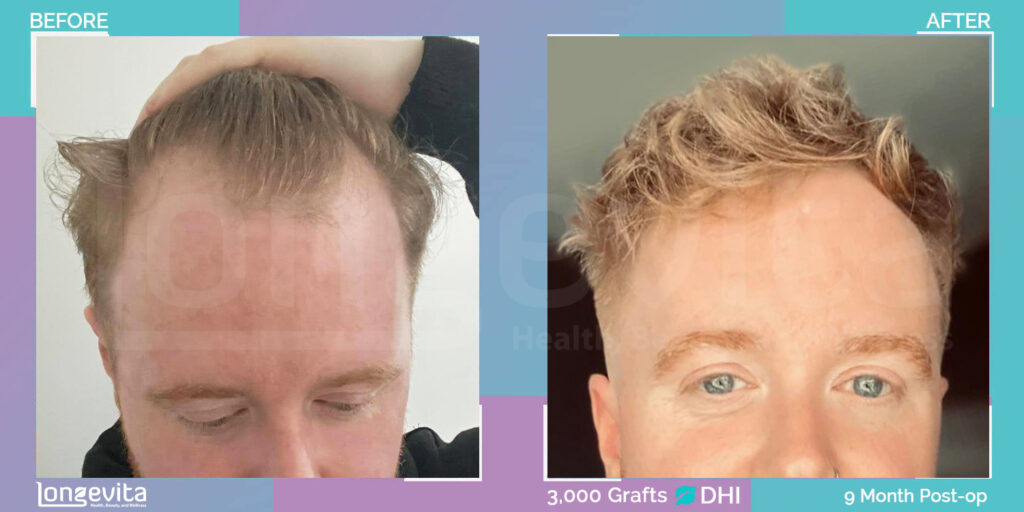
- Age: 33
- DHI
- 3,000 grafts
- 9 Months
David's DHI Hair Transplant Journey
In May 2024, David took the next step in restoring his confidence with a Direct Hair Implantation (DHI) procedure. His main concern was his receding hairline, particularly in the corners. After careful consultation, he opted for a 3,000 graft DHI procedure focusing on zone 2, helping to achieve a more youthful and natural-looking hairline.
Watch David’s journey as he experiences the transformation, from the initial stages to the final results.
Patient Journey
0:41
0:43
Ready to start your Hair Transplant Journey in Turkey?
Fill out the form to receive a callback and book a consultation to receive your Free, no-obligation hair transplant treatment plan tailored specifically for your hair loss requirements.
Frequently asked questions about DHI Hair Transplant
Many patients experience positive results with DHI hair transplantation. Effectiveness depends on individual factors including hair density, loss pattern, and clinician expertise. Compared to traditional FUE, DHI uses a Choi implanter pen that allows simultaneous incision and graft placement, which may support graft survival and precision. Individual outcomes vary — discuss your specific case with your clinician during consultation.
The results of a DHI hair transplant are long-lasting. The transplanted hair follicles are resistant to the effects of the hormone (DHT) that causes hair loss. Therefore, you can enjoy your results for many years.
A DHI hair transplant is performed under local anaesthesia, so you will experience minimal pain during the procedure. The administration of the anaesthesia itself might cause some discomfort, but you can avail of needle-free anaesthesia to ensure greater comfort.
DHI, or direct hair implantation, is a sub-type of FUE (follicular unit extraction). Grafts are extracted from the scalp in the same way in both methods. However, DHI uses a Choi Implanter pen, which allows for simultaneous incision-making and graft placement, while FUE employs metal blades to make manual incisions and forceps to place the grafts.
The Choi implanter pens minimise scalp trauma, which allows the patients to heal more quickly from this type of surgery.
The surgeon will use the Choi pen to insert the grafts in the balding area(s). However, technicians help with the loading of the grafts in the Choi pen to speed up the process.
You should start to see your hair grow 3-4 months after the surgery, but you’ll have to wait for 1-1.5 years for all your hair to grow out.

Dr Cagla earned her medical degree at Trakya University’s Faculty of Medicine in Bulgaria and has almost 6 years of hair transplantation experience. She is a specialist in FUE, DHI and Sapphire hair transplants of the scalp, eyebrows and beard and has performed over 6,000 surgeries. Dr Cagla is multilingual, with fluency in English, Bulgarian and Turkish.