
Back And Bra Fat Liposuction: Fat Removal Or A Back Lift?
Key Takeaways:
- This is about fat on the upper and middle back. The lower back and waist are a different area.
- “Bra fat” describes where something sits, not what it’s made of. Fat, loose skin and the way clothing presses can all play a part.
- Liposuction does best on firm, elastic skin in people who aren’t overweight, according to the NHS.
- Everyone’s back creases a bit at the bra line when they sit, bend or twist. That’s normal, not something to fix.
- If skin is the main cause, a back lift may be discussed. It removes skin, at the cost of a much longer scar.
A ridge where the bra band sits is something plenty of people notice in a fitted top or a photo taken from behind. It’s also easy to misread. 2 rolls can look identical. One turns out to be mostly fat, the other mostly skin. And sometimes the bra is just a size too small.
Which one you’ve got decides whether liposuction is even on the table. Here we cover what back liposuction changes, what it leaves alone, what a clinician checks first, and where a back lift fits in. Longevita, a UK-registered facilitator, doesn’t operate on anyone. Independent clinicians decide whether you’re suitable, choose the technique and do the surgery. Liposuction arranged through Longevita takes place in Istanbul, at accredited independent hospitals; our liposuction in Turkey page explains how it’s arranged.
What Does Back And Bra Fat Liposuction Treat?
Back and bra fat liposuction treats a localised area of fat on the upper or middle back, most often the soft fullness above and below where a bra band or strap sits. It’s aimed at contour: making that area less prominent under clothing.
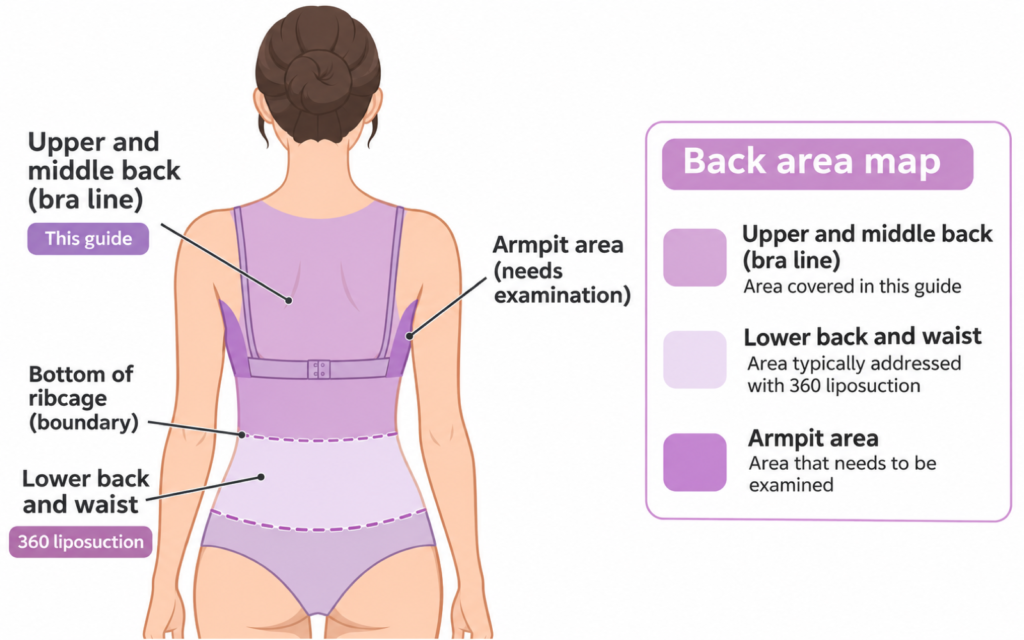
Where This Area Starts And Stops
The area runs across the back roughly between the shoulder blades and the bottom of the ribcage. Fat lower down, around the waist and lower back, is usually treated as part of a different plan, which our guide to 360 liposuction explains.
Fullness close to the armpit needs particular care. It can be fat, but it can also be breast tissue or something else, and it shouldn’t be treated as ordinary back fat until a clinician has examined it.
What It Isn’t For
Liposuction isn’t weight-loss treatment. The NHS says it “is not a treatment for obesity”. It won’t remove stretch marks either, and it doesn’t change the skin itself.
Why Does The Distinction Between Fat And Loose Skin Matter?
Liposuction takes the fat out, then leaves the skin to shrink back over the new shape by itself. Skin that’s lost its spring doesn’t do that well. Empty the fold from underneath and it can sag further.
That’s why the NHS says liposuction works best “in areas where the skin is firm and elastic”. Skin on the back can lose that firmness after a large weight loss, with age, or both. A fold that’s mainly skin often needs skin removal to change, and that’s a different operation. Our guide to loose skin after liposuction looks at the wider question of skin laxity.
| Concern | What needs assessment | Why liposuction alone could be limited |
|---|---|---|
| A soft roll above or below the bra band | How much is fat and how firm the skin is | If the skin is lax, it may not shrink back after the fat is removed |
| A fold that's still there with the bra off | Whether loose skin is driving the fold | Liposuction doesn't remove skin |
| A roll that mostly goes when the bra comes off | Whether clothing pressure is the main cause | Surgery won't change how a tight band presses on soft tissue |
| One side fuller than the other | Existing asymmetry in fat, skin and posture | Some differences between the sides can remain afterwards |
| Fullness near the armpit | What the tissue actually is | It may not be back fat at all |
| A fold after major weight loss | Skin quality and whether your weight is stable | Skin excess usually needs a different approach |
What Does A Clinician Assess Before Recommending Back Liposuction?
They want to know where the fullness is, what it’s made of and how your skin behaves. Then comes the real question: can lipo actually get you what you’re after? That assessment can’t be done from photographs or a pinch at home.
The Examination
You’ll usually stand for this, and you may be asked to lift your arms or lean forward. They’ll gauge how thick the fat is, watch how the skin moves and springs back, and compare one side with the other. Photographs from set angles are commonly taken for planning and comparison.
Your History
Your weight history matters, because a large weight loss can change skin more than people expect. So does whether your weight is still changing. Expect questions about your health too. Do you smoke? Take anything that thins the blood? Had surgery on your back before?
Your Goal
Say exactly what bugs you. Maybe it’s the ridge under a fitted top. Maybe it’s swimwear, or a fold that only shows when you sit down. Each one points to a slightly different bit of your back, and the clinician can only plan for what you tell them.
What Changes Can Back Liposuction Realistically Achieve?
If it’s mainly fat and your skin’s in fair shape, back lipo can take the fullness out of the bra line and smooth the upper and middle back under clothes. The change is a reduction, not a reshaping of the whole back.
Some things stay the same. Your skin won’t get any tighter, so a fold made of skin stays put. You’ll still crease when you bend or twist. Every back does. Small differences between the 2 sides may persist. And a bra that’s too tight will still press into soft tissue after surgery.
The incisions are usually a few millimetres long, and surgeons commonly try to place them where a bra band or strap will cover them. They’re small, but they’re scars, and they fade over months.
Different techniques exist. Our guide to VASER liposuction explains one of them. No technique turns loose skin into firm skin.
A Flatter Back Isn’t Always A Smoother One
If the fold is mostly skin, removing the fat under it can make the fold look deeper. Before agreeing to back liposuction, ask the clinician directly how much of what you see is skin, and what would happen to it after the fat has gone.
When Would A Clinician Discuss A Back Lift Instead?
It usually comes up when the fold is mostly loose skin. That’s common after losing a lot of weight. A back lift removes skin, which liposuction can’t do.
The trade-off is a much longer scar across the back, along with a bigger operation. Some people have both loose skin and fat, and the two procedures may be discussed together or in stages. That’s a judgement for the clinician. Our guide to back lift surgery covers the operation itself.
Weight stability matters here. UK guidance from BAPRAS on body contouring after weight loss uses “weight stability for 12 months” as one of its criteria for NHS-funded surgery. Private treatment follows its own rules, but a body that’s still changing can undo a plan made around it.
What Should You Know About Risks And Recovery In This Area?
The risks of back liposuction are those of liposuction generally. Top of the NHS list for liposuction is “lumpy and uneven results”. Bleeding under the skin, numbness that lingers and changes in skin colour follow, and, as with any operation, there’s a small risk of a blood clot in a vein. Hardly any research looks at the back on its own, so ask your clinician what they’ve seen in their own patients. Our guide to liposuction risks covers the full list.
A few practical points stand out for this area. You lie on your back and lean against chairs, so the treated area takes pressure from the first night; ask how you should sleep and sit. Unevenness right at the bra line tends to be noticed first, because clothing shows it up. Swelling also hides the result for a while. The NHS gives it up to 6 months to settle. Our guide to liposuction recovery goes through the stages.
It’s hard to check your own back. If something feels off, get someone else to have a look. Redness that’s spreading, heat, a discharge that smells or a high temperature? Ring your clinic that day. Struggling to breathe all of a sudden, chest pain, or a calf that’s swollen and sore could mean a clot.
In the UK, in an emergency: call 999 or attend the nearest A&E. If you’re not sure whether something is urgent, NHS 111 can advise.
If Longevita arranged your treatment, contact your clinician’s support team (contact details are in your Appointment Schedule). Anything urgent goes to 999, A&E or NHS 111 first.
Which Questions Should You Ask At Your Consultation?
The most useful questions pin down exactly what’s being treated, what will stay the same, and how the result will be judged. Use these as discussion points with your clinician, not as a way to decide suitability yourself.
- Exactly which part of my back would you treat, and where does it start and stop?
- Would this look different in another bra, other clothes, or if I stood differently?
- What’s fat here, what’s skin, and is one side already bigger?
- What would this procedure leave unchanged?
- Where would the incisions be, and what scar should I expect?
- When and how would we assess the result once healing has settled?
It’s also worth asking what would happen if you weren’t happy afterwards. Nobody can promise further treatment will be free. A clinician may waive their own fee, but other costs such as the hospital and anaesthetic can still apply, and travel is planned separately.
If you’d like Longevita to arrange a consultation with an independent clinician, contact us or book a free Discovery Call with us.
Myths And Facts
| Myth | Facts |
|---|---|
| “Bra fat is always fat.” | It describes a location. Fat, loose skin and clothing pressure can all contribute. |
| “Liposuction will tighten the skin on my back.” | It removes fat, not skin. The NHS says it works best where skin is already firm and elastic. |
| “After back lipo, my back will look smooth in everything.” | Normal folds still appear when you bend or twist, and fitted clothing can still crease. |
| “A fold near my armpit is just back fat.” | That area needs examining. It may be a different kind of tissue. |
Frequently Asked Questions
Can liposuction remove bra fat?
If it’s mostly fat and the skin’s firm, it can reduce it. A fold that’s mostly loose skin is unlikely to go with lipo alone.
Will a bra-line fold disappear completely after back liposuction?
Not necessarily. A fold made of skin needs skin removal to change, and some folding when you move is normal for everyone.
Is back liposuction the same as 360 liposuction?
No. Back liposuction focuses on the upper and middle back. 360 liposuction treats the waist all the way round, including the lower back.
Can I tell at home whether my bra roll is fat or skin?
You might notice it shifts with a different bra, or when you stand up straighter. Working out what it is, and whether lipo would help, takes an examination.
- Last Updated:

Dr. Mustafa Ekrem Güleş
Specialist in plastic, reconstructive and aesthetic surgery · Member of the Turkish Society of Plastic, Reconstructive and Aesthetic Surgeons
Last reviewed
Dr. Mustafa Ekrem Güleş is a highly experienced independent Specialist in Plastic, Reconstructive and Aesthetic Surgery, with a strong focus on breast and body contouring procedures. With extensive clinical training and international exposure, he is known for his precise, patient-focused approach and commitment to achieving natural-looking results tailored to individual goals. Dr Ekrem performs his procedures in Istanbul.
Request A Callback For A Discovery Call
With Longevita, you have the option to discuss your goals with us from the comfort of your couch.
- A UK-registered medical tourism facilitator
- Trusted by over 150,000 clients
- A free, no-obligation discovery call