
Hard Lumps After Liposuction: Swelling, Fibrosis Or Another Cause?
Key Takeaways:
- Most hard lumps after lipo are just the body healing. Give them a few months and they soften.
- If that tissue stays hard for longer than it should, doctors call it fibrosis. Usually it eases. Now and then it leaves a dent or a ridge behind.
- Not every lump is healing tissue. Some are fluid, some are infection, and some are fat that’s been damaged. You can’t tell which by feel alone.
- The evidence that massage softens lumps is thin. Don’t start it without your surgeon’s say-so.
- Don’t press, roll, heat or try to drain a lump yourself.
A hard lump after liposuction is usually just part of healing. The treated fat has been tunnelled through many times and repairs itself unevenly, so it’s common to feel knots, ridges and firm patches for weeks or months. Most of them soften. Some stay firm for longer, which is what people mean by fibrosis. A few turn out to be something else, and those need a clinician.
This guide is about telling those apart, or more accurately, about how a clinician tells them apart, because it can’t reliably be done at home. If your concern is overall puffiness, see our guide to swelling after liposuction. Longevita is a UK-registered facilitator and doesn’t perform surgery: liposuction arranged through Longevita takes place in Istanbul, with independent clinicians at accredited independent hospitals.
Hard Lumps After Liposuction At A Glance
| Firmness while healing | Common |
|---|---|
| Area fully settled | Up to 6 months (NHS), sometimes longer |
| Lasting contour deformity | 2.35% pooled rate (Aesthetic Surgery Journal, 2024) |
| Seroma | 0.65% in the same meta-analysis |
| Haematoma | 0.27% in the same meta-analysis |
Larger areas, denser fat and areas treated before tend to take longer to soften.
What Can A Hard Lump Represent?
A hard lump after liposuction can represent several things. Most are harmless and temporary. A few aren’t.
Healing Tissue That Hasn’t Softened Yet
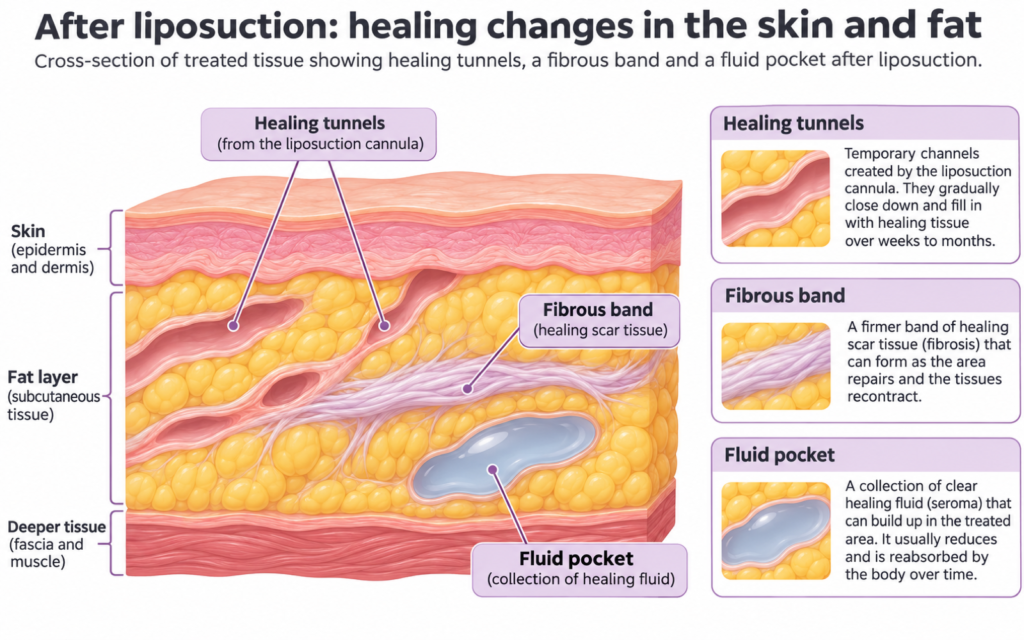
Healing tissue is by far the most common cause. While the area repairs, the body lays down new connective tissue in the tunnels the cannula left behind. It doesn’t do it evenly. Where there’s more of it, you feel a firm patch. It’s often tender to press, sometimes with numb skin over the top, and it slowly gets smaller and softer.
Fibrosis
Fibrosis is what doctors call healing tissue that’s still hard long after it should have softened. It feels woody, or knotty. Sometimes it grips the skin from underneath, so you see a dimple when you move. It’s more likely on the back, flanks and male chest, where the fat is denser, and in areas that have been treated before.
Most fibrosis still softens with time. Sometimes it doesn’t, and leaves a lasting dent or ridge. That’s one route to contour deformity, which a 2024 meta-analysis in Aesthetic Surgery Journal found to be the most common complication of liposuction: 2.35% across 39 studies and 29,368 patients. The studies varied widely, so it’s a rough guide. Nobody has good figures for fibrosis itself, and there’s no agreed definition.
A Fluid Collection
A fluid collection is a pocket of fluid under the skin. A seroma holds clear fluid. A haematoma is blood. Leave it a while and it can go firm as your body slowly clears it. Either one can pass for a lump.
Infection
An infected area can turn into a firm, sore lump. It’s usually hot or red, you may run a temperature, and sometimes something leaks out. Occasionally it forms an abscess, a pocket of pus.
Fat Necrosis
Fat necrosis means a patch of fat lost its blood supply and died. It may only turn up weeks later, as a firm lump that refuses to soften. It isn’t common, and it’s often nothing to worry about. You still want someone to examine it.
Something On The Surface
Something on the surface can feel like a lump too. Maybe it’s a small scar that’s thickened up where the cannula went in. Or a groove from a garment that has rolled or creased. Both happen a lot. Bring them up at your follow-up.
How Does A Clinician Tell The Causes Apart?
A clinician tells the causes apart by putting together your history, an examination and, when needed, a scan. There isn’t one test that settles it.
What You’ll Be Asked
When did you first notice it? Has it changed? Does it hurt? Expect those questions. Is it hot or red? Any fever or discharge? Bigger than last week? Each of those points somewhere different. So does timing. A lump that has been there since week 1 and is slowly softening is a very different story from a new one at week 8.
The Examination
The examination is mostly careful looking and feeling. The clinician compares the lump with the tissue around it and with the other side. Is it firm or soft? Fixed or mobile? Warm? Tethered to the skin? Each answer narrows things down.
When A Scan Helps
A scan helps when the examination leaves doubt. Usually that means an ultrasound first. It can show whether there’s fluid that might need draining, and can help identify fat necrosis.
Why A Home Test Doesn’t Work
A home test doesn’t work because the signs overlap. A seroma can feel firm. Fibrosis can be tender. An infection can start without much redness. Pressing hard to “check” can also hurt healing tissue. If a lump feels different from the rest of the area, the answer is to ask, not to prod.
When Is Assessment Urgent?
Assessment is urgent when a lump is hot, red, growing quickly or getting more painful, or when you have a fever. Signs of a blood clot need emergency help. The table sorts the common signs into 3 groups.
| Usually part of healing | Contact your clinician’s support team | Emergency |
|---|---|---|
| Firm, patchy areas that slowly soften | A lump that’s growing, hardening or more painful | A painful, swollen leg with breathlessness or chest pain |
| Tight cords under the skin | A soft bulge that ripples when touched | Sudden breathlessness or chest pain |
| Numb skin over a firm area | Redness, heat, fever or discharge | Coughing up blood |
| One side lumpier for a while | A new hard lump weeks after surgery | Fainting, confusion or a racing heart |
In the UK, in an emergency: call 999 or attend the nearest A&E. The NHS advises calling 999 if you have pain and swelling in 1 leg along with breathlessness or chest pain. Don’t drive yourself.
For anything in the middle column, contact your clinician’s support team the same day. If your procedure was arranged through Longevita, their contact details are in your Appointment Schedule. If you’re in the UK and can’t reach them about something that can’t wait, NHS 111 can advise.
Which Treatments Depend On The Diagnosis?
Treatment depends entirely on what the lump turns out to be. That’s the main reason to get it looked at before trying anything.
Healing Tissue And Mild Fibrosis
For healing tissue and mild fibrosis, the main treatment is patience. Your surgeon will probably tell you to stick with your post-treatment instructions, garment included, and have another look in a few weeks. Our guide to compression garments after liposuction covers how the garment should fit.
Fluid Collections
Fluid collections are sometimes left to absorb, if small. Larger ones may be drained with a needle by a clinician, occasionally more than once. Never try to do this yourself.
Infection
Infection is usually treated with antibiotics, and an abscess may need draining. Both need a clinician, and quickly.
Stubborn Fibrosis
Stubborn fibrosis is where clinics offer the widest range of treatments: ultrasound or radiofrequency devices, and in some cases steroid injections. Good evidence for any of them after liposuction is scarce. Steroid injections can thin the skin or leave a dip if used wrongly. These are decisions for the surgeon who knows your case, usually only after several months.
A Lasting Contour Irregularity
A lasting contour irregularity is only judged once the area has fully settled, usually from around 6 months. A dip may be filled with your own fat. A ridge or leftover bulge may be smoothed with more targeted liposuction. Sometimes the honest answer is that the difference is too small to justify another operation. If the issue is loose skin, our loose skin after liposuction guide explains why that’s a different problem. Our liposuction page explains the procedure itself.
What Should You Avoid Doing Yourself?
- Pressing, rolling or using massage guns: Keep foam rollers and massage guns away from healing tissue, and don’t dig in with your fingers. You can bruise it all over again, inflame it, and end up with a lump that feels harder.
- Trying to drain or squeeze a lump: Don’t squeeze it, and don’t try to drain it. You could let infection in and tear up tissue that’s still healing. Think there’s fluid in there? Get a clinician to check.
- Heat on numb skin: Avoid hot water bottles, heat pads and saunas while the area is numb. Reduced sensation increases the risk of burns, and heat can also increase swelling. The NHS says numbness can last 6 to 8 weeks, sometimes longer.
- Creams, supplements and online devices: Be cautious with products sold to “dissolve” lumps or scar tissue, as many have little evidence behind them. Some supplements can also affect bleeding. Ask your surgeon before trying them.
- Judging the result too early: Avoid making decisions about correction while the tissue is still changing. Surgeons generally wait for the area to settle before considering further treatment for contour concerns.
If your procedure was arranged through Longevita and you’re worried about a lump, contact your clinician’s support team (contact details are in your Appointment Schedule) and ask for a review. In an emergency, call 999 or go to A&E.
Hard Lumps After Liposuction: Myths And Facts
| Myth | Fact |
|---|---|
| “Lumps mean the surgery went wrong.” | Myth. Firmness is a normal part of healing for many people |
| “If it’s lumpy at 6 weeks, it’ll never be smooth.” | Myth. Most firmness keeps softening for months |
| “Pressing hard breaks lumps up faster.” | Myth. Deep pressure on healing tissue can make it firmer |
| “Massage is proven to get rid of fibrosis.” | Myth. Good trials on massage for fibrosis are lacking |
| “I can tell what a lump is by feeling it.” | Myth. The signs overlap. A clinician may need a scan |
| “A hard lump means the fat is coming back.” | Myth. Returning fat feels soft and spreads out |
Frequently Asked Questions
Is fibrosis after liposuction permanent?
Fibrosis after liposuction usually softens over months as the tissue remodels. It can occasionally leave a lasting dent or ridge, which a surgeon can assess once the area has settled.
Are hard lumps after liposuction normal?
Yes, hard lumps after liposuction are normal for many people in the first weeks and months. Most soften as the tissue heals.
Can I massage the lumps myself?
Only massage lumps yourself if your surgeon has said it’s safe, and only in the way they’ve shown you. Firm pressure in the early weeks can make things worse.
Can lumps appear months after liposuction?
Lumps can occasionally appear months after liposuction, and a new one should be checked. It could be fat necrosis, a fluid collection or something unrelated to the surgery.
Do some types of liposuction cause fewer lumps?
No type of liposuction has been shown to avoid lumps altogether. Our liposuction in Turkey page compares the techniques.
- Last Updated:

Dr. Mustafa Ekrem Güleş
Specialist in plastic, reconstructive and aesthetic surgery · Member of the Turkish Society of Plastic, Reconstructive and Aesthetic Surgeons
Last reviewed
Dr. Mustafa Ekrem Güleş is a highly experienced independent Specialist in Plastic, Reconstructive and Aesthetic Surgery, with a strong focus on breast and body contouring procedures. With extensive clinical training and international exposure, he is known for his precise, patient-focused approach and commitment to achieving natural-looking results tailored to individual goals. Dr Ekrem performs his procedures in Istanbul.
Request A Callback For A Discovery Call
With Longevita, you have the option to discuss your goals with us from the comfort of your couch.
- A UK-registered medical tourism facilitator
- Trusted by over 150,000 clients
- A free, no-obligation discovery call