
Compression Garments After Liposuction: How Long Should You Wear One?
Wearing a compression garment is standard after liposuction. The NHS puts it like this: the corset or bandages are worn constantly for several weeks. Nobody has come up with an exact number of weeks or the right amount of pressure, which is why your plan should be based on your operation and be checked along the way.
Key Takeaways:
- It is common practice to wear the compression garment for weeks. How many weeks, and how many hours a day, is for your treating clinician to tell you.
- Evidence on compression after liposuction is limited. A garment being routine after surgery doesn’t prove every benefit claimed for it.
- A good compression garment presses firmly and evenly on the treated areas. A tighter garment isn’t necessarily a better one.
- Worsening pain, numbness, skin colour changes or blisters are a reason to contact your clinician. Don’t wait until your next visit.
How Long Should You Wear A Compression Garment After Liposuction?
The short answer: expect to wear the garment day and night for several weeks, taking it off only to shower. A 2013 review puts the usual total at 4 to 6 weeks, or 8 to 12 weeks where loose skin is a concern. Your treating clinician sets your plan and changes it as you heal.
Plans differ from person to person. The right duration for you depends on your operation and how your body responds. The NHS doesn’t give a figure: it just says to wear the garment constantly for several weeks, taking it off to shower. Dixit and Wagh, in their 2013 review, say the usual period is 4 to 6 weeks, and 8 to 12 weeks where loose skin is a concern. These numbers reflect surgical habit rather than trial evidence.
It helps to think of your plan in three parts and to ask about each:
- Total duration: how many weeks, start to finish.
- Daily hours: whether it stays on overnight, and when that can ease off.
- Review points: when your clinician will check the fit and decide what happens next.
Why Do Two People Get Different Instructions?
One factor is the areas treated. A garment for the thighs covers a much smaller area than one for the abdomen, flanks and back together, as after a 360 liposuction. How much fat came out, and how, makes a difference too. Had a tummy tuck or breast surgery at the same time? Then that operation shapes your instructions as well. Lastly, the condition of your skin can affect the plan, because skin heals differently from person to person.
Any change to your plan is your clinician’s call. If you’re not sure why, ask.
Why Is Compression Prescribed After Liposuction?
The garment supports the treated tissue while it heals. It helps keep swelling and bruising to a minimum and makes healing more comfortable. That’s the NHS description. Almost every surgeon doing body contouring uses one.
What’s less well known is how thin the research is. When Ormseth et al. reviewed the literature in Plastic and Reconstructive Surgery Global Open in 2023, they did not find any randomised or comparative studies on compression after body contouring. Their strongest findings came from other operations: an elastic wrap reduced swelling and bruising after rhinoplasty, and compression reduced pain after some breast and abdominal operations. There was no effect on seromas. The researchers weighed these against the problems of discomfort, poor blood flow in the veins and skin damage, and encouraged surgeons to rethink routine use.
Much of what is written about liposuction garments traces back to a 1989 study of 189 patients, which recommended 17 to 20 mm Hg as the best pressure. According to Ormseth et al., the study had no statistical analysis, was carried out for a garment company and was not peer-reviewed. That doesn’t make compression pointless, but it shows how little evidence there is.
There are things a garment can’t do for you. It can’t remove extra fat, prevent fibrosis or seromas, tighten loose skin for good or guarantee a smooth outline. Whether the garment helps with loose skin at all is a separate question, covered in our guide to loose skin after liposuction.
How Should A Compression Garment Fit?
It must cover all the treated areas and press evenly on them, with nothing rolling, folding or cutting in. Even pressure matters more than tight pressure. Ormseth’s review reports cases of skin damage from poorly fitting garments, and quotes Illouz, who developed the technique, as saying that good surgery without a garment is better than a poorly fitting garment after surgery.
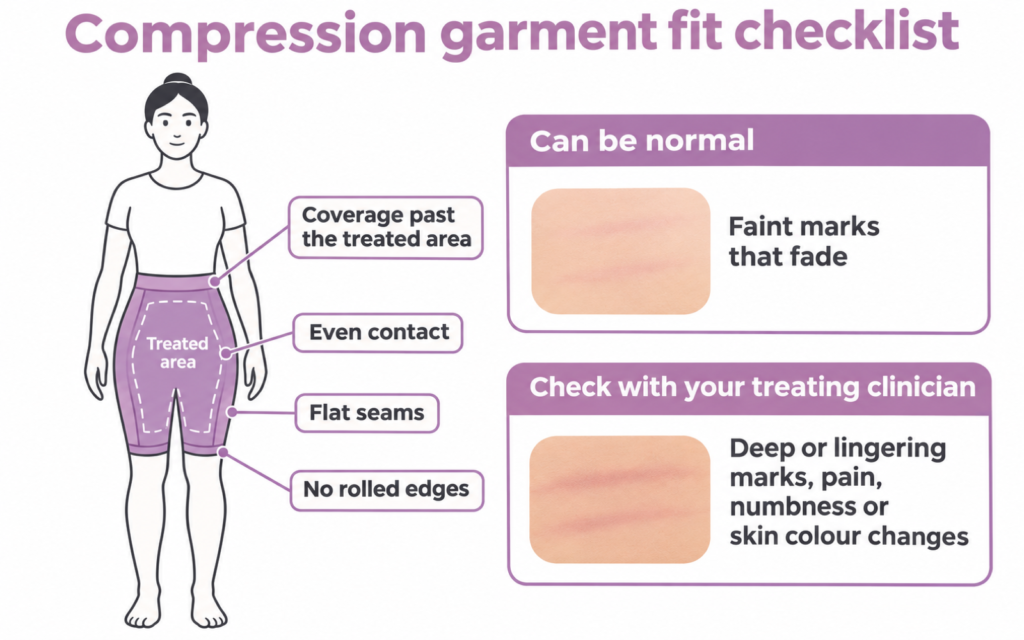
What you can check in the mirror:
- Coverage: The garment should run past the edges of the treated areas, so its edge isn’t sitting on treated tissue.
- Even contact: The fabric shouldn’t lift away anywhere, or grip much harder in one band.
- Seams and fastenings: They should lie flat, with no zips or hooks pressing into a wound.
- Rolling and bunching: A waistband or leg opening that rolls over becomes a tight band.
- Marks: Faint fabric marks that fade are normal. Deep grooves, blisters and broken skin aren’t.
Signs it may be too tight: deep grooves that don’t fade, numbness or tingling, pain that builds while you wear it, or skin that turns pale, dark or blotchy.
Signs it may be too loose: fabric that wrinkles, slides or gapes over a treated area, or edges that ride up and roll.
Passing all of these doesn’t prove the compression is right, and there’s no reliable test to do at home. The popular trick of slipping two fingers under the garment has never been shown to work. If you feel something is off, bring it up with your clinician.
Your fit will also change as you heal. A garment that felt tight while you were very swollen can feel loose a few weeks later. And one that felt comfortable at first might start to roll as your body changes. Don’t be tempted to buy a smaller size for extra compression.
What Does “Stage 2 Compression” Mean?
“Stage 2” is a label used by garment brands and clinics, not a recognised clinical standard. It usually means a second garment after the first post-surgery one, with fewer openings and a closer fit. What counts as stage 2, when it starts and how much pressure it gives vary from one company or clinic to the next, and the term isn’t used in the peer-reviewed review mentioned above.
Plenty of patients never move to a second garment. Some clinicians keep you in the same one throughout. Others switch you to a smaller size as the swelling goes down, or to a different style for comfort or coverage. If and when you need a stage 2 garment is for your clinician to judge from how you’re healing, and firmer doesn’t automatically mean more effective.
When Should Your Wearing Schedule Or Garment Change?
Changes are made when your treating clinician assesses your progress and decides they’re right for you. There’s no set deadline. Some practical questions come up often, and the table below covers them.
| Situation | What to clarify with your treating clinician |
|---|---|
| The garment feels loose | Whether you need a smaller size or a different style |
| Seams roll or dig in | Whether the size, style or way it is put on should change |
| You need a replacement | Which size and type to get, so it matches the original prescription |
| You’ve gone several hours without it | Whether to simply resume, and whether anything needs checking |
| You’d like to wear it only in the daytime | Whether you can stop wearing it overnight yet |
| You want to move to shapewear | Whether ordinary shapewear is suitable, and from when |
How Do You Wash It, And Do You Need A Spare?
Showering and washing need planning too. You can take it off to shower, the NHS says. Ask how long it’s allowed to stay off, though, and wash it the way your clinician and the care label tell you. Having a spare means one can dry while you wear the other. Check with your clinician whether you need one, and if it should be the same model.
Treat your wearing plan as a prescription that’s expected to change. A garment that fitted perfectly at your first check might be baggy, or too tight, a few weeks later. Swelling moves around. Say something early. Then your clinician can change the size, style or schedule before uneven pressure marks your skin. Our guide to swelling after liposuction explains how swelling changes as you heal.
If Longevita arranged your treatment, questions about your garment, with photos if they help, go to your clinician’s support team (contact details are in your Appointment Schedule). Our guide to post-treatment support once you are back in the UK explains what to expect once you’re home. Longevita doesn’t prescribe garments or make decisions about compression. Liposuction arranged through Longevita takes place in Istanbul, with independent clinicians at accredited independent hospitals; our liposuction in Turkey page explains how it’s arranged.
Which Garment Problems Need Clinical Advice?
Some problems are about fit and need the garment looked at. Others are symptoms, and they shouldn’t be blamed on the garment until a clinician has assessed them. The table won’t diagnose anything, but it should help you decide how quickly to get advice.
| What you notice | What to do |
|---|---|
| Rolling, gaps or a garment that has gone loose | Contact your clinician for a fit review |
| Pain, numbness or tingling that’s getting worse | Contact your clinician the same day |
| Skin that’s blistered, broken, dark or dusky | Contact your clinician the same day |
| Swelling that grows on 1 side or feels tense | Contact your clinician the same day |
| A hot, swollen, painful calf or leg | Get urgent same-day assessment through NHS 111 or an urgent GP appointment, as the NHS advises for a suspected DVT |
| Chest pain, breathlessness or coughing up blood | Call 999 or go to A&E |
If pain, numbness or skin changes are getting worse, don’t wait for a routine appointment: the NHS advises contacting the clinic where you had the operation as soon as possible. If you can’t reach them and the symptoms are severe, use NHS 111 or emergency services. Talk to your clinician before you change or stop a prescribed garment.
What Should You Ask Before Leaving The Clinic?
Get these answered, ideally in writing, before you go home:
- Which garment have I been given, and what size is it?
- How many hours a day should I wear it, and does that include overnight?
- When and for how long can I take it off to shower?
- How should I wash it, and do I need a second garment?
- When will the fit be reviewed, and what should prompt an earlier review?
- Will I need a stage 2 garment, and who decides when?
- Who do I contact about discomfort, poor fit or skin problems?
- What should I do if the garment needs replacing?
For the rest of your recovery, from swelling to flying home, see our guide to liposuction recovery. If you’d like Longevita to arrange a consultation with an independent clinician, contact us or book a free Discovery Call with us.
Frequently Asked Questions
Will wearing the garment for longer give me a better result?
Not as far as anyone knows. Nobody has shown that extra weeks improve the final shape. And a garment that’s stopped fitting can start causing skin problems. Do what your clinician says, and if you want to wear it longer or stop early, ask first.
Can I sleep without it?
Not usually in the early weeks. The NHS says the garment is worn constantly for several weeks, and that includes overnight. When you can stop wearing it at night is for your clinician to decide at a review, so ask rather than deciding yourself.
Can I buy a replacement garment online?
You can, but make sure the replacement matches your prescription. Garments vary in coverage, openings and compression, and sizes vary between brands. Check the specification with your clinician before you change anything.
Why wear a compression garment after liposuction?
It supports the treated tissue while it heals and, as the NHS puts it, helps keep swelling and bruising down. The research behind other claimed benefits is thin, so think of it as support for healing rather than something that shapes your final result.
Is a tighter compression garment better?
No. Even pressure matters more than tight pressure, and a garment that is too tight can damage the skin. Don’t buy a smaller size for extra compression. If yours feels loose, ask your clinician whether you need a different size or style.
Can I wear shapewear instead of a medical garment?
Only when your clinician says so. Ordinary shapewear isn’t made to the same specification, and its pressure, coverage and seams can differ from what you were prescribed. Ask at a review when, or whether, it is suitable for you.
- Last Updated:

Dr. Mustafa Ekrem Güleş
Specialist in plastic, reconstructive and aesthetic surgery · Member of the Turkish Society of Plastic, Reconstructive and Aesthetic Surgeons
Last reviewed
Dr. Mustafa Ekrem Güleş is a highly experienced independent Specialist in Plastic, Reconstructive and Aesthetic Surgery, with a strong focus on breast and body contouring procedures. With extensive clinical training and international exposure, he is known for his precise, patient-focused approach and commitment to achieving natural-looking results tailored to individual goals. Dr Ekrem performs his procedures in Istanbul.
Request A Callback For A Discovery Call
With Longevita, you have the option to discuss your goals with us from the comfort of your couch.
- A UK-registered medical tourism facilitator
- Trusted by over 150,000 clients
- A free, no-obligation discovery call