
Swelling After Liposuction: What Changes As You Heal?
Key Takeaways:
- Swelling after liposuction is expected, and the NHS says it can take up to 6 months to go.
- In the first few weeks, a lot of people look the same size as before, or bigger. It’s fluid, and it passes.
- Swelling goes up and down. Evenings, long days on your feet and travel make it worse.
- On its own, swelling doesn’t mean anything has gone wrong. The pattern over time matters more.
- A soft pocket that sloshes, 1 side suddenly much bigger, or heat and redness all need a clinician.
- Pain and swelling in 1 leg with breathlessness is an emergency.
Swelling after liposuction is normal, and it hangs around longer than most people expect. It tends to peak in the first week or 2, then drifts down over several months. According to the NHS, bruising and swelling can last up to 6 months. So the body you see in the mirror at week 3 isn’t the result. It’s a work in progress.
This guide covers what the swelling does along the way. Why it’s there, why it changes from one day to the next, how it differs from a fluid collection, and what’s worth writing down for your follow-up. Longevita is a UK-registered facilitator and doesn’t perform surgery: liposuction arranged through Longevita takes place in Istanbul, with independent clinicians at accredited independent hospitals.
Swelling After Liposuction At A Glance
| Most noticeable | The first 1 to 2 weeks |
|---|---|
| How it feels | Tight, heavy, firm to the touch |
| Bulk of the swelling | Goes down over the first few months |
| Last of it | Can take up to 6 months (NHS) |
| Slowest areas | Lower legs, ankles and knees |
| Persistent beyond 6 weeks | About 1.7% in one series of 600 patients (Lymphatics, 2025) |
Treat these as a rough pattern, not a timetable. Everyone swells differently, and how many areas you had treated makes a big difference.
Why Does Liposuction Cause Swelling?
Liposuction causes swelling for 2 reasons. The tissue under the skin has been disturbed, and the area was filled with fluid before the fat came out.
What Happens Under The Skin
Under the skin, the surgeon moves a thin tube called a cannula back and forth through the fat, over and over. That breaks small blood vessels, along with the fine lymphatic channels that usually drain fluid away. Healing tissue pulls fluid in. The drainage is damaged. Fluid builds up.
Where The Extra Fluid Comes From
The extra fluid is mostly a mix of saline, local anaesthetic and adrenaline, injected into the area at the start of the operation. Some of it seeps out of the small cuts over the first day or so, which is why the dressings can be soaked and slightly pink. The rest is absorbed over the following days and weeks.
How Does Swelling Change Over Time?
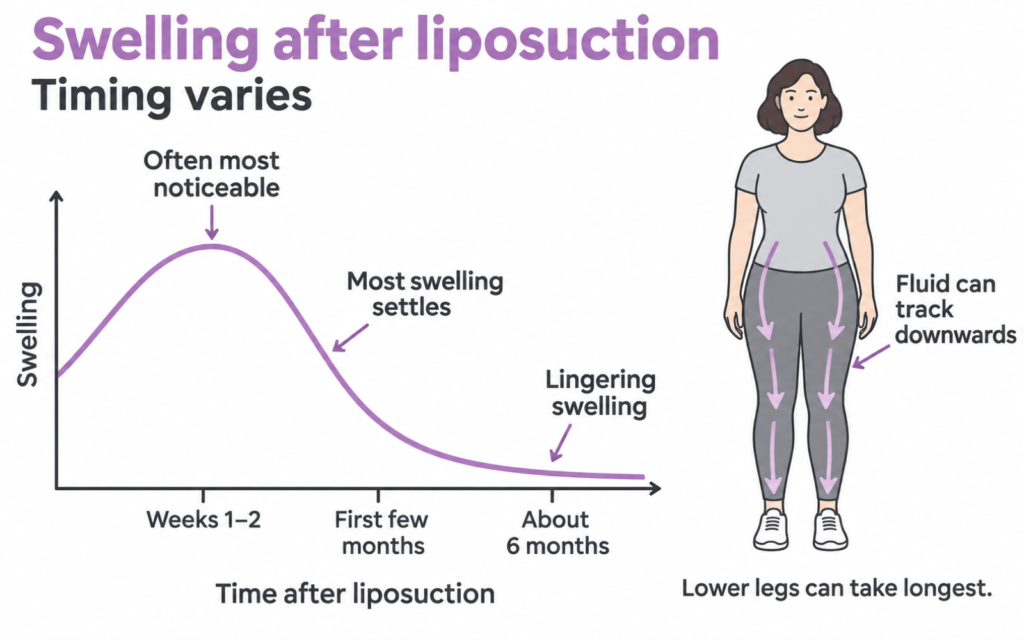
Swelling changes slowly, with a big drop early on and a long, gradual tail. What follows is a rough shape, not a schedule. Your surgeon’s advice comes first, and our liposuction recovery guide covers the wider recovery.
The Early Weeks
In the early weeks the area feels tight, heavy and full, and bruising often spreads well beyond where you were treated. Sitting and bending can be uncomfortable. This is the peak.
The Middle Stretch
The middle stretch, roughly weeks 2 to 6, catches a lot of people off guard. The bruises fade, so you expect to see the difference. Often you don’t. Plenty of swelling is still there, sitting where the fat used to be.
The Last Of It
The last of the swelling goes slowly over the next few months. Clothes start to fit differently. The outline gets sharper. The lower legs usually take longest, because fluid drains downwards and has furthest to travel.
Why You Can Look Bigger Before You Look Smaller
You can look bigger at first because, for a while, the fluid takes up more room than the fat that was removed. The scales can go up too, as the body holds on to fluid. It’s disheartening. It’s also very common, and it says nothing about your result.
Why Some People Take Longer
Some people take longer because more was done. Large volumes, several areas in 1 operation, or liposuction combined with something like a tummy tuck all add to the swelling. A 2025 review in Lymphatics lists extensive liposuction and combined body contouring among the risk factors for swelling that lasts.
Why Can Swelling Fluctuate?
Swelling fluctuates because fluid moves around, and lots of everyday things push it one way or the other. A worse day doesn’t mean you’ve gone backwards.
Time Of Day
Time of day makes the biggest difference. After hours upright, gravity pulls fluid into your lower body, so your thighs, knees and ankles look fuller by the evening. After a night lying down, they’re usually better again.
Activity, Heat And Travel
Activity, heat and travel can each bring on a flare. A long walk on day 10, a hot bath, a flight home: any of them can leave you puffier for a day or 2. The NHS advises waiting 10 to 12 weeks before strenuous activity, and checking with your surgeon first. If you’re flying back from Turkey, our liposuction in Turkey page covers timing.
Your Garment
Your garment can change how swelling sits. A seam that rolls or an edge that digs in can push fluid into the area just beyond it. Our compression garments after liposuction guide covers fit, and when to ask for it to be checked.
Why 1 Side Can Look Bigger
One side can look bigger simply because the 2 sides rarely heal at the same speed. Sleeping on 1 side can make a difference too. Mild, changing asymmetry in the first weeks is usually just swelling. A difference that appears suddenly, or keeps growing, is worth reporting.
Which Areas Stay Swollen Longest?
The lower legs, ankles and knees stay swollen longest, because fluid drains downwards with gravity and has the furthest to travel back. Even if you only had your thighs treated, you may notice puffy ankles for a while. The same thing happens further up. After abdominal liposuction, swelling and bruising can drift down to the pubic area, which looks alarming but is usually harmless.
| Area treated | What’s typical |
|---|---|
| Abdomen and flanks | Swelling can track down to the lower tummy and pubic area. Often settles within a few months |
| Thighs | Swelling may reach the knees and ankles. Slower than the upper body |
| Knees, calves and ankles | The slowest of all. Can still look full well into the second half of the year |
| Arms | Swelling may collect around the elbow and forearm |
| Chin and neck | Usually settles faster than the body, though firmness under the jaw can linger |
Swelling is also often worse at the end of the day, especially in the legs, and better after a night lying down. That daily swing is normal.
Is It Swelling, A Seroma Or Something Else?
Most swelling after liposuction is just swelling, but a few other problems can look similar at first, and they need different handling.
| What you notice | Likely cause | What it means |
|---|---|---|
| Even, firm puffiness that slowly improves | Normal swelling | Expected. Keep following your post-treatment instructions |
| A soft, squashy pocket that sloshes or ripples when pressed | Seroma, a collection of clear fluid | Contact your clinic. Larger ones may need draining |
| A tense, painful swelling with heavy bruising that appears early | Haematoma, a collection of blood | Contact your clinic the same day |
| Swelling that becomes hot, red and more painful, sometimes with fever | Infection | Contact your clinic the same day |
| 1 calf or thigh swollen, painful and warm | Possible blood clot (DVT) | Get urgent medical help. See the next section |
| An area that looked better, then fills out again months later with weight gain | New fat, not swelling | Weight gain goes to the cells that remain |
Swelling on both sides that improves a little each week is reassuring. Swelling that’s clearly worse on 1 side, or that gets worse after it had started to improve, is worth reporting. Firm lumps that last are a separate topic, covered in our guide to hard lumps after liposuction.
Does Lymphatic Drainage Massage Help?
Lymphatic drainage massage may help some people feel more comfortable, but there’s little good evidence that it speeds up how quickly swelling goes. In a 2020 study of 20 women who had a tummy tuck with liposuction, those who had lymphatic massage lost slightly more swelling around the waist than those who wore a garment alone. The difference wasn’t statistically significant, and the study was small.
Surgeons also disagree on when it’s safe to start. Our guide to lymphatic drainage massage covers the method, timing and who shouldn’t have it. Whatever you decide, get the go-ahead from your surgeon first.
What Else Helps With Swelling, And What Doesn’t?
Gentle walking helps most, because moving your legs keeps fluid and blood flowing. You’ll be encouraged to walk from the first day. Short, frequent walks are better than 1 long one.
A few other things are worth knowing:
- Raising your legs: If your ankles or lower legs are puffy, resting with your feet up on a cushion can ease it.
- Long journeys: Sitting still for hours, on a plane or in a car, makes leg swelling worse and raises the risk of a clot. Get up and move when you can. Our liposuction treatment page covers when it’s safe to fly.
- Heat: Saunas, hot tubs and long hot baths draw more blood to the area. Wait until your surgeon says it’s fine.
- Supplements and remedies: Plenty are sold for post-surgical swelling. Some can affect bleeding, so check with your surgeon before taking any.
- Exercise: Strenuous exercise too soon can make swelling flare. The NHS advises waiting 10 to 12 weeks for strenuous activity, and checking with your surgeon first.
Nothing on this list will make 6 months of swelling disappear in 6 weeks. Anyone selling something that promises that is selling you something.
When Is Swelling A Warning Sign?
Swelling is a warning sign when it’s on 1 side only with pain, when it’s getting worse after it had improved, or when it comes with fever or breathlessness. The table sorts the common signs into 3 groups.
| Normal in the first weeks | Contact your clinic | Emergency |
|---|---|---|
| Swelling on both sides that slowly improves | Swelling getting worse after it had started to improve | 1 leg swollen, painful and warm |
| Firm, lumpy areas | A soft pocket that sloshes (possible seroma) | Sudden breathlessness or chest pain |
| Bruising that spreads downwards | Redness, heat or a fever | Coughing up blood |
| Puffy ankles at the end of the day | 1 side far more swollen than the other | Fainting, confusion or a racing heart |
| Pinkish fluid from the cuts in the first days | Smelly discharge, or a cut that opens | Severe or rapidly worsening pain |
In the UK, in an emergency: call 999 or attend the nearest A&E. The NHS advises calling 999 if you have pain and swelling in 1 leg along with breathlessness or chest pain. Don’t drive yourself.
If you think you might have a clot but have no chest or breathing symptoms, get urgent advice from NHS 111 or your GP the same day. For anything in the middle column, contact your clinic. If Longevita arranged your treatment, that’s your clinician’s support team (contact details are in your Appointment Schedule).
If you’d like Longevita to arrange a consultation with an independent clinician, contact us or book a free Discovery Call with us.
Swelling After Liposuction: Myths And Facts
| Myth | Fact |
|---|---|
| “If I look bigger at 2 weeks, it hasn’t worked.” | Myth. Early swelling often hides the change completely |
| “The scales will show my result in the first week.” | Myth. Fluid can push your weight up at first |
| “A bad evening means I’m going backwards.” | Myth. Swelling usually builds through the day and eases overnight |
| “Swelling means something’s gone wrong.” | Myth. Swelling is expected. The pattern over time is what matters |
| “Still swollen at 3 months means a problem.” | Not necessarily. It can take up to 6 months, longer in the lower legs |
Frequently Asked Questions
When is swelling worst after liposuction?
Swelling is usually worst in the first week or 2 after liposuction. After that it eases gradually, with the biggest change over the first couple of months.
Is it normal for swelling to come and go?
It’s normal for swelling to come and go. It’s often worse in the evening, after a lot of standing, after a flight or after exercise, and better first thing.
Why are my ankles swollen when I had my thighs done?
Your ankles swell because fluid from the thighs drains downwards and gathers lower in the leg. Raising your legs can help. If 1 leg is painful as well as swollen, get it checked urgently.
How long does bruising last after liposuction?
Bruising after liposuction usually fades over a few weeks. It often spreads downwards before it clears, which is normal.
Does VASER cause less swelling?
There’s no strong evidence that VASER or any other technique makes a big difference to swelling over the whole recovery. Our liposuction in Turkey page compares the techniques.
When will I see my final result?
You’ll see your final result once the swelling has fully settled, which usually takes around 6 months and can take longer in the lower legs.
- Last Updated:

Dr. Mustafa Ekrem Güleş
Specialist in plastic, reconstructive and aesthetic surgery · Member of the Turkish Society of Plastic, Reconstructive and Aesthetic Surgeons
Last reviewed
Dr. Mustafa Ekrem Güleş is a highly experienced independent Specialist in Plastic, Reconstructive and Aesthetic Surgery, with a strong focus on breast and body contouring procedures. With extensive clinical training and international exposure, he is known for his precise, patient-focused approach and commitment to achieving natural-looking results tailored to individual goals. Dr Ekrem performs his procedures in Istanbul.
Request A Callback For A Discovery Call
With Longevita, you have the option to discuss your goals with us from the comfort of your couch.
- A UK-registered medical tourism facilitator
- Trusted by over 150,000 clients
- A free, no-obligation discovery call