
Open Vs Closed Rhinoplasty: How Is The Approach Chosen?
Key Takeaways:
- Open and closed rhinoplasty differ in how the surgeon gets in, not in what the nose ends up looking like.
- Closed rhinoplasty is done through cuts inside the nostrils. Open adds a small cut across the columella, the strip of skin between the nostrils.
- Open gives the surgeon a direct view of the framework. Closed involves less lifting of the skin but a narrower view.
- Pooled studies show no clear difference in satisfaction, breathing, swelling, bruising or complications.
- Neither approach guarantees a faster recovery.
- The right choice depends on your nose, what you want changed, and what your surgeon does well.
Open vs closed rhinoplasty is mostly a question of access. In a closed rhinoplasty, the surgeon works through incisions hidden inside the nostrils. In an open rhinoplasty, they add a small cut across the columella so the skin can be lifted up, like opening a bonnet, and the cartilage and bone underneath seen directly. Both can reshape a nose well. Neither one is “better” on current evidence.
What matters is which suits your nose, and which your surgeon can do best. This guide explains what each approach changes during surgery, which kinds of noses tend to suit which, the trade-offs, and the questions to ask. For the whole procedure, from anaesthetic to results, see our rhinoplasty treatment page. Longevita is a UK-registered facilitator and doesn’t perform surgery: rhinoplasty arranged through Longevita takes place in Istanbul, with independent clinicians at accredited independent hospitals.
Open Vs Closed Rhinoplasty At A Glance
| Aspect | Open | Closed |
|---|---|---|
| Cuts | Inside the nostrils, plus a small cut across the columella | Inside the nostrils only |
| Skin over the framework | Lifted up from the tip and bridge | Lifted less, and only where needed |
| What the surgeon sees | The cartilage and bone, directly | Parts of it, with much of the work guided by feel |
| Grafts and stitches | Placed and fixed under direct view | Possible, but harder to place precisely |
| Visible scar | A small line under the tip | None on the outside |
| Results in pooled studies | No clear difference (Crosara 2017; Daou 2025) | No clear difference |
The approach is only one choice your surgeon makes. It’s separate from which tools they use on the bone, and from whether they follow a “preservation” strategy.
What Differs Between The Approaches?
What differs between open and closed rhinoplasty is the way in. Once the surgeon reaches the cartilage and bone, many of the same changes are possible either way.
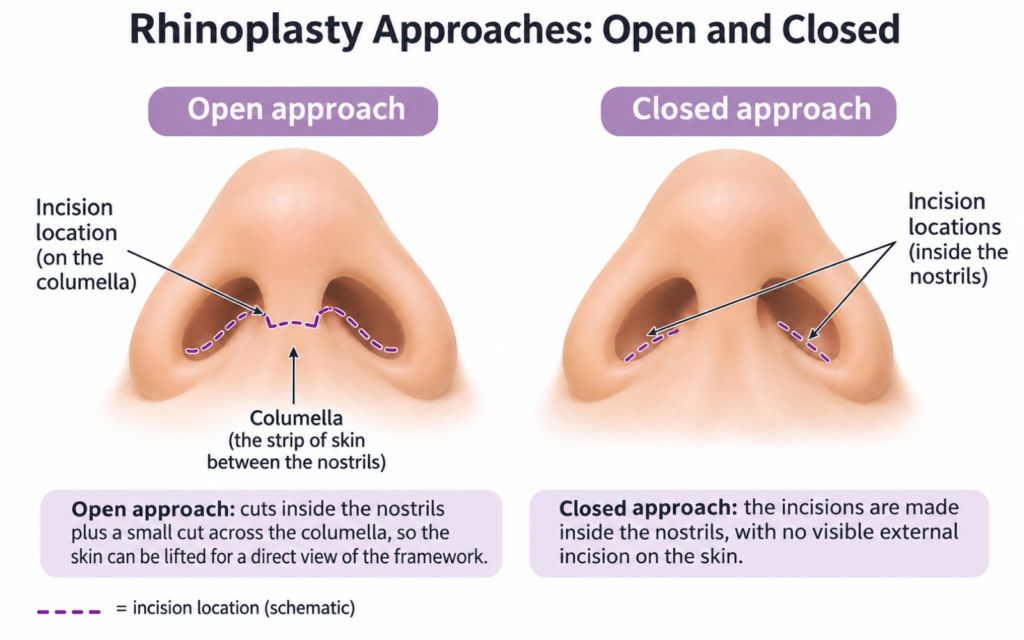
The Incisions
The incisions are where the approaches part company. Both use cuts inside the nostrils. Open rhinoplasty adds a short cut across the columella, usually shaped like a small step or an inverted V, which joins up with the inside cuts. That one extra cut lets the skin of the tip and bridge be folded back.
What Gets Lifted
What gets lifted is the soft tissue covering the framework. In open rhinoplasty, a wide area is lifted so the surgeon can see the whole tip and much of the bridge. In closed rhinoplasty, the surgeon creates pockets under the skin through the nostril cuts and lifts only what the plan needs.
What Stays The Same
What stays the same is a longer list than most people expect. The anaesthetic, the length of most operations, the splint, and the general shape of recovery are broadly similar. So are most of the risks covered on our rhinoplasty treatment page.
What The Approach Isn’t
The approach isn’t the same thing as the tools or the strategy. Piezo, or ultrasonic, rhinoplasty is about how bone is cut. Preservation rhinoplasty is about how much of the existing structure is kept. Both can be done through an open or a closed approach, though some combinations are more common than others.
| Decision | What it answers | Examples |
|---|---|---|
| Access | How does the surgeon get in? | Open, closed |
| Bone work | What cuts or shapes the bone? | Rasps, osteotomes, piezo |
| Strategy | How much of the existing structure is kept? | Structural, preservation |
How Does Access Affect Surgery?
Access affects surgery mainly through how much the surgeon can see and how easily they can work. That shapes some techniques more than others.
Seeing The Framework Directly
Seeing the framework directly is the open approach’s main strength. The surgeon can look at both sides of the tip cartilages at once, spot asymmetries, and check the result before closing. It also makes it easier for a second surgeon or a trainee to see what’s being done, which is one reason the approach is widely taught.
Working By Feel
Working by feel is a bigger part of closed rhinoplasty. The surgeon sees some structures through the nostril and judges others by touch and by watching the outside of the nose. In experienced hands this works very well. It does depend heavily on that experience.
Grafts And Sutures
Grafts and sutures are where the difference shows most. Many tip changes rely on small pieces of cartilage stitched in place, or on stitches that reshape the cartilage itself. These are easier to place precisely when everything is in view. They can be done closed, but there’s less room to work.
Less Disturbance Of The Tissues
Less disturbance of the tissues is the closed approach’s main argument. Fewer layers are lifted, there’s no cut across the columella, and some of the natural supports of the tip are left alone. Some surgeons believe that means less tip swelling and a more predictable tip position. Pooled studies haven’t shown a clear difference in swelling, as the recovery section explains.
Changing Course Mid-Operation
Changing course mid-operation is possible. A surgeon who starts closed can convert to open if they find more than they expected. Ask whether yours would do that, and whether you’d be told about it in advance as a possibility.
Which Anatomy And Goals Matter?
Anatomy and goals matter more than the name of the approach. The same surgeon might choose open for one patient and closed for the next.
Noses Often Done Open
Noses often done open are the more complex ones. That usually means major tip work, a twisted or crooked nose, significant asymmetry, noses that need several grafts, and many revision operations, where earlier surgery has left scar tissue and changed the anatomy. Our guide to nose tip surgery explains what tip work involves.
Noses Often Done Closed
Noses often done closed tend to need more limited changes. Reducing a bump on the bridge, small changes to the tip, or narrowing the bones are common examples. A closed approach suits these well in the hands of a surgeon who uses it regularly.
Skin Thickness
Skin thickness plays a part, though surgeons don’t agree on which way it points. Thick skin hides small details and is slow to shrink down over a new framework. Thin skin shows every irregularity. Both affect how much structural work is worth doing, and that can affect the approach. Your surgeon should explain how your skin type affects the plan.
Breathing
Breathing needs to be part of the conversation. If your septum or nasal valve also needs work, that can influence the approach. Tell your surgeon how well you breathe through your nose now, even if you only want a cosmetic change.
Your Surgeon’s Experience
Your surgeon’s experience is probably the biggest factor of all. Most surgeons do one approach far more often than the other. A surgeon who does most of their work closed may get better results that way than through an approach they use rarely, and the reverse is true too.
What Trade-Offs Should Patients Discuss?
The trade-offs worth discussing are the ones that matter to you. There’s no free option. Each approach gives something up.
- Columella scar: The most obvious trade-off of open rhinoplasty. It usually heals to a fine line that’s hard to spot at normal distance, but it is a scar, and healing varies. Rarely, the edge of the columella can heal unevenly or notch. Our rhinoplasty scars guide covers how scars are assessed.
- Precision vs disturbance: The core trade-off. Open rhinoplasty gives the surgeon more control over complex changes, at the cost of lifting more tissue. Closed rhinoplasty disturbs less, at the cost of a narrower view. Which matters more depends on how complex your nose is.
- Tip swelling: Often said to last longer after open rhinoplasty. It’s a common clinical impression, but pooled studies haven’t confirmed a clear difference. Expect the tip to be the last part to settle with either approach.
- Revision rates: Don’t clearly favour either approach. A 2017 systematic review of 49 studies found reoperation rates of 2.73% after primary open rhinoplasty and 1.56% after closed rhinoplasty, a difference that wasn’t statistically significant. Open was used far more often in those studies, and the noses were not directly comparable, so the figures don’t show one approach causing more revisions.
Does Either Approach Guarantee Faster Recovery?
Neither approach guarantees a faster recovery. A 2025 systematic review and meta-analysis in Plastic and Reconstructive Surgery Global Open, pooling 12 studies and 1,067 patients, found no significant difference between open and closed rhinoplasty in swelling, bruising, satisfaction, breathing scores, operating time or complications. The studies were varied and the overall evidence quality was moderate, so the picture is not settled. The evidence does not support assuming that closed rhinoplasty means a week less time off work.
What Affects Recovery More
What affects recovery more is what’s done inside the nose. Whether the bones are broken and reset, how much the tip is changed, whether grafts are used, and how your own body heals all make more difference than the approach. Our rhinoplasty recovery guide covers what to expect.
Bruising And The Bones
Bruising around the eyes mostly comes from work on the bones, not from the approach. How the bone is cut can matter. Our guide to ultrasonic rhinoplasty covers that.
When Results Settle
Results settle slowly with both approaches. Most of the swelling goes in the first few months, and the tip is usually the last part to settle. Your surgeon will tell you when they’d consider your result final.
Which Questions Belong In Consultation?
The questions that belong in consultation are the ones that tell you why this approach, for this nose, with this surgeon. Ask them plainly. A good surgeon won’t mind.
About The Approach
- Which approach would you use for my nose, and why?
- What could you do with the other approach, and what couldn’t you?
- How often do you use each one?
- Would you ever switch from closed to open during my operation?
About The Plan
- What exactly do you plan to change, and which parts are hardest?
- Will you need grafts, and where would they come from?
- Will you be working on my septum or breathing as well?
- How does my skin thickness affect what’s possible?
About The Result
- Where will any scar be, and how does it usually heal in your patients?
- Can I see before and after photos of noses like mine, done with this approach?
- How long before you’d consider the result final?
Our rhinoplasty consultation guide has the full checklist. If you’re comparing options abroad, our nose job in Turkey page explains how consultations work when your treatment is arranged through Longevita. For questions before you book, contact us or book a free Discovery Call with us.
Open Vs Closed Rhinoplasty: Myths And Facts
| Myth | Fact |
|---|---|
| “Closed rhinoplasty is always better because there’s no scar.” | Myth. No scar on the outside, but a narrower view for complex work |
| “Open rhinoplasty is only for difficult noses.” | Not quite. Many surgeons use it routinely for most noses |
| “Closed means a much faster recovery.” | Myth. Pooled studies show no clear difference in swelling or bruising |
| “Open rhinoplasty leaves a noticeable scar.” | Usually not. Most heal to a fine line, though healing varies |
| “The approach decides how my nose will look.” | Myth. The plan and the surgeon’s skill matter far more |
| “Piezo and preservation are types of closed rhinoplasty.” | Myth. They’re about tools and strategy, and can be done either way |
Frequently Asked Questions
Is open or closed rhinoplasty better?
Neither open nor closed rhinoplasty is better overall. Pooled studies show similar results. The better choice is the one that suits your nose and your surgeon’s experience.
Does open rhinoplasty leave a scar?
Open rhinoplasty leaves a small scar across the columella, under the tip. In most people it fades to a fine line that’s hard to see at a normal distance.
Is closed rhinoplasty less painful?
Closed rhinoplasty hasn’t been shown to be less painful. Most people describe rhinoplasty as more uncomfortable and blocked than painful, whichever approach is used.
Can I choose which approach I have?
You can tell your surgeon your preference, but the approach should follow what your nose needs. If a surgeon recommends one, ask why, and what they couldn’t do with the other.
Is revision rhinoplasty usually done open?
Revision rhinoplasty is often done open, because scar tissue and changed anatomy make a direct view more useful. Some revisions can be done closed. Our revision rhinoplasty guide covers this in more detail.
Is closed rhinoplasty the same as scarless rhinoplasty?
Closed rhinoplasty leaves no scar on the outside, which is why it’s sometimes called scarless. There are still cuts and healing inside the nose.
- Last Updated:

Prof. Dr. Fuat Yüksel
Board-certified plastic surgeon (TSPRAS) · ISAPS member · 34+ years' experience
Last reviewed
Known around the world for his surgical prowess, Prof. Dr. Fuat is a board-certified plastic surgeon and an active member of the International Society of Aesthetic Plastic Surgery (ISAPS). He has performed over 25,000 surgical procedures in his illustrious 34-year career. A number of his research articles have been in well-reputed medical journals, and he has authored a book as well as written a book chapter. His expert opinion is also often sought-after in the media. Prof. Dr. Fuat can speak both English and Turkish fluently.
Request A Callback For A Discovery Call
With Longevita, you have the option to discuss your goals with us from the comfort of your couch.
- A UK-registered medical tourism facilitator
- Trusted by over 150,000 clients
- A free, no-obligation discovery call