
Rhinoplasty Recovery: What To Expect As You Heal
Key Takeaways:
- Your splint comes off after about a week. The NHS suggests booking up to 2 weeks off work.
- Week 1 is mostly about a blocked nose. You’ll be breathing through your mouth.
- Black eyes take around 3 weeks to fade. Swelling hangs on for up to 6 months.
- No heavy exercise or contact sport for 4 to 6 weeks.
- Flying home after surgery abroad? The NHS says wait 7 to 10 days.
Rhinoplasty recovery has 2 speeds. The visible part, the splint and the black eyes, is over in a few weeks. The rest happens out of sight, as swelling inside the nose drains away bit by bit over the following months.
If you go in expecting that, the first few weeks are a lot less worrying. Below you’ll find what tends to happen and roughly when, what to do at home, and the symptoms that mean you should get help. The timings are typical ranges from the NHS, BAPRAS and published research. If your surgeon tells you something different, go with your surgeon.
How Long Does Rhinoplasty Recovery Take?
Rhinoplasty recovery takes about 2 weeks before you feel like yourself, and several months before the nose finishes changing. The NHS says to allow up to 2 weeks off work. The splint is off after roughly 7 days, and hard exercise is back at 4 to 6 weeks. Swelling, though, takes up to 6 months to go completely, and the British Association of Plastic, Reconstructive and Aesthetic Surgeons (BAPRAS) says the tip goes on changing for as long as a year.
How you get on depends partly on the operation. An open rhinoplasty, which involves a small cut across the strip of skin between the nostrils, swells more and takes longer to recover from than a closed one, according to BAPRAS. Work on the bones, the septum or the tip each adds something. So before you book time off, ask your surgeon which of these your operation involves.
What Does Rhinoplasty Recovery Look Like Stage By Stage?
Rhinoplasty recovery follows a predictable order, even when the timing isn’t. Splint and blocked nose come first. Bruising follows, then months of swelling slowly going down. The table sets out what the NHS and BAPRAS describe at each point. Use it to see what’s coming next, not as a set of deadlines, and bear in mind an open operation tends to move through it more slowly.
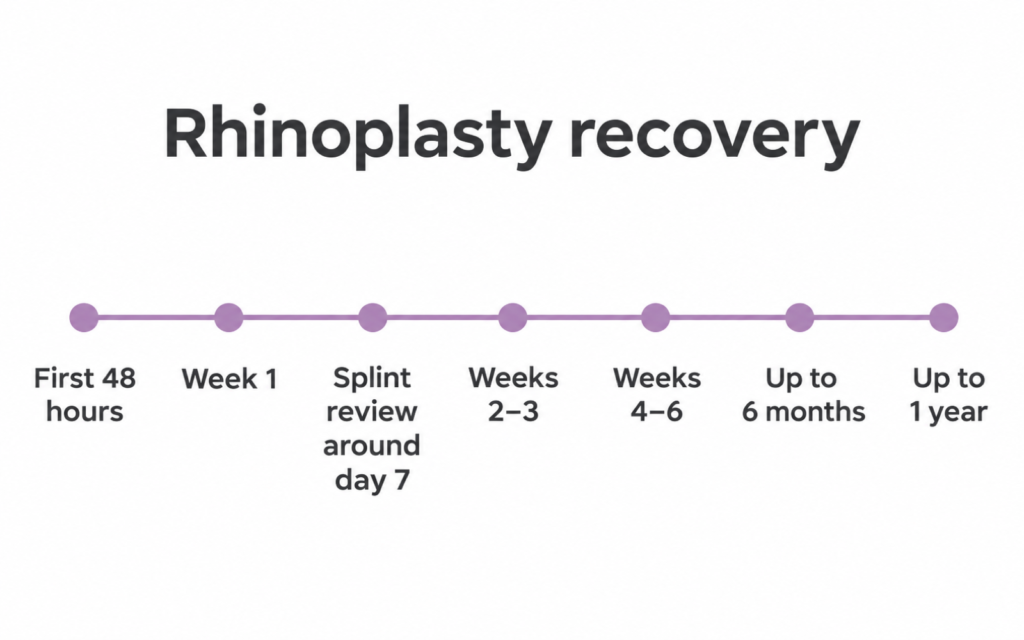
| Stage | What is commonly described |
|---|---|
| First 12 to 48 hours | A pad under the nose for about 12 hours. Some light bleeding from the nose in the first few days. Most people stay in the hospital for 1 or 2 nights. |
| Week 1 | Splint taped over the nose. Breathing through the nose is difficult. Bruising around the eyes is at its most obvious. |
| About day 7 | Splint comes off. Stitches are removed unless they dissolve. |
| Weeks 2 to 3 | The bruising turns yellow and fades. Swimming is back on at around 3 weeks. |
| Weeks 4 to 6 | You're cleared for strenuous exercise and contact sport. |
| Up to 6 months | Swelling goes completely. The full effect of the operation becomes visible. |
| Up to 1 year | Changes to the tip continue to settle. |
Being a little behind this table isn’t a problem in itself. Something getting worse when it should be getting better is the point to call.
What Will The First Week After Rhinoplasty Feel Like?
The first week after rhinoplasty is uncomfortable more than painful for most people, and the blocked nose is the main reason. The NHS says you’ll need to breathe through your mouth for a week or so, and lists a stiff and numb nose, soreness, swelling and bruising around the eyes, and light nosebleeds in the first few days as common side effects.
People tend to shrug off mouth breathing until the first night. By morning your mouth is dry, your tongue feels like sandpaper and you’ve woken up several times. Food doesn’t taste of much either. Keep water and lip balm by the bed and stick to soft things to eat for a few days.
You’ll be given painkillers, and the NHS describes them as being for “any pain or discomfort”. BAPRAS adds that some patients have pain for a number of weeks. If yours is getting stronger after the first few days, tell your surgeon.
In the first week after rhinoplasty, a blocked nose is expected. The NHS advises that breathing through the nose is difficult for about a week, and that a stiff, numb nose and light nosebleeds in the first few days are common. Pain that increases after the first few days is not on that list and should be reported.
How Do You Look After Your Nose At Home?
Looking after your nose at home is mostly about keeping the swelling down and leaving it alone. That means sleeping propped up for the first couple of days, keeping the splint dry, staying out of hot baths, not touching the crusts and sneezing through your mouth. All of that comes straight from the NHS.
The NHS list in full:
- Prop your head up with pillows for a couple of days when resting
- Avoid hot baths and getting the splint wet
- Don’t blow your nose or remove any crusts until the appointment to have your splint removed
- Sneeze through your mouth to keep pressure off your nose
- Avoid strenuous exercise and contact sports for 4 to 6 weeks
There are 2 questions the NHS page doesn’t answer, and both are worth putting to your surgeon before you go home. When are glasses allowed to rest on the bridge again? And how, and from when, should you clean inside the nostrils? Our guide to how to clean your nose after rhinoplasty covers the second in detail.
A toddler’s head, a dog jumping up, a door you didn’t see coming: noses get knocked. If it happens to yours, get in touch with your surgeon and have a look at our guide on hitting your nose after rhinoplasty.
How Long Do Bruising And Swelling Last After Rhinoplasty?
Bruising after rhinoplasty lasts around 3 weeks, and swelling up to 6 months. The NHS says soreness, swelling and bruising around the eyes last around 3 weeks. BAPRAS breaks the bruising down further for a closed rhinoplasty: noticeable for 7 to 10 days, then yellowing for 10 to 20 days.
Is there a way to speed it up? Less than you’d hope. Researchers writing in Aesthetic Surgery Journal in 2016 combined the results of 8 trials, 336 patients in all, and found that steroids given around the time of surgery reduced swelling and bruising in the first days. By day 7 there was no benefit left. In other words, the early bruising is something a surgeon is able to soften. The long tail of swelling is a matter of time.
That long tail has its own guide. For how swelling changes month by month, and why the tip is last to settle, see rhinoplasty swelling stages.
When Can You Work, Exercise And Fly After Rhinoplasty?
After rhinoplasty, plan on up to 2 weeks off work. Walking a decent distance is fine after 3 to 5 days, swimming at about 3 weeks and harder exercise at 4 to 6 weeks, going by the NHS and BAPRAS. Anyone flying home after surgery abroad should wait 7 to 10 days, which is the NHS figure for facial procedures.
| Activity | What the guidance says |
|---|---|
| Walking a distance | After 3 to 5 days |
| Work | Allow up to 2 weeks off |
| Swimming | At around 3 weeks |
| Strenuous exercise | At 4 to 6 weeks |
| Contact sports | Avoid for 4 to 6 weeks |
| Flying home after surgery abroad | Wait 7 to 10 days |
| Driving | Your surgeon will tell you, and it's worth a call to your insurer as well. |
Why wait to fly? Because of blood clots. Surgery makes them more likely, and so does a flight, and the NHS page on cosmetic surgery abroad warns against combining the 2 too soon. Agree your flight date with your surgeon before you book it.
The 2 weeks off work is a cautious figure, and it has as much to do with appearance as with how you feel. A splint and bruised eyes are hard to hide in a meeting. For which kinds of exercise to restart with, see our guide to exercise after surgery.
When Will You See The Final Result Of A Rhinoplasty?
The final result of a rhinoplasty shows at around 6 months for most of the nose and up to a year for the tip. According to the NHS, the full effect takes several months to appear, with swelling gone completely by about 6 months. Tip surgery is slower still. BAPRAS reckons about 60% of the change is visible at 3 weeks, and the other 40% comes through over several months, sometimes a year.
Keep that 60/40 figure in mind on splint-removal day. It means the nose you see when the splint comes off is a rough draft. It will look wide, the tip will look turned up, and it won’t match the plan yet. None of that tells you how it will finish.
It’s also why surgeons won’t discuss further surgery early. If something still bothers you once the nose has settled, our guide to revision rhinoplasty explains how that decision is made.
The nose you see when the splint comes off is not the final result. BAPRAS estimates that after tip surgery about 60% of the change shows by 3 weeks, with the remaining 40% developing over several months or up to a year. Swelling, says the NHS, takes up to half a year to clear completely.
What Does Longevita Do During Your Recovery?
Longevita is a UK-registered facilitator, so it doesn’t perform surgery or give medical advice. Rhinoplasty arranged through Longevita takes place in Istanbul, with independent clinicians at accredited independent hospitals. The instructions you follow in recovery, from when the splint comes off to when you exercise, come from the independent clinician who treated you. Once your Appointment Schedule is issued, you deal with the clinician directly about your treatment. Questions about your recovery, with photos if they help, go to your clinician’s support team (contact details are in your Appointment Schedule).
Our guide to post-treatment support once you are back in the UK explains what to expect once you’re home.
When Should You Get Urgent Help After Rhinoplasty?
A nosebleed that won’t stop, struggling to breathe, chest pain or a hot, swollen, painful calf all mean 999 or A&E, straight away. Pain that’s severe or getting worse, a temperature, or redness creeping across your face is a same-day call to your surgeon. Heavy nosebleeds, infection and blood clots are all on the NHS list of things that go wrong after nose reshaping.
Call 999 or go to A&E
- A heavy nosebleed that doesn’t stop
- Chest pain or shortness of breath
- A hot, swollen, painful calf
- Sudden swelling of the lips, tongue or throat
- A sudden change in vision
Contact your surgeon the same day
- Severe pain, or pain that is getting worse
- A temperature, pus or a bad smell
- Redness spreading across the nose or cheeks
- Skin on the nose turning dark, dusky or blistered
- Both sides of the nose blocked with increasing pain and pressure
- A knock to the nose
The NHS advice is to contact the clinic where you had the operation as soon as possible if you have severe pain or any unexpected symptoms. NHS 111 is there day and night if you’re unsure. If your procedure was arranged through Longevita, contact your clinician’s support team (contact details are in your Appointment Schedule). For anything urgent, use 999 or A&E.
Frequently Asked Questions
When does the splint come off after rhinoplasty?
The splint comes off after about 7 days. The NHS and BAPRAS both describe a splint held over the nose with tape for 7 days.
When is it safe to blow your nose after rhinoplasty?
The NHS advises not blowing your nose or removing crusts until the appointment to have your splint removed. That appointment is the time to ask when you’re allowed to start.
How should you sleep after rhinoplasty?
Sleep with your head raised after rhinoplasty. The NHS advises propping your head up with pillows for a couple of days when resting, to reduce swelling.
Is recovery longer after an open rhinoplasty?
Yes, according to BAPRAS, which says swelling is greater and recovery time longer after an open rhinoplasty than a closed one.
When is swimming allowed after rhinoplasty?
Swimming is allowed at around 3 weeks after rhinoplasty, according to both the NHS and BAPRAS.
- Last Updated:

Prof. Dr. Fuat Yüksel
Board-certified plastic surgeon (TSPRAS) · ISAPS member · 34+ years' experience
Last reviewed
Known around the world for his surgical prowess, Prof. Dr. Fuat is a board-certified plastic surgeon and an active member of the International Society of Aesthetic Plastic Surgery (ISAPS). He has performed over 25,000 surgical procedures in his illustrious 34-year career. A number of his research articles have been in well-reputed medical journals, and he has authored a book as well as written a book chapter. His expert opinion is also often sought-after in the media. Prof. Dr. Fuat can speak both English and Turkish fluently.
Request A Callback For A Discovery Call
With Longevita, you have the option to discuss your goals with us from the comfort of your couch.
- A UK-registered medical tourism facilitator
- Trusted by over 150,000 clients
- A free, no-obligation discovery call