
The Psychology After A Hair Transplant: What Patients Actually Go Through
Key Takeaways:
- The psychological side of hair transplant recovery is as significant as the physical side, but is rarely discussed openly.
- Shock loss and the “ugly duckling phase” are normal parts of hair transplant recovery, not signs of failure.
- Temporary regret is something that a lot of people experience in the beginning. It usually gets better as they start to see some progress.
- Media and celebrity transformations do not really show the whole story. They make it look seamless by skipping the difficult middle stages of recovery.
- Nighttime anxiety is frequently reported during the first few months after surgery.
- Many patients notice meaningful emotional improvement from around month four onwards.
- Realistic expectations and preparation make a positive psychological recovery more likely.
The procedure is over. The redness and scabbing are starting to fade. A few weeks later, many people find themselves standing in front of a mirror and wondering if everything is actually going to work.
People usually talk about hair transplants in terms of how long it takes to heal and look at pictures from before and after the hair transplant. They always seem to focus on the hair transplant and the results of it. What gets less attention is the psychological side of recovery. The waiting. The uncertainty. The temptation to examine your hairline every day and search for signs that something is happening.
This is the most challenging part of the process. Hair grows slowly, and recovery rarely feels as straightforward. Progress can feel like it is not happening for weeks. Then one day things seem to be going in the right direction. Next, you’re convinced nothing has changed at all.
That’s why the emotional side of recovery catches so many people unprepared. Not because something has gone wrong, but because waiting for visible results from a slow biological process can test even the most patient person.
Patients researching hair transplant recovery focus entirely on graft survival and growth timelines, while overlooking the mental adjustment period that comes with appearance-related procedures.
Why Does A Hair Transplant Feel Emotionally Intense?
Hair loss is rarely just about hair. Before deciding on a hair transplant, many people spend years adapting to it. They choose hairstyles that help conceal thinning areas, think carefully about photographs and lighting and become more aware of their appearance in everyday situations. Over time, hair loss can affect not only how people look, but also how they feel about themselves.
Research on hair loss and body image shows that hair loss is typically experienced as a moderately stressful condition that lowers body image satisfaction.
So a hair transplant becomes emotionally important to people before it happens. It represents something: taking back control. Reversing the visible ageing, fixing a source of insecurity that’s been quietly present for years. That kind of emotional freight does not disappear once the surgery is done, it gets transferred onto the recovery. And because a hair transplant delivers its results slowly, over months rather than days, that uncertainty creates a specific kind of psychological discomfort that patients consistently underestimate.
Why Do Patients Constantly Check Their Hairline After Surgery?
Many patients become hyperaware of their scalp after surgery. Some check mirrors dozens of times a day. Others compare photographs under different lighting or analyse tiny changes in density every morning.
This behaviour becomes common because recovery feels visually unpredictable in the early stages.
One day the hairline looks fuller. The next day shedding starts. Scabs disappear but redness remains. Tiny changes suddenly feel emotionally significant because patients are focused on the outcome constantly.
Online forums and social media often make this situation worse. People with hair transplants compare their recovery progress against strangers without considering graft counts, lighting, hair calibre, medications, healing speed and styling of the hair transplant patients. Just a reminder that everyone is unique and that hair transplant recovery is different for each person.
Why Does Shock Loss Create So Much Anxiety?
Shock loss is often the first major source of anxiety after a hair transplant. Immediately after surgery, many patients feel reassured because they can see the newly placed grafts and the outline of their new hairline. A few weeks later, those hairs begin to shed. Even when patients know this is expected, seeing it happen in the mirror can be unsettling.
Many patients find themselves asking:
- “What if the grafts failed?”
- “Why does it look thinner?”
- “Did I ruin the transplant somehow?”
- “Was this a mistake?”
Shedding is a part of the hair growth cycle. The hair follicles stay under the scalp and new hair grows slowly over the following months.
This is one of the most common concerns during the first few months after surgery. Lots of people want to see results soon after their procedure. So when the shedding phase starts it can be really scary for them even if they knew it was going to happen. It is not unusual for patients to worry that the transplant has failed when shock loss begins, despite it being a normal part of the recovery process. If you are worried about how your shedding looks, your clinician’s support team (contact details are in your Appointment Schedule) can tell you what is expected for your procedure.
Clients reading about shock loss after a hair transplant before surgery cope better emotionally because they understand the process in advance.
Why Do Some Patients Feel Temporary Regret After A Hair Transplant?
Temporary regret is something many patients experience. A 2025 review of the psychological side of hair transplantation notes that temporary feelings of doubt, impatience or regret are common while the new hair grows. It is not necessarily a sign that the hair transplant has failed. Rather, it often reflects the emotional challenges that many patients experience during the early stages of recovery.
The first few weeks after you get a hair transplant involve:
- swelling
- redness
- shedding
- uneven growth
- temporary appearance changes
Patients who expect an immediate transformation sometimes struggle psychologically when recovery “looks worse before it looks better.” This stage becomes harder when social media creates unrealistic expectations.
Online transformations usually skip shedding phases, awkward growth stages, uneven density, and emotional stress. They only show the final result. That disconnect between expectation and reality creates anxiety for many patients during months 1–4.
Clients researching hair transplant gone wrong cases become overly fearful during normal recovery phases, even when healing is progressing correctly.
Why Does Social Media Distort Hair Transplant Expectations?
Social media compresses a year-long process into a 15-second transformation video.
What viewers rarely see:
- multiple procedures
- medication use
- hair fibres
- strategic styling
- harsh lighting avoidance
- editing
- recovery struggles
When we see celebrities talking about hair transplants, it makes people think they can get the same results. But the thing is celebrities often have to get touch ups and have procedures over time.
People who see these celebrities or watch videos on TikTok of transformations think they can get the same thick hair from just one procedure. They compare themselves to celebrities and those viral transformations. The same hair density is not realistic, from just one hair transplant procedure. Celebrity hair transplants are often not one procedure so people should not expect the same results.
Some of our clients begin researching cosmetic hair fibres shortly after surgery because they want to improve the appearance of their hair immediately. However, products that come into direct contact with the scalp are generally not recommended during the early healing period, as recovery should take priority over cosmetic concealment.
Reading realistic celebrity hair transplant transformations instead of idealised social media clips gives clients a more balanced understanding of long-term outcomes.
What Is The “Ugly Duckling” Phase After A Hair Transplant?
Some patients go through what online communities call the “ugly duckling phase” after a hair transplant. The phase develops between week 2 and month 4, when the scalp often looks cosmetically worse before noticeable improvement begins.
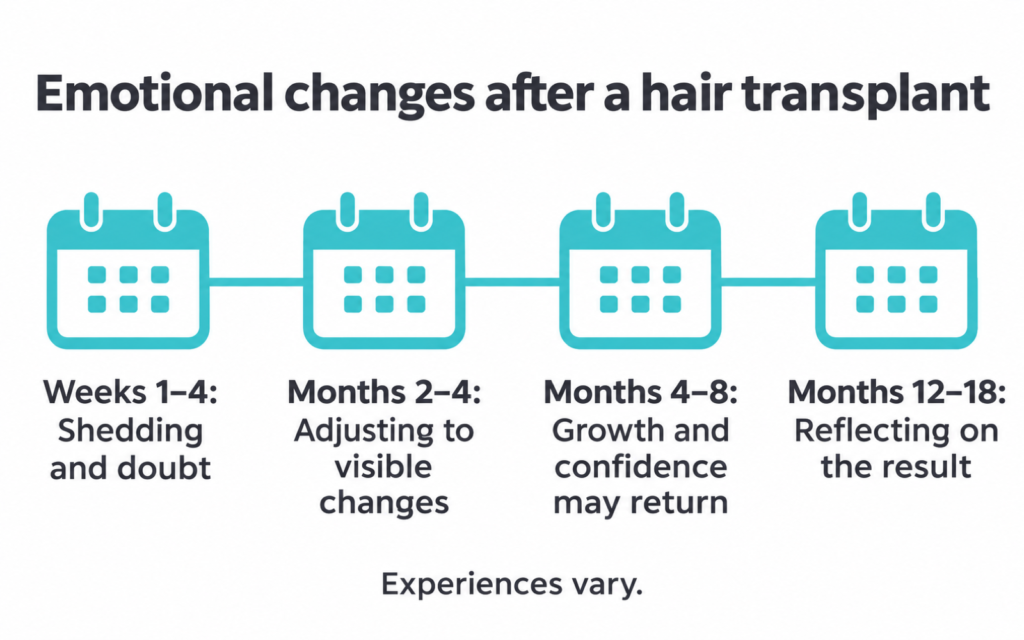
During this period, transplanted hairs often shed, redness may remain visible, and temporary shock loss can create patchy or uneven-looking areas. Many patients worry the procedure has failed, but this phase is usually a normal part of recovery.
Although the visible hair shafts often shed during the first few weeks after transplantation, the follicles themselves typically remain viable beneath the scalp. This temporary shedding reflects a normal transition into the resting (telogen) phase rather than graft failure. New hair growth begins around months 3 to 4, with density and coverage continuing to improve over the following months as more follicles re-enter the growth (anagen) phase.
Why Does Hair Transplant Anxiety Often Get Worse At Night?
Many patients describe nighttime anxiety during recovery. The distractions of the day disappear, which leaves more room for overthinking, mirror-checking, reading forums, analysing grafts, searching symptoms online.
Questions repeat constantly:
- “Did I damage the grafts while sleeping?”
- “Why is one side growing slower?”
- “Why does density look uneven?”
- “What if the transplant fails?”
Sleep itself becomes stressful because patients become afraid of touching or damaging the grafts accidentally. Knowing how to sleep properly after a hair transplant helps reduce some of that early recovery anxiety.
When Does Confidence Start Returning After A Hair Transplant?
Emotional improvement often develops gradually as new hair starts to grow. While the recovery timeline differs for everyone, many patients describe feeling more like themselves as visible results begin to appear.
“I couldn’t be happier with the results. I feel like a completely different person.” — Dean Simmonds, Longevita client
Dean’s experience reflects how the emotional benefits of a hair transplant often emerge alongside physical progress, with confidence returning as the results become noticeable.
For many people, the biggest emotional change goes beyond appearance. As concerns about thinning hair begin to fade, they spend less time thinking about hair loss in everyday situations. That sense of mental freedom often becomes one of the most meaningful outcomes of the recovery process.
Following a month-by-month hair transplant growth chart can make that journey feel less overwhelming. Knowing what to expect at each stage helps clients understand that changes take time and that emotional confidence often develops alongside physical results.
How Can Patients Mentally Prepare For Hair Transplant Recovery Better?
The healthiest mindset before surgery is realistic optimism. People who deal with their emotions in a healthy way usually understand what to expect during the recovery process and they focus on how they will be doing in the long run. They do not get too worried about how they’re feeling from one day to the next. Patients who are optimistic before surgery understand the recovery process clearly and focus on long-term progress rather than day-to-day changes.
- Focusing on monthly progress, not daily changes: Hair transplant recovery happens gradually. Looking for visible improvement every day often creates unnecessary stress. Most patients notice meaningful cosmetic changes month by month rather than week by week.
- Avoiding constant online comparisons: Recovery time varies for each individual. When you compare your hair growth to pictures or videos online it can make you think things are not going as well as they should. This can make you more worried during normal healing phases.
- Accepting temporary shedding phases: Shock loss and temporary shedding are common parts of the recovery process. Early shedding does not mean the transplant has failed. In many cases, it is a normal stage before new growth begins.
- Preparing for temporary lifestyle and styling restrictions: Many Longevita clients want to return to their usual appearance as quickly as possible. Some ask about using hair fibres soon after surgery, while others wonder whether hats or wigs can help conceal their recovery process. The early healing period involves temporary restrictions. Your clinician’s support team (contact details are in your Appointment Schedule) can tell you when these are safe to use.
- Understanding that density develops gradually: Hair density improves progressively over several months. Final results typically continue developing for up to 12–18 months depending on the individual and the procedure performed.
- Expecting confidence to rebuild progressively: A hair transplant is rarely an overnight emotional transformation. Confidence usually improves gradually as healing progresses and visible growth develops over time.
- Learning about the psychological side before surgery: Understanding the emotional aspects of recovery before the procedure often makes the experience feel less overwhelming afterwards. Patients who are prepared for temporary fluctuations in appearance generally cope better during the recovery period, and the 2025 review describes managing expectations as a critical factor in how satisfied people are with their hair transplant.
Hair transplants are discussed entirely in physical terms. The emotional side is rarely mentioned. But for many patients, the psychological recovery is the hardest part. The months of uncertainty, the compulsive checking and the temporary regret are not signs of weakness or surgical failure. They are a predictable response to a slow, visually inconsistent process that carries enormous personal meaning.
The patients who navigate recovery best are not the ones with the fastest recovery. They are the ones who knew what was coming. Preparation will not eliminate the difficult stages, but it changes how those stages feel when they arrive. That distinction matters more than most people realise before they go under the needle.
Frequently Asked Questions
Is it normal to feel regret after a hair transplant?
Yes. A lot of patients feel regret after a hair transplant. It typically happens when patients see some hair shedding on their scalp. This feeling of regret goes away as they start to see their hair growing back, between three to six months after the hair transplant.
What is shock loss after a hair transplant?
Shock loss refers to the shedding of transplanted hairs that occurs a few weeks after surgery. Although it can feel alarming, it is a normal part of the hair growth cycle. The follicles remain intact beneath the scalp and new growth typically begins around months three to four.
How long does hair transplant anxiety last?
Anxiety is most common during the first months of recovery. Many patients notice an improvement in confidence and emotional wellbeing from around month four onwards, as visible growth begins to appear.
Why do I keep checking my hairline after surgery?
Hyperawareness of the scalp after surgery is extremely common. The visual unpredictability of recovery, shedding, redness, uneven growth, causes many patients to monitor changes constantly. This behaviour typically decreases naturally as growth stabilises and results become more visible.
Does a hair transplant actually improve confidence long-term?
For many patients, yes. A 2023 study in the Journal of Cosmetic Dermatology found that men’s quality of life and self-esteem scores improved significantly after hair transplantation. Research published in Dermatology found that men with greater hair loss reported greater dissatisfaction with their appearance, and heightened concern about how their hair loss was perceived by others.
The British Association of Dermatologists confirms that hair loss can have a significant psychological impact, leading to decreased self-esteem and body image concerns.
Research by Thomas Cash, published in the British Journal of Dermatology, found that androgenetic alopecia is typically experienced as a moderately stressful condition that diminishes body image satisfaction, with effects on self-esteem particularly pronounced among those actively seeking treatment.
Many patients find this psychological aspect unexpectedly significant after surgery. Restoration does not just change how someone looks; for a substantial proportion, it reduces the daily cognitive load of hair loss entirely.
When will I start to see results after a hair transplant?
Initial growth typically begins between months three and four. Meaningful density improvements are usually visible from month six onwards, with final results continuing to develop for up to 12 to 18 months depending on the individual.
How can I manage anxiety during hair transplant recovery?
The most effective approach is preparation. Understanding what each stage of recovery looks like, including shedding, the ugly duckling phase, and gradual density improvement, significantly reduces anxiety when these stages occur. Avoiding daily comparisons online and focusing on monthly progress rather than day-to-day changes also helps considerably.
- Last Updated:

Dr Çağla Alkılıç
Hair transplant specialist (FUE, DHI and Sapphire) · Member of SANATDER and MESTDER
Last reviewed
Dr Cagla earned her medical degree at Trakya University’s Faculty of Medicine in Bulgaria and has almost 6 years of hair transplantation experience. She is a specialist in FUE, DHI and Sapphire hair transplants of the scalp, eyebrows and beard and has performed over 6,000 surgeries. Dr Cagla is multilingual, with fluency in English, Bulgarian and Turkish.
Request A Callback For A Discovery Call
With Longevita, you have the option to discuss your goals with us from the comfort of your couch.
- A UK-registered medical tourism facilitator
- Trusted by over 150,000 clients
- A free, no-obligation discovery call