
Hair Transplant: The Complete Guide To Procedures, Costs, Recovery And Results
Medically reviewed by Dr Çağla Alkılıç
Hair transplantation is the only treatment that restores hair to areas where follicles have stopped producing growth. Medications aim to slow future loss; surgery redistributes your own permanent hair to rebuild thinning or bald areas. The two do different jobs, and for most people the realistic plan involves both.
Key Facts
| Procedure type | Surgical relocation of your own hair follicles |
|---|---|
| Anaesthesia | Local anaesthetic, sometimes with sedation; you stay awake |
| Time in clinic | Commonly a single day |
| First new growth | From around month 3–4 |
| Final result | Matures over 10–18 months |
| Permanence | Transplanted hair is expected to be long-lasting; surrounding untreated hair remains subject to ongoing loss |
Timings above follow NHS guidance on hair transplants. Individual clinics vary, and yours takes precedence.
What Is A Hair Transplant?
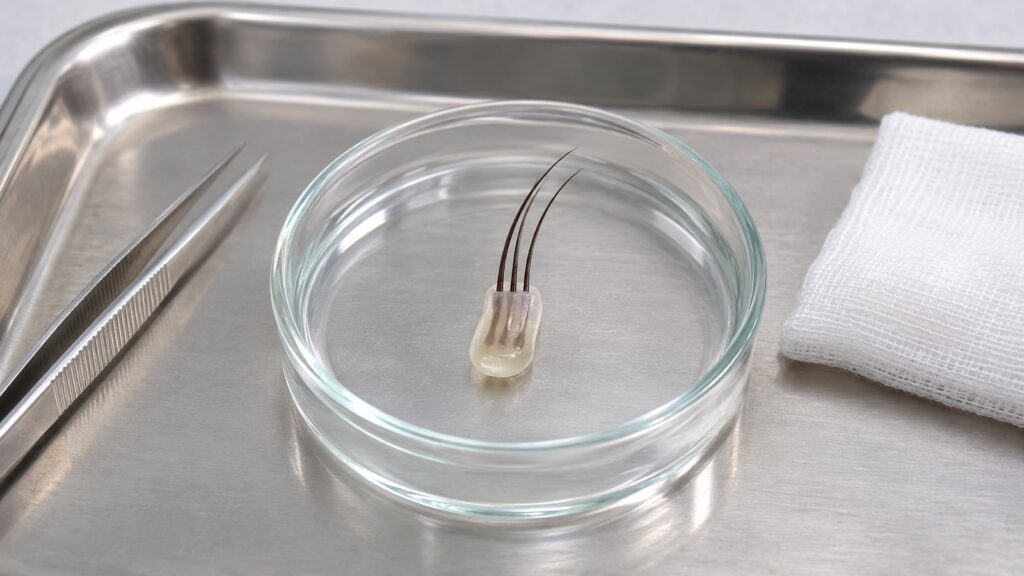
A hair transplant is a surgery where they take healthy hair follicles from parts of your scalp that have plenty of hair, usually the sides and back, and move them to areas where your hair is thinning or not growing anymore. Each bit they move is called a graft, and each graft has about one to four hairs. This surgery doesn’t actually make new hair; it just moves the hair you already have around. That’s why planning is just as important as the procedure itself.
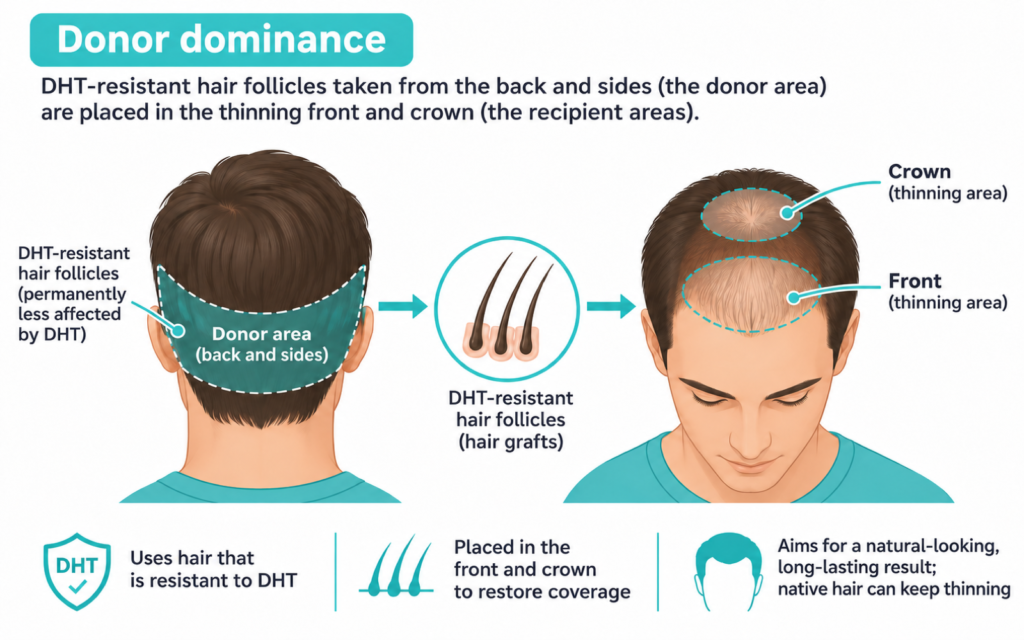
The reason the procedure works at all is a principle called donor dominance. Male and female pattern hair loss is caused by genetic sensitivity to dihydrotestosterone (DHT) in the follicles in the front and crown, which causes them to gradually shrink. The back and sides have far more resistant follicles. The resistant follicle, when transplanted to a bald area, still has the characteristics of the area from which it came and continues to produce hair as it did before.
How Does A Hair Transplant Work?
No matter how it’s done, all hair transplants today go through pretty much the same steps. First, the treating clinician figures out the plan: where the new hairline will go, which areas need the most work, and how many grafts can be taken from the donor spot without making it look sparse. Then, the scalp is numbed with local anaesthetic.
Next is extraction. In follicular unit excision (FUE) grafts are removed one at a time with a fine punch; in the older strip method (FUT) a narrow strip of skin is excised and then divided into grafts under magnification. The grafts are kept in a holding solution until the recipient area is ready and then placed one by one into small channels at angles corresponding to the natural direction of growth. Most patients go through this all in one day, and you’re awake the whole time.
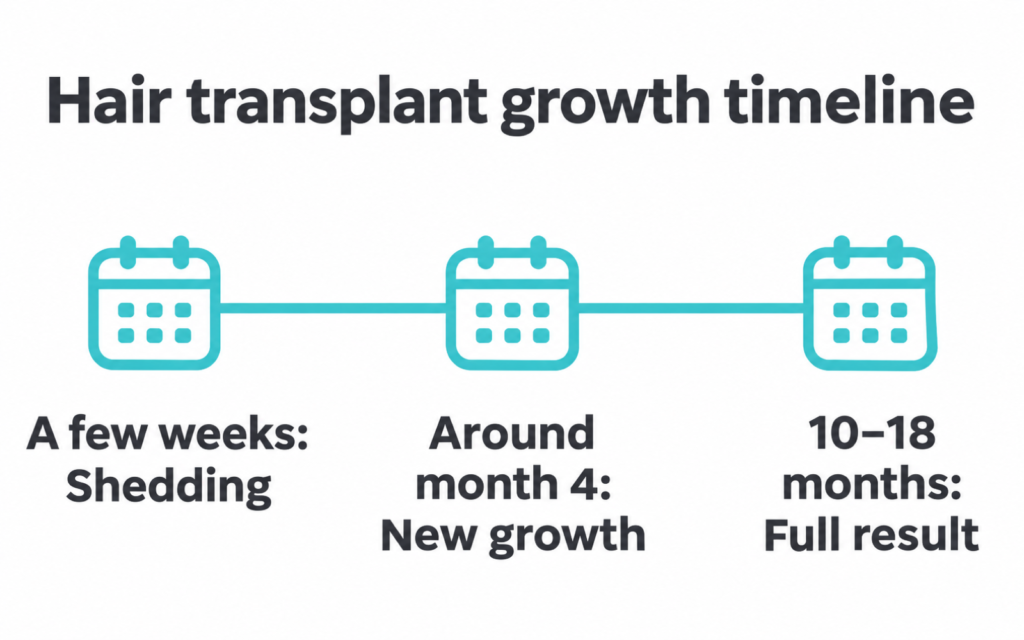
Once the procedure is complete, the focus shifts from surgery to healing. The transplanted hairs usually shed during the first few weeks before entering a new growth cycle. New hair commonly starts appearing around months three to four, while the final result develops gradually over the following year.
Is A Hair Transplant Permanent?
The transplanted follicles are expected to keep growing for life, because they carry their DHT resistance with them. What is not long-lasting is the appearance of the result as a whole, and that catches people out.
If your native hair continues to recede around a transplanted area, the coverage you paid for stays put while everything around it thins, which can leave the result looking isolated rather than natural several years on. This is the single most common reason a first transplant ages badly, and it is a planning failure rather than a surgical one.
Is A Hair Transplant Worth It?
Yes, for the right patient, it’s the only treatment that will bring hair back to areas where the hair follicles have already been lost. The result is your own growing hair, not a cosmetic cover. For many people, a hair transplant can produce a long-lasting improvement in appearance and confidence. Whether it is the right option depends on factors such as the cause of your hair loss, the quality of your donor area and what you hope to achieve from surgery.
- Stability: Your hair loss should be reasonably stable. If it is still progressing rapidly, a transplant performed too early may leave transplanted hair surrounded by newly receding areas, creating an unnatural “island” effect.
- Donor Area: The donor area is a limited resource. It must contain enough healthy follicles to support both the current procedure and any future treatment you may need as hair loss progresses over time.
- Expectations: A successful transplant restores coverage, improves framing of the face, and can create a much fuller appearance. However, it cannot recreate the density of a teenage hairline or a completely untouched scalp.
- Long-Term Commitment: The best outcomes are usually seen in people who view a hair transplant as part of a long-term hair restoration plan. This may include protecting existing hair through ongoing medical management and regular follow-up.
When these four factors align, hair transplantation has a strong track record of delivering meaningful, natural-looking improvement. If one or more factors are not in place, an experienced surgeon may recommend delaying or avoiding surgery, and that recommendation can be just as valuable as the procedure itself.
Are Hair Transplants Safe?
A hair transplant is generally a safe procedure when performed by a qualified surgical team on a suitable patient. It is carried out under local anaesthetic, so it avoids the risks of general anaesthesia, and it involves only the skin of the scalp, nothing deeper.
Low risk is not no risk. The NHS lists bleeding, infection and allergic reaction to the anaesthetic among the possible complications, along with the risk that the transplant does not take or that a noticeable scar forms. How likely any of these are depends on three things: whether you were a suitable candidate in the first place, the standard of the team performing the surgery, and how the scalp is cared for afterwards.
Who Is A Hair Transplant For?
Surgery is one answer to hair loss, not the answer to all of it. Our hair loss guide explains the causes, and the hair loss treatments guide covers the non-surgical options. Before technique, cost or timing becomes relevant, two questions have to be settled: what is causing your hair loss, and whether that particular kind of loss is something surgery can help.
Wanting a hair transplant is not the same as being a suitable candidate, and candidacy matters more than any choice you will make about technique. A well-executed FUE performed on the wrong patient produces a poor long-term result. A carefully planned procedure on the right patient produces a good one whether the grafts were placed with forceps or an implanter pen. Technique is a preference; candidacy is a prerequisite.
Which Types Of Hair Loss Can Be Treated With Surgery?
Surgery is designed for hair loss where the follicles have been lost in one area while remaining healthy in another, which in practice means pattern (androgenetic) hair loss and certain forms of scarring or traction-related loss that have become stable.
It is not designed for shedding with a reversible cause. Telogen effluvium after illness, stress or childbirth, thyroid disorders, iron deficiency and several other conditions cause hair to fall out for reasons that treatment can correct, and operating on them wastes donor hair on a problem that would have been resolved. Active inflammatory or autoimmune conditions such as alopecia areata can attack transplanted grafts in the same way they attacked the original hair.
How Is Hair Loss Diagnosed?
A diagnosis separates a plan from a guess, and it is usually quicker to obtain than people expect. A clinician takes a history, examines the scalp (often with a dermatoscope) and orders blood tests where a systemic cause is plausible.
The result determines everything downstream. Reversible causes get treated, not operated on. Scarring conditions need to be quiet before surgery is considered. Pattern loss can be staged and planned.
How Bad Is Your Hair Loss? The Norwood Scale Explained
The Norwood scale is the standard classification of male pattern baldness, from stage 1 (no meaningful recession) to stage 7 (hair remaining only in a horseshoe band). It is important for planning because it sets the arithmetic: the higher the stage, the larger the area to be covered and the smaller the remaining donor reserve. Two men at stage 5 can be very different candidates, so your stage doesn’t determine eligibility by itself, but it anchors an honest conversation about coverage priorities.
Are You Suitable For Hair Transplant?
Not everyone with thinning hair does. If your loss is early, medical treatment alone may hold the position for years and leaves every surgical option open later. If it is diffuse and recent, the cause may resolve on its own. Surgery earns its place when follicles in one area have stopped producing hair, the loss is stable enough to plan around, and no non-surgical route will restore what has already gone.
Are You A Candidate?
Before you go further, it’s good to know what an online assessment can’t show you. This includes how thick and good the hair is in the area where it will be taken from, how much hair is thinning in other spots, how loose or healthy your scalp is, and even if your hair loss is actually due to genetics. You’ll need to see someone in person or have a special microscopic exam for some of these things. An online assessment can begin the conversation; it cannot conclude it.
A quick self-check before any consultation:
- Has your hair loss slowed or stabilised over the last couple of years, or is it visibly progressing?
- Do you have thick, healthy hair on the back and sides of your head?
- Do you know what caused your loss, or has it never been diagnosed?
- Are you expecting restored coverage, or the density you had at eighteen?
- Are you prepared to look after the hair you still have after surgery?
Who Is Not A Candidate?
It’s wise to know the common disqualifiers ahead of time: undiagnosed or rapidly changing hair loss, a weak or depleted donor area, active scalp disease at the planned surgical sites, certain types of alopecia (like active alopecia areata or scarring alopecias) in which transplanted grafts would be attacked or fail, some uncontrolled medical conditions, and expectations that no surgery could fulfil. Unsuitability is not always forever. Loss becomes established, conditions are managed, plans mature.
What Is The Best Age for A Hair Transplant?
Age matters less than most people think, and not in the direction they think. For a healthy patient with an adequate supply of donors, there is no upper age limit. The greater caution applies to younger patients: in your early twenties, the final pattern of your hair loss is still unknown, and a hairline designed for your face today can look wrong, and prove impossible to maintain, two decades on. Practitioners look at the pattern of loss for maturity more than the number.
Can You Have A Transplant Before Losing All Your Hair?
Yes, and most patients do. Thin-but-present hair is the normal starting point, not an obstacle. Operating within existing hair requires extra care, since grafts are placed between native hairs without damaging them, and if your loss is untreated and progressing, the hair around the transplant will continue to recede. That is why surgeons ask about stability and long-term medical management before operating into a thinning zone.
Hair Transplant Techniques
Which Hair Transplant Method Is Best For You?
All surgical hair transplants are based on one of two extraction methods; taking out grafts one at a time (FUE) or taking out a strip of donor skin and dividing it (FUT), once you remove the brand names. All the rest that you will come across; DHI, Sapphire, robotic systems, “micro” and “nano” are variations in the instruments used or the way grafts are placed.
What Is A FUE Hair Transplant?
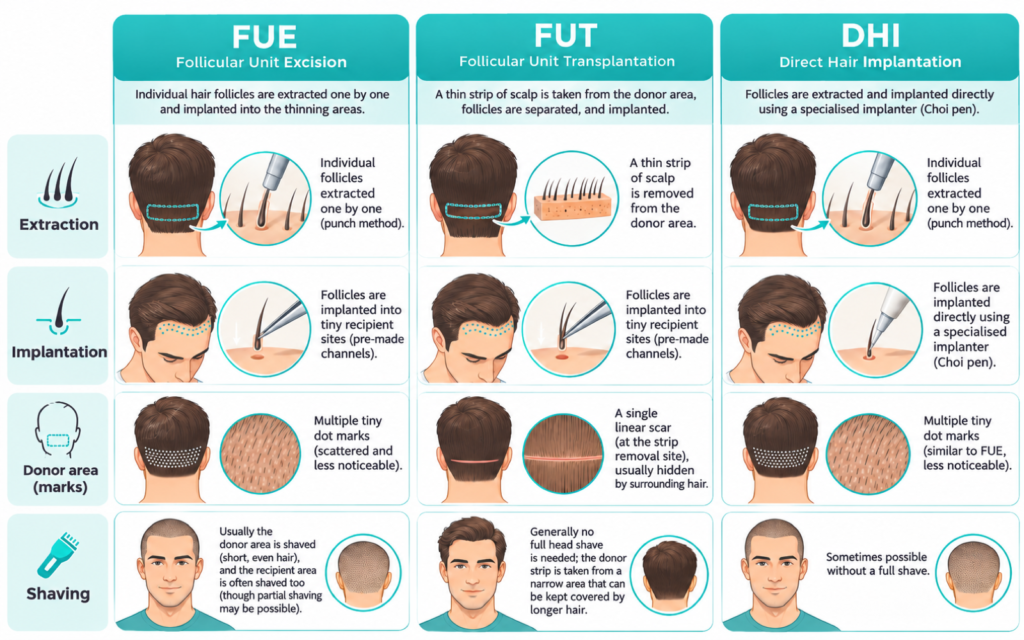
FUE, or follicular unit excision, involves taking out individual hair follicles with a tiny tool. Instead of one long scar, it leaves small dots in the area where the hair was taken from. This is the way most hair transplants are done now. It works well for people who like to wear their hair short. If you’re thinking about getting an FUE hair transplant, check out our guide. It explains everything, from taking the hair, to healing, and what results you can expect.
What Is FUT Hair Transplantation?
FUT (follicular unit transplantation, the strip method) involves removing a narrow strip of scalp, which is then dissected into individual grafts. It leaves a linear scar that is usually concealed within the surrounding hair. Although FUT remains a legitimate option, particularly when a large number of grafts is required and the patient keeps the hair longer at the back, it is used less frequently today. FUE has become the more commonly performed technique because it avoids a linear donor scar and offers greater flexibility for shorter hairstyles.
What Is A DHI Hair Transplant?
DHI (direct hair implantation) should be seen as a modification of FUE. Grafts are still taken out one by one but they are loaded into a spring-loaded implant pen which creates the channel and inserts the graft in one motion. Benefits claimed are angle and depth control; trade-offs are longer procedure times for large sessions.
FUE, FUT, Or DHI: Which Hair Transplant Is Better?
FUE, FUT and DHI are the main hair transplant techniques used today. The key differences lie in the extraction method, implantation process, scarring pattern and shaving requirements, all of which can influence which approach is most suitable for a particular patient.
| FUE | FUT (strip) | DHI | |
|---|---|---|---|
| Extraction | Individual punch | Strip of donor skin | Individual punch (as FUE) |
| Implantation | Channels opened, then grafts placed | Channels opened, then grafts placed | Implanter pen opens and places in one step |
| Donor marks | Small dots through donor area | Single linear scar | Small dots through donor area |
| Shaving | Donor area shaved (full or partial) | Strip area only | Sometimes possible without a full shave |
One technique is not better than another. The better question is which method suits your donor area, the session size and the outcome you’re planning.
Sapphire FUE: Technique Or Tool?
A tool. Sapphire FUE is standard FUE in which the recipient channels are created with a synthetic sapphire blade instead of a steel one. Small comparative and histological studies have reported cleaner incisions and less tissue trauma, but there is no high-quality independent evidence that final growth outcomes differ, and the studies most often cited come from clinics with a commercial interest in the answer.
It is worth naming the pattern here because it is repeated throughout the industry. Technique explains how grafts are removed and implanted (FUE, FUT). Tool describes a tool used within a technique (Choi implanter pen, sapphire blade). Brand refers to a trademarked device or package (NeoGraft, ARTAS). A branded procedure usually does not represent a different surgery; it is typically FUE performed using specific equipment or implantation tools.
Should You Consider Robotic Hair Transplant Surgery (ARTAS)?
The ARTAS robotic system uses image-guided technology to help with graft harvesting, selecting and scoring follicular units with machine reliability before the human team finishes the job. It changes the way grafts are harvested, not what the operation is.
Is NeoGraft Different From Standard FUE?
NeoGraft is a hand-held device utilising pneumatic suction to facilitate FUE extraction, reducing handling of grafts between extraction and placement. Similar to ARTAS, the brand is not a unique operation but equipment.
Are Mega Session Hair Transplants Worth It?
A mega session is a transplant involving a very large number of grafts in a single procedure. The appeal is obvious: one procedure, one recovery. The trade-offs are more time under local anaesthetic, greater demands on graft handling, and a hard ceiling on what your donor area can safely give.
There is also a clinical argument for caution. Megasessions and dense packing are listed among the technical risk factors for recipient-site necrosis in a recent review of FUE complications, which is one reason experienced surgeons set limits instead of maximising numbers. Whether a mega session is reasonable or an overreach depends on your donor capacity and the team’s workflow.
Do Biofibre (Synthetic) Hair Implants Work?
Synthetic hair implantation is not a hair transplant and should not be mistaken for one. Instead of moving your own follicles, artificial fibres are embedded in the scalp. They don’t grow, they need constant maintenance and replacement from time to time, and foreign material implanted in the body carries its own risks of inflammation, infection and rejection, which is why the approach is regarded with caution by much of the medical community and isn’t available in some countries. Anyone considering it should understand the maintenance burden and complication profile before comparing it to surgery using living hair.
Are Stem Cell Hair Treatments Available Yet?
Stem cell hair restoration remains one of the most promising areas of hair loss research. While scientists are exploring ways to regenerate or create new follicles, there is currently no clinically established stem cell treatment that can reliably restore hair in routine practice.
How Is A Hair Transplant Planned?
Everything that determines the quality of your result is decided before the first graft is taken. Planning answers four connected questions: how much donor hair you have, where it should go, at what density, and what has to be left in reserve for the future.
Hairline Design
A natural hairline isn’t simply drawn across the forehead. It should fit your face today and still look right years from now. That’s why experienced surgeons don’t automatically place the hairline as low as possible, even if a patient asks for it. A lower hairline can look dense in the short term, but it may seem unnatural as your face changes with age or if hair loss continues. The best results come from careful planning. The front edge is usually made with single-hair grafts arranged in a slightly irregular pattern, while larger grafts are placed behind them to create natural density. Each graft is also angled to match the way your hair would normally grow. The hairline transplant guide covers design principles, graft numbers and results.
How Many Grafts Would You Need?
Enough to cover the priority areas with a density that looks natural and does not overdraw the donor area. For context, hairline and temple work is usually planned in the hundreds to thousands of grafts. Advanced loss across the front and crown pushes requirements into several thousand.
How Many Grafts Per Cm² Will Look Natural?
A hair transplant does not attempt to recreate the scalp’s original density in every area. Density in the donor zone at the back and sides of the scalp is typically around 65–85 follicular units per cm², whereas transplanted areas are usually planned at lower densities to achieve a natural-looking result while preserving the limited donor supply. The visual impression of fullness arrives long before true original density does. Where the grafts are concentrated matters as much as how many there are: density is weighted towards the hairline and the frontal zone, where the eye judges fullness, and graduated behind it.
What Will 3,000 Grafts Cover?
A session of about 3,000 grafts is a big session and is usually associated with restoring a receding hairline and reconstructing the frontal third of the scalp in moderate loss. In advanced baldness it will not stretch to cover the front and crown completely. Whether 3,000 is a generous or slim number depends on the surface involved and your hair’s characteristics, the same number that makes one head of hair just tidies another.
Is It Possible To Have 5,000 Grafts Done In One Session?
Sometimes, but respect the number. 5,000 grafts assumes a donor area firm enough to part with them safely, and a session (or two staged sessions) long enough to cope with them without impairing graft survival. Some clinics quote big round numbers freely; a good surgeon will count what your donor area can really spare, and then work backwards. Graft count is one of the key determinants of both price and coverage, so a 5,000-graft plan carries clinical and financial weight.
When Do You Need 8,000 Grafts?
Almost never in one sitting. Such figures are suggestive of a large, Norwood 6-7 loss and are realistically a lifetime total for staged procedures, not a single operation. A pledge of 8,000 grafts per session should make you ask some tough questions about donor protection, since harvesting at that scale risks the overharvesting problems outlined later in this guide. In most patients with advanced loss, the realistic plan is a first procedure with a defined strategy for the future.
Good To Know
Graft numbers don’t tell the whole story. Two people receiving the same number of grafts can achieve noticeably different results depending on factors such as hair thickness, curl pattern, natural density and the contrast between their hair and scalp colour. This is why graft estimates should always be interpreted alongside an individual assessment rather than used as a guarantee of coverage.
What Makes A Good Donor Area?
The donor site, the strip of hair around the back and sides, is the budget for everything a transplant will ever do for you. Its value depends on density (follicular units per cm²), the calibre and character of the hairs, and how much can be removed before the area itself begins to look thin. This is the single most consequential thing a surgeon looks at, and it’s a physical examination, not a photo judgement. Once the donor hair is gone, it’s gone; a plan that empties the account in one sitting leaves nothing for the future. The donor area guide describes how capacity is evaluated.
Hair Transplant With Fine Hair: Will It Work?
Yes, fine hair does not preclude surgery, but it changes the arithmetic. Thinner shafts provide less visual coverage per graft, so density planning, graft selection and expectations all need adjusting rather than assuming the averages apply. What a realistic outcome looks like is described in hair transplants with fine hair.
Hair Transplants For Different Needs
Hair Replacement For Particular Areas And Hair Types
The principles above apply across the head, but anatomy changes the plan. The crown behaves differently from the hairline, afro hair behaves differently from straight hair, and eyebrows are a different discipline from scalps. Each area has its own guide; what follows is what makes each one distinct and when to read further.
By Treatment Area
Crown Hair Transplants
The crown is the most graft-hungry area of the scalp. Because the hair grows in a spiral pattern, there is less overlap of coverage, so the same area consumes more grafts for the same visual density. Here, too, the loss that’s going to continue is the most difficult to predict, making timing a real strategic decision, transplant a crown too early, and ongoing recession can leave the result high and dry. Surgeons are careful to balance crown work with frontal priorities, as the front frames your face and the crown mostly faces people behind you in queues. The crown hair transplant guide covers the whorl, graft budgeting and timing.
Hairline Transplants
A hairline transplant rebuilds or moves a receded hairline with grafts, gradual, natural and with no scalp incision. Here is where the weight lies: the line has to match your face now, and it has to stay maintainable as native loss continues, which is why conservative placement is the mark of good work.
Beard Transplant
A beard transplant uses follicles, usually taken from the scalp, to add hair to sparse areas or reconstruct facial hair affected by genetics, scarring or injury. Because beard hair is viewed at close range, natural direction, angle and distribution are particularly important. Scalp donor hair may also behave differently from existing facial hair and can require regular trimming.
Hairline Lowering Surgery
Hairline lowering (also called forehead reduction) is a different operation altogether. An incision along the hairline allows the hair-bearing scalp to be advanced forward, lowering the line in a single step at the cost of a surgical scar and its own risk profile.
Hairline lowering suits patients with a high natural hairline, good scalp laxity and stable hair, not active pattern loss. Grafting suits almost everyone else.
By Hair Type And Patient Profile
Female Hair Transplant
Female hair loss is different in most cases, with diffuse thinning over the top, not the receding pattern typical in men. That difference is important surgically, because diffuse loss can mean the donor area is thinning too.
Several causes of female hair loss (thyroid, iron deficiency, telogen effluvium, traction alopecia) are treatable without surgery or make surgery inappropriate, so a proper workup precedes any planning. Women with stable, well-defined loss and a good donor area are good candidates for surgery, including traction alopecia at the hairline and temples. The female hair transplant guide covers diagnosis, suitability and technique.
Afro Hair Transplants
Afro-textured hair can produce excellent visual density because the natural curl provides more coverage. However, the follicles are often curved beneath the skin, making them more difficult to extract without damage. For this reason, it’s important to choose a surgeon with experience treating Afro hair.
Curly Hair Transplants
Curl affects both extraction and planning. The same curvature that makes coverage efficient makes the follicle harder to remove intact, and it changes how the result is judged: curly hair conceals the scalp far more effectively at a given density, so density targets that would look sparse in straight hair can look full here.
Forehead Reduction: Graft Or Surgery?
If you’re worried about a big forehead, the decision between moving the hairline forward with grafts and surgically lowering it depends on how loose your scalp is, how stable your hair loss is, how much change you want and how you feel about scarring. Each route has cases it clearly serves and cases it doesn’t. A comparison of getting a smaller forehead works through which fits which.
Eyebrow Transplants
Restoring brows is a delicate, small-scale operation; single-hair grafts at very flat angles, along the natural sweep of the brow. And because donor hair is taken from the scalp, it continues to grow and needs regular trimming. Eyebrow transplants are ideal for brows lost to overplucking, scarring or naturally sparse growth; the alternative of semi-permanent tattooing is honestly compared in microblading vs eyebrow transplants.
Eyelash Transplants
Eyelash transplantation is the most technically demanding of the small-area procedures and the least commonly performed. Individual scalp hairs are threaded through the lash line at a precise angle and curvature, a few dozen per eye rather than the hundreds used on a brow, and the margin for error is measured in fractions of a millimetre.
Two things follow from using scalp hair. It grows continuously, so transplanted lashes need trimming every few weeks and often curling to sit correctly. And it is straighter and finer than a natural lash, so the aesthetic result depends heavily on placement rather than volume.
Most candidates come to it after trauma, burns, scarring or trichotillomania rather than for cosmetic enhancement, and for purely cosmetic goals extensions or lash serums are usually the more proportionate answer.
Does It Matter What Type Of Hair You Have?
It affects the visual outcome more than the surgery. The appearance of coverage a given number of grafts gives depends on the curl of the hair, the thickness of the hair shaft and the contrast between hair and skin colour. There is a lot of coverage from curly, coarse hair per graft; the most difficult combination is straight, fine, dark hair on a light background. Hair characteristics and transplant suitability explains how each characteristic factors into planning.
What If Your Scalp Has Psoriasis, Burns Or Scarring?
Neither is a blanket rejection, but both change the calculus. In psoriasis, it is about control. Operating on skin that is flaring puts you at risk of poor healing and koebnerisation (new plaques forming at sites of injury); our guide to hair transplants with psoriasis covers this in more detail. Burns or injury can create scar tissue, which reduces graft survival and requires modified, sometimes staged, techniques. The guide to transplants on burnt or scarred skin explains what makes these procedures succeed.
Transgender Hair Transplants
Hair restoration is a common part of transition for many people, most noticeably hairline feminisation, which changes a higher, M-shaped hairline to a lower, rounded one, and facial hair transplants in masculinising care. Planning is affected by hormone therapy, as oestrogen and anti-androgens change the pattern of hair loss, and timing decisions are taken alongside your wider care. The dedicated guide to transgender hair transplants covers options, planning and what to discuss with your clinical team.
Can You Use Another Person’s Hair?
No. The transplanted follicles are living tissue, and tissue from another person is recognised and destroyed by your immune system unless you take lifelong immunosuppressant medication, drugs whose serious risks are only accepted for organ transplants that preserve life, never for cosmetic surgery. The only theoretical exception would be an identical twin. That’s why the capacity of the donor area is so important, the only supply is your own hair.
Is A Hair Transplant Haram?
There has been a lot of discussion on this question by Islamic scholars, and the general consensus is that hair transplantation is allowed: it involves relocating the person’s own living hair to correct hair loss, rather than adding foreign or artificial hair. Replacing what was lost is generally distinguished from altering creation. Different schools and scholars differ in detail in their rulings, so patients for whom this matters should consult a scholar they trust. Synthetic implants and hair from another person raise separate considerations, both are covered above.
Before your procedure
What Questions Should You Ask In Your Consultation?
A consultation is your best filtering tool. The NHS suggests asking about a surgeon’s qualifications, how many transplants they have performed, how many resulted in complications, and what follow-up to expect if things go wrong. We would add the following:
- Who performs each part of the surgery, the surgeon or technicians, and which parts specifically?
- How many grafts do you estimate, and how did you arrive at that number?
- Will my donor area be sufficient for this plan and for any future work?
- If I were your relative, would you operate now, wait, or treat medically first?
- What does the quote include: post-treatment support, medication, follow-up reviews, revision policy?
- What difficulties do you encounter in your own practice, and how do you deal with them?
- Can I see healed donor areas, not just recipient-area results?
- What happens if I am unhappy with the outcome?
Medications That Need Reviewing Before Surgery
Anything that affects bleeding, healing or interaction with local anaesthetic should be declared and reviewed, not self-stopped. The usual review list includes blood-thinning medication and some everyday painkillers such as aspirin and ibuprofen, certain supplements (fish oil, vitamin E, ginkgo and others with mild anticoagulant effects) and some prescription drugs for which individual advice is required.
Your surgical team will tell you which to stop, which to keep taking and when, based on your health and what your prescriber says. Times will vary from drug to drug and patient to patient, so this page deliberately gives none. Hair-loss medications such as finasteride and minoxidil have their own pre- and post-surgery considerations, which your surgeon will outline. Medication after the procedure, such as antibiotics, anti-inflammatories and restarting hair-loss treatment, is covered in the hair transplant recovery guide.
Is It Possible To Drink Alcohol Before A Hair Transplant?
You will usually be advised to avoid alcohol in the days leading up to surgery, and it is worth taking that advice seriously rather than treating it as small print: stopping alcohol before surgery is linked to fewer post-operative complications in people who drink regularly. Alcohol can increase the risk of bleeding during surgery, which may make graft extraction and placement more technically challenging. After a hair transplant, alcohol is generally avoided because it can increase bleeding and swelling, contribute to dehydration, and affect how the body processes local anaesthetics and other post-operative medications. It can also disrupt sleep, which is not ideal in the period immediately before and after surgery.
Clinical teams determine their own required abstinence window before and after the procedure, follow yours exactly. If it feels difficult to stop for a couple of weeks, that is a conversation to have frankly and in advance with the clinic, not something to be hidden.
Will You Be Shaved Before Hair Transplantation And Should It Matter?
Yes, for most procedures, and it’s a working advantage, not a clinic convenience. A shaved donor area allows the surgeon to see follicular units clearly, select the strongest grafts and space extractions evenly; a shaved recipient area makes angles, direction and existing hair easier to read. Both result in more precise work, and shaved hair regrows alongside your transplanted hair, which keeps early regrowth looking uniform.
Can I Get A Hair Transplant Without Shaving?
Yes, you don’t always have to shave. There are unshaven and partial-shave approaches for patients who can’t absorb a shaved head into their work or life, at the cost of longer procedure times and smaller sessions. How much you’re willing to sacrifice is a personal calculation. The no-shave and long-hair hair transplant guide explains how these procedures work and who they’re for.
Why Is Local Rather Than General Anaesthesia Used?
Because it’s safer and the surgery doesn’t require more. A hair transplant takes place on the surface of the scalp; local anaesthetic numbs the working area while you are awake and able to reposition, take breaks, eat and talk to the team, practical points in a procedure lasting several hours. Surgeons don’t use general anaesthesia for routine transplants for the same reason, it adds nothing to the outcome, but adds its own risks (airway management, cardiovascular effects, longer recovery) and its own pre-operative requirements.
Does A Hair Transplant Hurt?
The pain is real but front-loaded. The injections of local anaesthetic sting for a bit, and once the scalp is numb the operation itself should not be painful. In the days after, as the scalp heals, there is some tenderness, tightness and itching. Does a hair transplant hurt? covers what patients actually say at each step, and how it’s managed.
What Should You Prepare For If You’re Going To Turkey?
Many people travel to Turkey for hair transplants, and the best way to assess a Turkish provider is the same way you would assess a British one, with a few travel-specific add-ons. Price alone doesn’t tell you much one way or the other, and UK health bodies advise weighing any saving against the added risks of treatment abroad, including variable standards and limited recourse for post-treatment care.
Do this before you book:
- Regulation and licensing: Hospital or clinic licensed by the Turkish Ministry of Health, and can it show you proof?
- The surgeon: Who are they, what do they do on the day, and how much of the procedure do technicians do?
- The quote: What is included: transfers, accommodation, medication, post-treatment care kit, follow-up reviews, revision policy?
- Distance post-treatment care: How are post-operative questions handled once you’re back in the UK, and who do you contact if something worries you?
- Time on the ground: Enough days for the procedure, first wash and a check before flying home?
Timing the trip is more about comfort and convenience than outcome, and choosing a season for surgery is mostly a matter of personal preference. Some clients consider combining the trip with other cosmetic procedures. For how hair transplants with independent clinicians in Istanbul are arranged through Longevita, see hair transplant in Turkey.
Hair Transplant Cost
What Is The Cost Of A Hair Transplant?
The cost of a hair transplant can be divided into a few factors, and understanding them is more helpful than any headline figure. Quotes only become comparable when you understand what is included.
| Cost factor | Why it moves the price |
|---|---|
| Number of grafts | The biggest single factor, the more grafts, the longer the surgery and the more team time |
| Technique and instruments | DHI and some device-assisted procedures are priced differently from standard FUE |
| Surgeon involvement | A surgeon performing key stages costs more than a technician-led model |
| Country and local costs | Staffing, premises and regulation costs vary between markets |
| What's included | Post-treatment, medication, follow-ups, accommodation and transfers are inside some quotes and extras in others |
| Revision policy | Whether a touch-up, if required, is included or charged |
Because graft count is the first thing on the list, the graft calculator doubles as a first cost-orientation tool: estimate your probable graft range, then read quotes against it. An estimate is a basis for a consultation, not a price guarantee.
Why The Most Affordable Quote Can Cost More In The Long Run?
The number on a quote covers the day of surgery, not what happens if that day goes badly, and a low headline price is often where corners get cut. Repair work costs more than doing it right for the first time. Correcting a poor hairline or thin, patchy growth means paying for a second procedure that draws on an already-reduced donor supply. Poor graft survival is a hidden cost. Grafts held too long or handled by an inexperienced team can fail to grow, however generous the graft counts on the invoice.
Weak planning is the most expensive shortcut, because a rushed diagnosis or badly designed hairline can lead straight to corrective surgery with less donor hair left to fix.
The most affordable price is not automatically wrong, nor the priciest automatically right. Price is one line in a bigger equation that includes who operates, how the donor area is protected, and what happens if the result is not right the first time.
What Is The Cost Of A Hair Transplant In Turkey?
Many clinics in Turkey quote one overall price that may combine the procedure, accommodation, transfers and post-treatment care. This makes the “what’s included” row above particularly important when comparing similar-looking quotes. Independent clinicians’ prices for FUE hair transplants arranged through Longevita in Turkey start from £1,650; current prices for each technique are in our price calculator. Flights, accommodation and transport are your own arrangements.
How Do UK and Turkey Prices Compare?
The price difference between the UK and Turkey is significant, and it is more for structural reasons, staffing costs, clinic overheads and procedure volumes, than because one market is by definition cutting corners. The fair comparison weighs total cost (procedure, travel, time off) against surgeon involvement, regulation and access to post-treatment, which is exactly how we do our UK vs Turkey comparison.
How Does Turkey Stack Up Against India?
The same structural logic applies between destinations: both markets offer much lower prices than the UK, and the meaningful differences lie in clinic standards, surgeon involvement and travel practicality, not the headline figure. A Turkey vs India comparison weighs the two side by side.
Will Insurance Or The NHS Cover Hair Transplants?
Generally, no. Hair transplants for pattern hair loss are categorised as cosmetic surgery and are therefore not funded by the NHS and not covered by standard private health insurance. The exceptions are limited: reconstructive cases, hair loss from burns, trauma or certain medical treatments, are sometimes considered by insurers or NHS trusts on individual assessment, and complications of surgery may be treated as medical events in their own right. If you think your case is reconstructive, the route is a GP referral and a direct conversation with your insurer before committing to anything.
Hair Transplant Results
What’s The Recovery Like After A Hair Transplant?
The healing is front-loaded: the visible healing occurs in the first fortnight, whereas the result itself takes a year or more to arrive. Hair transplant recovery follows a predictable pattern. During the first one to two weeks, the scalp gradually heals and patients can begin gentle washing by day 6. The NHS notes that transplanted hairs often fall out after a few weeks before growing back later. New hair usually starts to appear around 4 months, while the full result is generally seen between 10 and 18 months. BAAPS similarly states that transplanted hairs begin growing at 3-4 months and may continue to improve in quality for up to 18 months after the procedure.
You will leave with post-operative medication and instructions, what those cover is part of proper post-treatment care. How you manage those weeks matters a lot for graft survival, and the detail is important: washing technique, sleeping position, when exercise, sweating, sun, swimming and haircuts become safe again, and which products help rather than hinder. It all lives in our dedicated hair transplant recovery guide, the page to bookmark for the weeks after surgery.
Would A Hair Transplant Change Your Hair Colour?
The surgery itself does not change the colour the follicles produce, a moved follicle still has its pigment and other characteristics. What patients see is different and transient: newly growing transplanted hair comes in finer, sometimes wiry, curlier or slightly different in colour, and settles in as the hair matures through its growth cycles. There’s also a planning aspect to it, the donor hair from the back of the head can be subtly different in colour or texture from the hair that used to grow at the front, which is another reason donor assessment is done carefully rather than assumed.
Does Transplanted Hair Turn Grey?
Yes, on its own schedule. The biology of the follicle itself dictates greying, the slow decline of pigment cells, and follows the genetic timeline of the donor area. A transplant does not accelerate or prevent greying. The donor hair at the back of the head tends to grey on a similar timeline to the rest, so transplanted hair tends to grey in step with the surrounding hair. Colour is irrelevant to graft survival; grey donor hair transplants just as well.
What If The Density Is Less Than You Hoped For?
First, check the calendar, most “low density” concerns before month twelve are simply immaturity. There are occasions when the real density falls short: graft survival differs between patients, some plans intentionally spread density over two sessions, and expectations are sometimes different from what was agreed. The options range from patience through medical support to a planned second pass, described in how to improve density after a transplant.
Do You Need A Second Hair Transplant?
Second transplants occur for good reasons (adding density, extending coverage as planned in a staged approach) and frustrating ones (continued native hair loss changing the picture). That is why donor management in the first surgery is really important: a conservatively harvested donor area keeps your options open, an emptied one closes them. The second hair transplant guide covers timing, donor budgeting and what a second procedure can achieve.
Risks And Complications
What Are The Risks And Side Effects of Hair Transplant?
Most hair transplant patients recover without incident, and most of what you’ll see in the first two weeks is normal healing, not a complication. The art is to distinguish between the two and to act early on the few signs that need clinical attention. Our guide to hair transplant complications goes into more detail.
| Expected in early healing | Contact your clinical team immediately |
|---|---|
| Swelling of scalp or forehead in the first days | Swelling that gets worse after day 4–5 rather than improving |
| Small scabs around each graft | Redness spreading, heat or throbbing pain |
| Itching as skin heals | Discharge or a smell |
| Temporary loss of feeling | Fever or feeling unwell |
| Pink or red patches for weeks | Dark patches of skin anywhere on the scalp |
| Shedding of transplanted hair | Bleeding that does not stop with gentle pressure |
If you are concerned about a symptom, contact your clinician’s support team (contact details are in your Appointment Schedule). If you are in the UK and feel very unwell, call NHS 111, or call 999 or go to A&E in an emergency.
What Side Effects Are Normal In The Healing Process?
The usual early course consists of swelling, scabbing, itching, numbness, tightness, redness and shedding of transplanted hairs, which resolve over days to weeks. The smallest nerves take the longest to heal, and numbness can last for months. Anything not on this list is worth a conversation with your clinic, not a search engine.
What Is Hair Transplant Trypophobia?
In the first few days post-op, the normal pattern of graft sites and scabs is visibly dotted, and some find the sight distressing, a reaction to clustered holes common enough to have a name, trypophobia (excessive fear of clusters of holes). It doesn’t tell you how well you’re healing, and the appearance goes away as scabs clear. If you have issues with patterns of holes, read about hair transplant trypophobia before looking at close-up healing photos.
Will A Hair Transplant Leave A Scar?
Yes, all surgery leaves scars, and any claims of scar-free procedures are marketing, not medicine. The truth: FUE leaves tiny round dot scars scattered across the donor area, normally invisible when the hair is at normal length but visible on a closely shaved head; FUT leaves one linear scar hidden by the hair above it. Whether the scar is visible depends on how you heal, the extraction technique and density, and how short you keep your hair. If you want a grade-zero clipper cut, say so at consultation, it changes the recommended approach.
How Can You Tell If You Have An Infection?
Infection after a hair transplant is rare, the scalp has an excellent blood supply, but it requires prompt treatment when it does occur. The signs of infection versus normal healing: redness that spreads instead of fading, pain that increases after the first few days, heat, swelling in certain areas, pus or discharge, and fever. Prevention is mostly post-treatment discipline: hand hygiene, correct washing, keeping the scalp protected from dirty environments and following your medication instructions. If you suspect an infection, contact your clinician’s support team (contact details are in your Appointment Schedule) or a doctor the same day.
What Is Scalp Necrosis?
The most serious local complication of hair transplant surgery is the death of an area of scalp tissue due to insufficient blood supply, called necrosis. It is rare. It occurs when the blood supply to the scalp is overwhelmed beyond its large reserve. Reported risk factors include smoking, diabetes and vascular conditions in the patient, and overly dense packing, mega-sessions or overly deep incisions on the surgical side.
The warning sign is skin in the treated area turning dusky, then blackish, generally with pain. This is an emergency, not a wait-and-see one: contact your clinician’s support team straight away, and in the UK call 999 or go to A&E. Two practical takeaways: be honest about smoking and medical conditions at assessment, as these affect surgical planning; and choose teams that explain their limits on graft density rather than offering maximum packing.
Can Surgery Damage Your Existing Hair?
It can, which is exactly why care is needed between existing hairs. The common, harmless type is shock loss, in which the native hair surrounding the surgical areas falls out from the trauma of surgery and then regrows within months, because the follicles themselves survive. The version planning seeks to avoid is permanent damage, grafts placed carelessly can transect neighbouring follicles, and hair already miniaturised by DHT is the most vulnerable to being tipped into permanent loss by surgical stress. The protections are technique, spacing and an honest assessment of your native hair’s condition. Ask your surgeon directly how they work around existing hair.
What Is An Overharvested Donor Area?
Overharvesting is when too many grafts are taken, or are taken unevenly, and the donor area itself is left looking thin, patchy or moth-eaten, swapping a permanent problem at the back of your head for coverage at the front. It is one of the most important preventable complications, because donor hair will not grow back. Prevention is a surgeon calculating safe extraction limits for your density and saying no to graft numbers beyond those limits. The red flags when selecting a provider or clinic are guaranteed mega-numbers without examination and unwillingness to display healed donor photos. Options for those already affected range from scalp micropigmentation to careful corrective work. The full guide to overharvested donor areas covers causes, prevention and repair in depth.
What Are The Risks Of A Beard Transplant?
Beard work doesn’t behave quite like scalp work. The usual problems are angle mistakes, facial hair applied too steeply that looks like it is coming out of the cheek rather than lying flat, along with patchy or unrealistic density, scarring or colour change visible on the facial skin, and thinning in the donor zone at the back of the head. The face is less forgiving than the scalp: it’s viewed close up, without the shading of surrounding hair.
Correction is possible (removal and re-angling of grafts, camouflage, further grafting) but more difficult than getting it right the first time, which argues for demanding beard-specific experience and results at consultation. The recovery for beard procedures, and its own timeline, sits in the hair transplant recovery guide.
If You Don’t Like The Result, What Can You Do?
Follow a step-by-step sequence rather than reacting on impulse:
- Check the timeline first: If you are within the first 12 months, the result is usually not yet final. Many patients feel disappointed too early, before growth and density have fully developed.
- Document progress consistently: Take monthly photos in the same lighting, angle, and distance so changes can be assessed objectively over time.
- Return to the provider: A reputable provider should compare the current result with the original treatment plan, explain what is happening, discuss possible remedies and clarify any revision policy agreed beforehand. If your procedure was arranged through Longevita, contact your clinician’s support team (contact details are in your Appointment Schedule).
- Seek an independent opinion if needed: If the discussion with the provider is unsatisfactory, obtain an independent assessment from an experienced hair restoration surgeon before paying anyone for corrective work.
Genuine poor outcomes can usually be identified through a proper surgical assessment, and many can be improved with corrective treatment. The next sections explain the most common bad outcomes and the options available to address them.
How Do You Recognise A Hair Transplant Gone Wrong?
The signs of a failed transplant differ from those of an immature one; a hairline set too low or too straight, growth remaining patchy after the twelve-month mark, grafts angled against the natural direction, visible plugginess, or a damaged donor area. Causes range from poor technique to poor planning, and it matters to distinguish between them because the remedy is different. The hair transplant gone wrong guide covers signs, causes and what to do next.
What Is Involved In Corrective Hair Transplant Surgery?
Corrective surgery corrects work done earlier: taking out and repositioning badly placed grafts, softening an unnatural hairline, increasing density in patchy growth or hiding donor damage. The second time around is more constrained, as the donor supply has already been spent, which makes surgeon selection even more consequential. The corrective hair transplant guide explains what repair procedures can restore and what they cannot.
Combining Treatments
Can I Get A Hair Transplant And Other Treatments At The Same Time?
A transplant just moves hair around; it doesn’t slow the loss of the hair you have. This is why combination approaches are the norm and not the exception, medical treatment to hold native hair, and sometimes adjunctive or cosmetic procedures alongside.
What Is PRP And Can It Be Used With A Hair Transplant?
Some clinics offer platelet-rich plasma around transplant surgery, an injection of concentrated platelets taken from your own blood, to support healing and early growth. The evidence is mixed: several systematic reviews show increased hair density with PRP, but on low-quality evidence with high variability between studies, so it remains an adjunct rather than an established requirement. Treat it as an option to discuss its merits and cost, not the deciding factor between clinics. Our guide to PRP for hair loss explains more.
Can A Hair Transplant Be Combined With Plastic Surgery?
Sometimes, within limits that exist for safety rather than to make scheduling easier. It’s easy to see why doing multiple procedures in one trip is attractive, one recovery period, one journey, but every procedure adds anaesthetic load, competing wound-healing demands and compounding post-treatment instructions, so realistic options depend on which procedures, in what order, with what gap. Some pairings are fine for a single trip with staged days; others have to be separated by weeks or months.
Thinking About A Hair Transplant?
If there is one thing in this guide that should shape your next step, let it be this: the quality of a hair transplant is largely determined before the first graft is taken, during diagnosis, donor assessment, realistic graft planning, and hairline design that takes future hair loss into account.
Choose a provider pathway that verifies before it commits: one that evaluates your donor capacity, discusses long-term expectations honestly, and explains what is and is not achievable in your specific case.
When you’re ready to explore your options, contact Longevita or book a free Discovery Call with us. Longevita arranges access to treatment with independent clinicians at accredited independent hospitals in Istanbul; the clinician you choose assesses your suitability and estimated graft requirements and gives you the treatment plan and quote, with no obligation to proceed.
Key Takeaways:
- Hair transplantation restores existing hair rather than creating new follicles. The procedure redistributes healthy follicles from your donor area to thinning bald areas.
- The quality of your donor area is one of the biggest factors influencing your results. Every graft is a limited resource, so careful planning is essential.
- Choosing the right technique is only one part of a successful outcome. Experience, surgical planning and long-term hair loss management often have a greater impact than whether you choose FUE, DHI or another variation.
- A hair transplant does not stop future hair loss. Many clients benefit from combining surgery with a long-term hair restoration plan to protect their existing hair.
Frequently Asked Questions
How long does a hair transplant take?
Usually a single day, and you should not need to stay overnight. If a large area is being treated you may need two or more sessions on different days.
How much time will I need off work?
Typically one to two weeks, depending on your job. Physical work, dusty environments and anything requiring a helmet need longer.
When will I see the final result?
New hair usually starts appearing around four months, and the full result should be visible between ten and eighteen months. Crown work often lags frontal work by a couple of months.
Is the transplanted hair permanent?
The transplanted follicles are expected to keep growing, because they carry their DHT resistance with them. Your untreated native hair remains subject to ongoing loss, which is why medical management is usually discussed alongside surgery.
Will anyone be able to tell?
For the first two weeks, at close range, probably. Most people find the scalp looks unremarkable from around week three.
Can I have a hair transplant if I’m still losing hair?
Often yes, but it changes the plan. Ongoing loss has to be factored into hairline design and donor budgeting, and your surgeon may recommend medical treatment alongside or beforehand.
Do I need to stop finasteride or minoxidil before surgery?
Ask your independent surgical team; do not decide yourself. Both have specific pre- and post-operative considerations, and minoxidil in particular is usually paused around surgery.
What happens if a graft doesn’t take?
Some variation in graft survival is normal and is absorbed into the planned density. Significant failure is assessed at twelve months, against the original plan, by an independent clinician, and not in a bathroom mirror at month three.
- Last Updated:
Request A Callback For A Discovery Call
With Longevita, you have the option to discuss your goals with us from the comfort of your couch.
- A UK-registered medical tourism facilitator
- Trusted by over 150,000 clients
- A free, no-obligation discovery call