
Crown Hair Transplant: Grafts, Timelines and Whether It Is Worth Your Donor Hair
Key Takeaways:
- A graft placed in the crown gives less visible coverage than the same graft placed at the hairline. That is geometry, not surgical quality.
- Standard surgical guidance advises against treating the vertex in isolation, because of the doughnut effect as surrounding loss progresses.
- The number of grafts comes from the area measured multiplied by the planned density. For most crowns this works out at roughly 1,000 to 3,000 follicular units.
- Medical therapy has its strongest published evidence base at the vertex specifically, though finasteride carries MHRA safety warnings that need a discussion with a prescriber.
- Crown results run on an 18-month curve. Month 6 is not the answer.
- Your donor area is finite. Spend it in the order that will still make sense in 20 years.
The crown is the area most patients underestimate and most surgeons approach with caution. It hides at the back of the head, so people notice it late, often from photographs taken by someone standing behind them. It also swallows grafts faster than any other zone on the scalp, and it grows in a spiral that has to be rebuilt rather than simply filled.
This guide covers what a crown transplant involves, how many grafts the area realistically needs, why growth reads slower there, and the question that matters more than any other: whether the crown is the right place to spend a finite donor supply.
What Is A Crown Hair Transplant?
A crown hair transplant moves follicular units from the safe donor zone at the back and sides of the scalp into the vertex, the circular area at the top rear of the head where hair grows outward from a central whorl. The surgical steps match any other scalp transplant, using FUE or DHI extraction and placement. What changes is the design. Each graft has to follow a spiral that shifts direction by a few degrees at a time, and the exit angles sit low against the scalp instead of pointing in one shared direction.
The occipital donor area holds roughly 65 to 85 follicular units per square centimetre in most people. Because those follicles come from an androgen-resistant area, they keep their donor characteristics after transfer, including calibre. That is the whole basis of the operation. Crown work is rarely planned in isolation. Most people who reach the point of considering it have some degree of loss further forward as well, and the two areas get planned together as a single donor budget.
Why Does The Crown Behave Differently From The Hairline?
Three things separate the crown from the front of the scalp, and none of them is about surgical difficulty in the extraction phase. The hair radiates outward in a 360-degree whorl instead of flowing forward. The surface is domed, so the same number of grafts covers less apparent area. And the crown catches overhead light, which means the scalp shows through at densities that would look perfectly full at the hairline.
Put those together and you get the single most useful fact about crown restoration: a graft placed at the crown buys less visible coverage than the same graft placed at the hairline. At the front, hairs lie in overlapping rows and shingle over one another, so each one shades the skin beneath it. In the whorl, hairs fan away from each other. There is less overlap, and the centre of the spiral shows scalp by design, even in people who have never lost a hair.
International surgical guidance reflects this: recipient sites at the crown are created to follow the angles and spiral pattern of the vertex, and getting that direction wrong is far more visible here than anywhere else on the head. Steep angles produce a brush-like look that no amount of added density will correct later.
The “Thicker Skin, Less Blood Flow” Claim
You will read on a lot of clinic websites, including older versions of this one, that crown skin is thicker and less vascular, and that this is why crown grafts grow more slowly. That explanation is repeated widely but it is not well supported in the published literature. The scalp as a whole has a rich blood supply.
The better explanation for slow-looking crown results is optical. You need broader coverage at the crown before improvement registers to the eye, and the viewing angle from above is unforgiving. Growth follows the same biological schedule as anywhere else on the scalp. It just takes longer to become obvious.
We would rather tell you that than repeat a mechanism nobody has demonstrated.
Should The Crown Be Treated At All? The Donor Budget Question
This is the part of the consultation that separates a good plan from an expensive regret. Standard surgical teaching is that grafting only the vertex should generally be avoided, because it uses donor grafts prematurely and risks a doughnut appearance as the surrounding native hair continues to thin. You end up with an island of transplanted hair ringed by loss that arrived afterwards.
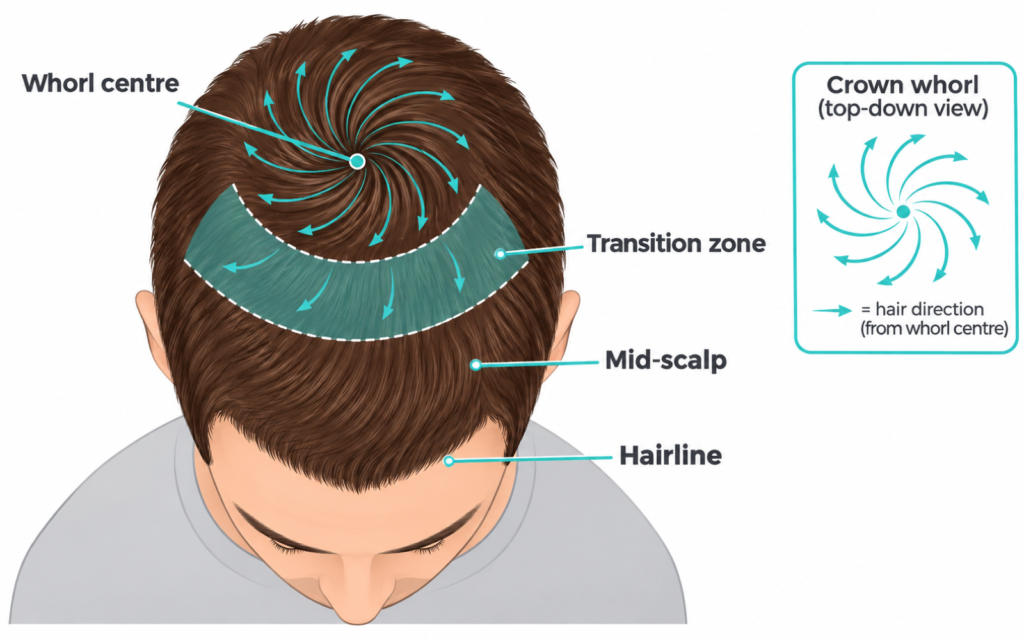
Your donor area is a fixed account. Nothing adds to it. Every graft taken for the crown is a graft unavailable for the hairline and mid-scalp in ten years, and the hairline is the area that frames your face in every mirror and every photograph taken from the front. Surgeons writing on candidacy warn specifically against using up donor supply to make the vertex thick in young patients whose loss is still progressing.
A working priority order many surgeons use:
| Priority | Zone | Why it ranks here |
|---|---|---|
| 1 | Frontal hairline | Frames the face, visible in every interaction, highest coverage value per graft |
| 2 | Mid-scalp | Connects the hairline back, low risk of isolated-island effect |
| 3 | Vertex transition zone | The forward edge of the crown, gives visual return before the whorl itself |
| 4 | Central whorl | Highest graft cost, lowest coverage return, most exposed to future loss |
If your donor supply is limited and you are asked to choose, the crown is the zone that waits. That is not a sales position. It is what the surgical literature says.
When Crown-First Does Make Sense
Some people genuinely are crown-first candidates. If your hairline is intact and stable into your late thirties or beyond, your family pattern points to vertex-only loss, and your donor density is strong, treating the crown can be a reasonable decision to make with your clinician. The younger you are, the weaker that argument becomes.
Who Is A Suitable Candidate?
Suitability for crown restoration rests on four things: a stable and clearly established pattern of loss, adequate donor density, an absence of active scalp disease, and expectations set at the right level. The final decision on suitability is always the treating clinician’s. A review of surgical candidacy in pattern hair loss sets out the main questions: is there a pattern to the loss, is there more than 50% loss in the area to be treated, is the scalp healthy, and is the donor hair good enough in quality and quantity?
Checklist to work through before your consultation:
- Age and stability: Pattern loss in younger men often progresses quickly, and surgery performed too early depletes donor supply before the final pattern is known. Surgeons are particularly cautious with men in their late teens and early twenties, and medical therapy with monitoring usually comes first.
- Degree of loss: Areas where the scalp clearly shows through have usually lost more than half of their native density. Below that threshold, medical treatment and monitoring are the recommended route.
- Miniaturisation in the recipient area: More than 15% miniaturisation in the crown puts you at risk of shock loss that may be permanent. Six to twelve months of medical therapy first is the standard approach.
- Donor density: Fewer than 60 follicular units per cm² in the donor region is considered low density, which limits what any surgeon can achieve.
- Diffuse unpatterned alopecia: If thinning involves the sides and back of the scalp as well as the top, there is no reliable safe zone, and medication, not surgery, is the treatment of choice.
- Scarring alopecias: Hair transplantation is not indicated in active scarring alopecias such as lichen planopilaris or discoid lupus. Transplanting into active disease carries a high risk of failure and can worsen the condition.
- Alopecia areata: Hair transplantation is generally not appropriate while alopecia areata is active. If this is your diagnosis, the right first step is a dermatologist, not a hair transplant clinic.
- General health: Your clinician will ask about medical conditions, medicines and smoking, because these can affect healing and graft survival.
If you fall outside these, that is worth knowing now instead of after you have committed to surgery.
How Many Grafts Does A Crown Transplant Need?
Crown graft numbers come from arithmetic, not from a price list. Surgeons measure the balding area in square centimetres and multiply by the density they plan to place. For example, at a planned density of 30 follicular units per cm², a 30 cm² crown needs roughly 900 grafts and a 60 cm² crown needs closer to 1,800. The number rises steeply because the crown expands outward in a circle, and the area of a circle grows with the square of its radius.
That last point explains why the crown has a reputation for consuming grafts. Widening a bald patch from 5 cm across to 8 cm across does not increase the area by 60%. It more than doubles it.
| Extent of crown loss | Approximate area | Planning range |
|---|---|---|
| Early whorl widening, scalp visible under light only | 10 to 20 cm² | 400 to 900 grafts |
| Defined bald patch, Norwood III vertex to IV | 25 to 40 cm² | 1,000 to 1,800 grafts |
| Large crown, merging toward mid-scalp, Norwood V to VI | 50 to 70 cm² | 2,000 to 3,000+ grafts, frequently staged |
Treat these as planning brackets for a conversation, not as quotes. Two people with identical bald areas need different numbers depending on hair calibre, curl, and the contrast between hair colour and skin tone. Coarse light-brown hair on fair skin covers considerably better than fine dark hair on the same scalp. If you are not sure where you sit, our guide to the Norwood scale explains the stages.
A note on density targets: chasing high density in the centre of the whorl is a mistake. The centre of a natural whorl shows scalp. Surgeons commonly place fewer, finer grafts at the pivot and build density outward, which is what makes a rebuilt spiral read as real.
Medication Before Surgery: The Crown Has The Strongest Evidence Base
If there is one piece of information crown patients rarely receive, it is this. The pivotal trials that established oral finasteride for male pattern hair loss measured their results at the crown. In two one-year trials of 1,553 men, with extension studies into a second year, hair counts were taken in a 5.1 cm² circle of balding vertex scalp. Finasteride-treated men had 107 and 138 more hairs than the placebo group at one and two years, while men taking placebo continued to lose hair.
In other words, the area where surgery gives the lowest coverage return per graft happens to be the area where medical therapy has the best-documented effect. That is a genuinely useful asymmetry, and it argues for treating the crown medically for a period before deciding on surgery: not instead of the consultation, but before it. Our guides to finasteride and minoxidil cover both medicines in more detail.
Two things need saying plainly alongside that.
Finasteride carries regulatory safety warnings in the UK. The MHRA has strengthened warnings for finasteride and dutasteride covering depression, suicidal ideation and sexual dysfunction, and it notes these effects may persist after treatment stops. Patient alert cards are included in UK finasteride packs. Prescribers are advised to ask about any history of depression or suicidal ideation before prescribing and to review patients regularly afterwards. Anyone taking finasteride 1 mg who develops suicidal thoughts or depression should stop the medicine and contact their prescriber as soon as possible. This is a decision for you and a doctor, and it is not one to make from a website.
Neither finasteride nor minoxidil is generally available on the NHS for pattern hair loss. The NHS notes that these treatments do not work for everyone and only work for as long as they are used. The British Association of Dermatologists’ patient information on male pattern hair loss is a good neutral starting point.
Your surgeon may ask you to pause topical minoxidil for a short time before surgery, and will tell you when to restart it once the recipient area has settled.
FUE, DHI Or Sapphire For The Crown?
All three are variations on follicular unit excision, and the choice matters less at the crown than the surgeon’s control of angle and direction. FUE has become the more commonly used approach because it avoids a linear donor scar and allows selective graft targeting, which suits the mixed graft sizes a whorl needs.
| Approach | How placement works at the crown | Where it helps | What to weigh |
|---|---|---|---|
| FUE | Recipient sites created first, grafts placed after | Large crowns, staged sessions, mixed graft sizes | Site creation is where the whorl is won or lost |
| DHI | Choi implanter makes the site and places the graft in one movement | Tight directional control in small areas, working around native hair | Slower per graft, so session sizes tend to be smaller |
| Sapphire | Sapphire blades create the recipient sites | Fine, closely spaced sites | A blade material, not a separate procedure |
The useful question to ask a surgeon is not which method they use. It is: where will you place the centre of the whorl, which way does it turn, and how will you handle the transition zone at its front edge? A surgeon who answers that fluently is the one you want.
Recovery: The First Month, Week By Week
Crown recovery follows the same schedule as any scalp transplant, with two differences worth planning for. The recipient area sits where your head touches a pillow, and it is the hardest part of the scalp to inspect yourself. A hand mirror and a second person help more than you would expect.
The timings below are typical. Your clinician’s own post-operative instructions always take priority, and the NHS advises being very careful with transplanted hair for the first two weeks, because the grafts are not yet secure.
| Period | What happens | What to do |
|---|---|---|
| Days 1 to 3 | Swelling and redness peak, grafts are at their most fragile | Sleep with the head elevated as instructed, keep the area moist as instructed, ice the forehead and never the grafts |
| Days 4 to 7 | Crusting forms, first washes begin | Wash gently as directed, no rubbing, avoid high-pressure water |
| Week 2 | Crusts clear with gentle washing, transplanted shafts start to shed | Return to normal washing gradually, no styling products yet |
| Weeks 3 to 4 | Recipient area looks bare again, this is expected | Avoid full immersion of the head, no direct sun on donor or recipient areas |
| Month 2 onward | Quiet phase, nothing visible is happening | Resume medical therapy as advised, keep the follow-up photos |
Other common points: no heavy lifting or strenuous activity in the early days, no cutting or colouring hair until your clinician says it is safe, and not smoking around the time of surgery gives the best healing conditions.
The shedding at week 2 catches people out every single time. Transplanted hairs often fall out after a few weeks and later grow back. Nearby native hairs sometimes shed too, which is shock loss. It is usually temporary, though it can be permanent where hairs were already heavily miniaturised, which is why medical therapy before surgery matters.
When To Contact Your Surgeon
Most recovery is uneventful. These are the signals that warrant a call rather than a wait. If your procedure was arranged through Longevita, contact your clinician’s support team (contact details are in your Appointment Schedule) promptly if you notice:
- Spreading redness, warmth or increasing pain in the donor or recipient area after the first few days, which points to infection
- Pus, or a fever
- Bleeding that does not stop with light, steady pressure
- A graft that has come loose, particularly in the first 72 hours
- Swelling that worsens after day four instead of settling
- Numbness or scalp hypersensitivity that persists well beyond the early weeks
If you are in the UK and unsure how urgent a symptom is, call NHS 111. Call 999 or go to A&E for breathing difficulty, facial or throat swelling, chest pain, or any symptom suggesting a severe allergic reaction. Do not wait for a clinic to open.
Growth Timeline: Why The Crown Reads As Slower
Transplanted crown hair follows the standard post-transplant schedule, but the visual payoff arrives later than it does at the hairline. Shedding happens within the first few weeks. The NHS says new hair usually starts to appear after about four months, and the full results should be seen after 10 to 18 months. At the crown, expect to be at the later end of that range.
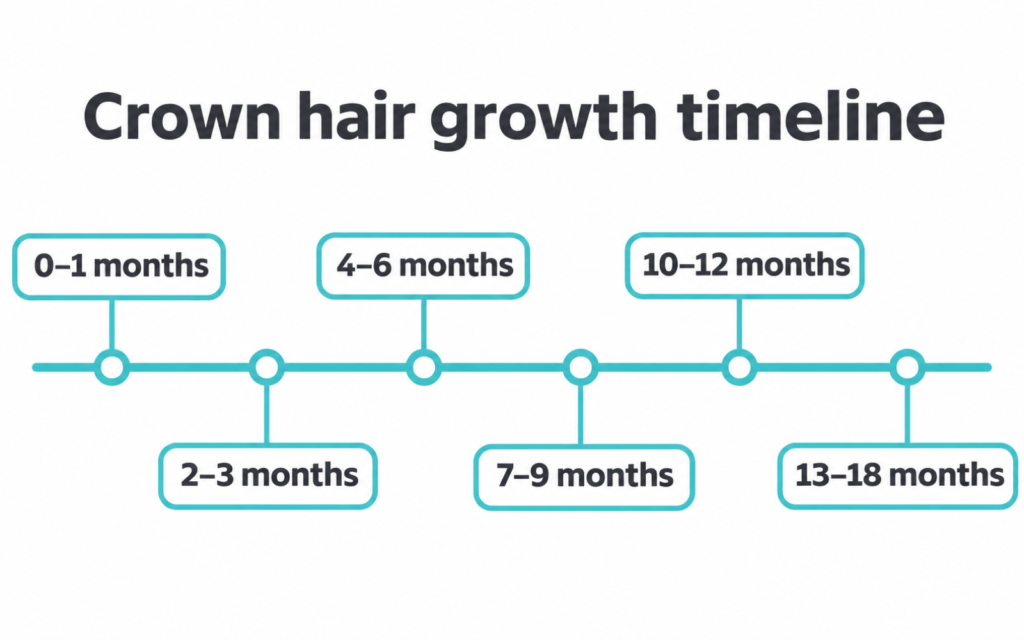
| Month | What is happening | What you will see |
|---|---|---|
| 0 to 1 | Grafts anchor, transplanted shafts shed | Bare crown, sometimes worse-looking than before |
| 2 to 3 | Follicles cycle into anagen | Little or nothing. This is the hardest stretch |
| 4 to 6 | Fine new hairs emerge, often thin and pale | Fuzz that catches the light, patchy coverage |
| 7 to 9 | Shafts thicken and gain pigment | Real change, though still uneven |
| 10 to 12 | Density fills in across the whorl | The result most people would call the outcome |
| 13 to 18 | Calibre and texture continue maturing | Softer, more natural flow, better light behaviour |
If your transplant covered the hairline as well, the front will look better sooner. That is normal and it is a matter of geometry, not graft quality. Judging a crown at month six is like judging a photograph while it is still developing.
Why Crown Results Disappoint, And How To Avoid It
Crown dissatisfaction rarely comes from technical failure. It usually comes from a planning decision made months earlier.
| What goes wrong | Underlying cause | Prevention |
|---|---|---|
| Doughnut effect | Vertex treated in isolation while surrounding loss progressed | Plan against your likely final pattern, treat the crown late |
| Density looks thinner than expected | Whorl geometry and dome curvature, not graft failure | Set expectations at "bald patch gone", not "teenage density" |
| Brush-like appearance | Recipient sites made at too steep an angle | Ask directly how the surgeon maps the whorl |
| Result judged a failure at month 6 | Crown maturation runs to 18 months | Compare against month 0 photos, not against memory |
| No grafts left for the hairline later | Donor budget spent on the crown early | Treat donor supply as a lifetime resource |
| Shock loss that does not recover | Significant miniaturisation in the recipient area before surgery | Medical therapy for 6 to 12 months first |
The most common regret we hear about is not the crown someone had treated. It is the hairline they could no longer treat afterwards. If a crown is already transplanted and you are weighing more surgery, our guide to a second hair transplant covers how remaining donor supply is assessed.
What It Costs In The UK And In Turkey
The NHS puts the cost of a hair transplant in the UK anywhere between £1,000 and £30,000, depending on the extent of hair loss, the type of procedure and the clinic. Crown cases are generally quoted either per graft or as a fixed price for a session, so a large crown treated in a single session sits towards the higher end. Clinic location, surgeon experience and the technique used all move the figure. Longevita isn’t arranging UK hair transplants at the moment; hair transplants are currently arranged with independent clinicians in Istanbul.
Treatment in Istanbul is usually considerably less expensive for the same graft count, which is why many UK patients consider travelling. Independent clinicians’ prices for FUE Hair Transplant arranged through Longevita in Turkey start from £1,650. You can see current prices on our price calculator, and our guide to hair transplant costs in Turkey explains what affects them.
If you are weighing up treatment abroad, the questions that matter are who performs the extraction and placement, how many patients the surgeon sees per day, what happens if you need a second session, and what support exists once you are back in the UK. Our guide to post-operative care after returning to the UK covers that last point. Price alone tells you very little.
Hair transplant surgery for pattern hair loss is not available on the NHS, because it is cosmetic surgery.
Alternatives And Additions Worth Knowing About
Surgery is not the only route, and for some people with crown thinning it is not the best one.
- Medical therapy alone: For early crown thinning, this is the most evidence-backed option, as the vertex trial data above shows. It requires ongoing use to maintain any benefit.
- Scalp micropigmentation: Pigment deposited in the scalp reduces the contrast between skin and hair, which makes a thin crown read as denser. It can be useful at the crown, where the problem is partly one of contrast. It is also a sensible companion to surgery when donor supply cannot cover the whole area.
- PRP: Used as an adjunct in some protocols. The evidence base is less settled than for finasteride and minoxidil, and it should be presented as supportive rather than as a treatment in its own right.
- Doing nothing: A shaved or closely cropped style suits many patterns of crown loss, and it costs nothing and carries no risk. It deserves to be on the list.
Myths And Facts: Crown Hair Transplant
| Myth | Fact |
|---|---|
| “The crown grows more slowly because the skin is thicker there.” | Not well supported. Growth follows the standard post-transplant cycle. The crown looks slower because its geometry needs more coverage before improvement is visible. |
| “A crown transplant is permanent.” | Transplanted follicles come from an androgen-resistant zone and keep their donor characteristics. The native hair surrounding them continues to follow its own course, so the overall appearance changes over time. No clinic can promise a fixed result. Our guide on how long hair transplants last explains why. |
| “Crown transplants have a 95% success rate.” | Figures like this circulate widely without a traceable source. Graft survival with modern technique is generally reported as high, but a single headline percentage tells you nothing about whether your crown will look the way you want it to. |
| “More grafts means a better crown.” | Packing the whorl centre densely produces an unnatural result and drains donor supply. Direction and gradient matter more than volume. |
| “You can have the crown done now and the hairline later.” | You can, if donor supply allows. Whether you should is the question, and the standard answer is to treat the hairline first. |
Frequently Asked Questions
Can you get a hair transplant on the crown?
Yes. The crown is a recognised recipient area and is treated routinely. The clinical debate is not about whether it is possible but about sequencing, since standard guidance advises against treating the vertex alone in someone whose pattern is still progressing.
How long does a crown transplant take to grow?
Expect shedding in the first few weeks, first regrowth from around month four, and the bulk of the result between months 10 and 12. The crown continues maturing to around 18 months.
Will one session be enough?
For a small, stable crown, often yes. Larger crowns are frequently staged across two sessions to protect donor supply and to see how the surrounding hair behaves.
Does the crown need more grafts than the hairline?
Usually, for two reasons. Crown bald areas tend to be larger by the time people act, and each graft delivers less apparent coverage on a domed, outward-radiating surface.
Can women have a crown transplant?
Female pattern loss is more diffuse and spares the hairline, which changes both the assessment and the design. It is assessed differently and requires confirmation that the donor area is unaffected. See our guide to female hair transplants.
Is the crown transplant painful?
The procedure is performed under local anaesthetic, sometimes with sedation. Discomfort afterwards is generally mild and manageable with the medication your clinician provides. Swelling in the first few days is common.
What if I have alopecia areata?
Hair transplantation is generally not appropriate while alopecia areata is active. Even after two or more years without active disease, the risk is reduced but not eliminated, because transplanted hair can still be affected. A dermatology assessment is the right route.
Thinking About Your Crown?
If you would like to talk through crown restoration in Istanbul, contact us or book a free Discovery Call with us. The independent clinician you choose will assess your donor area, decide whether you are suitable and give you a treatment plan and quote.
- Last Updated:

Dr Çağla Alkılıç
Hair transplant specialist (FUE, DHI and Sapphire) · Member of SANATDER and MESTDER
Last reviewed
Dr Cagla earned her medical degree at Trakya University’s Faculty of Medicine in Bulgaria and has almost 6 years of hair transplantation experience. She is a specialist in FUE, DHI and Sapphire hair transplants of the scalp, eyebrows and beard and has performed over 6,000 surgeries. Dr Cagla is multilingual, with fluency in English, Bulgarian and Turkish.
Request A Callback For A Discovery Call
With Longevita, you have the option to discuss your goals with us from the comfort of your couch.
- A UK-registered medical tourism facilitator
- Trusted by over 150,000 clients
- A free, no-obligation discovery call