
Hair Loss Treatments: What Works, What Doesn’t, And How To Choose
The first year of noticeable thinning matters more than any other, because almost every treatment on this page is better at keeping hair than at bringing it back. A follicle that is thinning can often be held. A follicle that has been dormant for a decade generally cannot. Anyone who understands that one point before they start spending is already ahead of most of the market.
What follows is an attempt to be straight about all of it: the handful of treatments with genuine clinical evidence behind them, the procedures with promising but incomplete data, the natural remedies that occupy an enormous amount of internet attention on very little research, and the products that are cosmetic rather than medical. Some of it is less exciting than the advertising suggests.
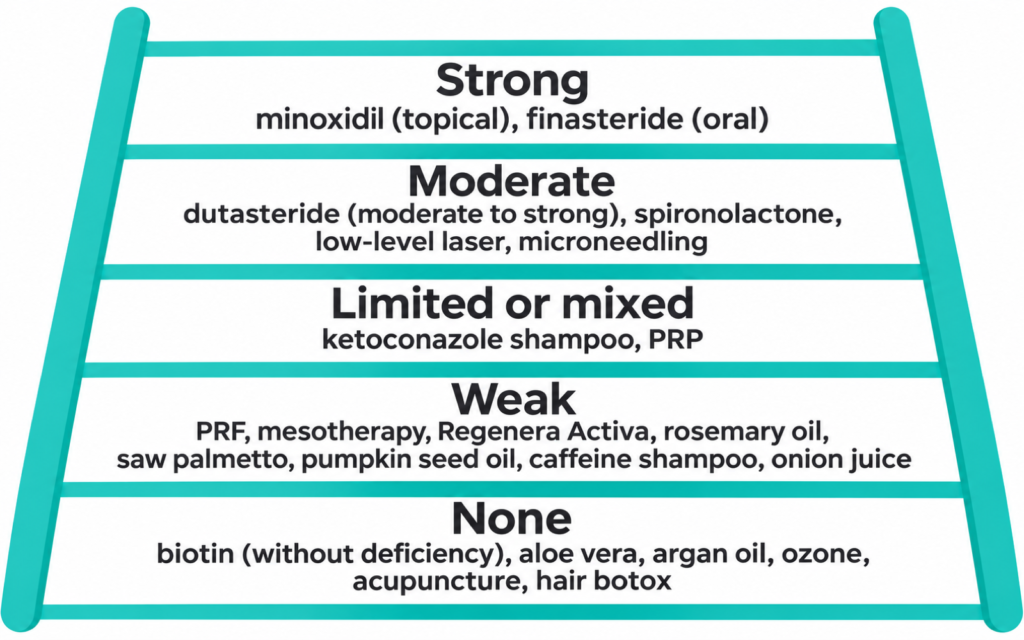
| Treatment | Evidence | Described as |
|---|---|---|
| Minoxidil (topical) | Strong | First-line, both sexes |
| Finasteride (oral) | Strong | First-line for men |
| Dutasteride | Moderate to strong | Off-label in the UK, more potent |
| Spironolactone | Moderate | Off-label, women only |
| Low-level laser therapy | Moderate | Adjunct, modest effect |
| Microneedling | Moderate | Adjunct, best combined with minoxidil |
| Ketoconazole shampoo | Limited | Adjunct, mild effect |
| PRP | Mixed | Adjunct, variable protocols |
| PRF, mesotherapy, Regenera Activa | Weak | Limited published data |
| Rosemary oil, saw palmetto, pumpkin seed oil | Weak | Single small trials |
| Caffeine shampoo, onion juice, green tea | Very weak | Laboratory or single-study evidence |
| Aloe vera, argan oil, hyaluronic acid | None for hair loss | Cosmetic or scalp-condition benefit |
| Ozone, acupuncture, hair botox, salmon PDRN | None established | Emerging or unsupported |
| Biotin (without deficiency) | None | No benefit if levels are normal |
| Hair fibres, prostheses | Not applicable | Cosmetic concealment, not treatment |
How Do You Choose The Right Hair Loss Treatment?
Most people approach this backwards. They start with the treatment, a shampoo a friend mentioned, a serum an advert followed them around with, and only later ask what is actually causing the problem. It is the equivalent of choosing a medicine before anyone has said what the illness is.
Getting the order right removes most of the difficulty. Diagnosis first, then the category of treatment, then the specific product. If you do not yet know why your hair is thinning, our hair loss guide covers causes and how they are identified, and it is a better use of the next twenty minutes than anything below.
Do You Need Surgery Or Non-Surgical Treatment?
The distinction that matters is not surgical versus non-surgical. It is whether the follicles in the area you care about are still alive.
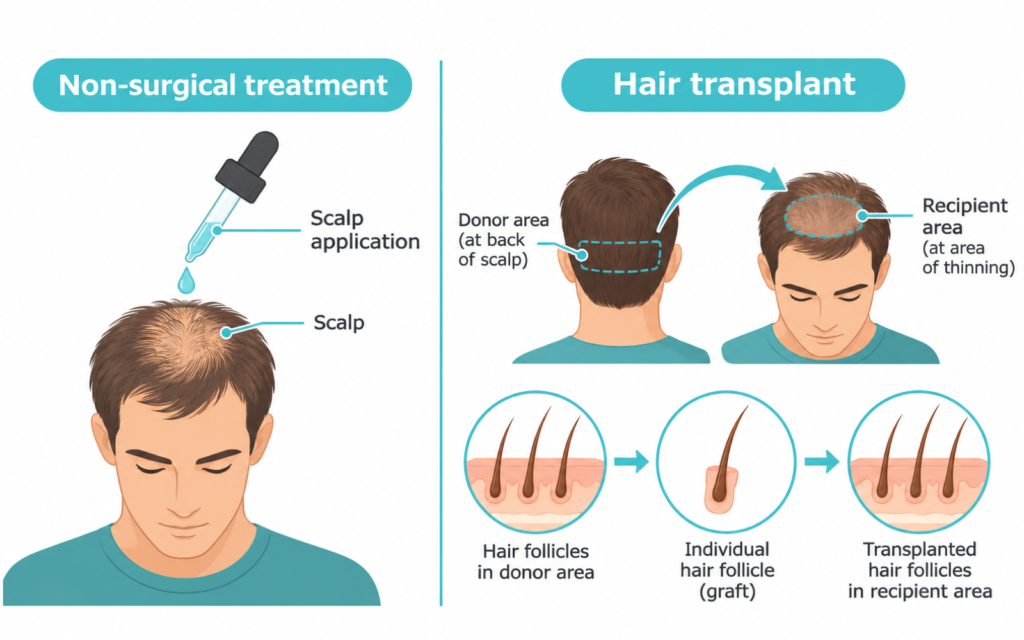
Medication and in-clinic procedures work on follicles that still function. They can slow miniaturisation, extend the growth phase and thicken hair that has become fine. What they cannot do is create a follicle where none remains. Once an area has been smooth and shiny for years, the follicles there are gone, and no topical, tablet or injection will bring them back.
Surgery does the opposite. It moves living follicles from an area of surplus to an area of shortage. It restores coverage where nothing is growing, and it does nothing whatsoever to protect the hair around it.
Which is why the framing of “medication or surgery” is misleading. For most people with progressive pattern hair loss, the realistic answer is both, in sequence: medication to hold what remains, surgery later to replace what has already gone. Someone who has a transplant and takes no steps to protect their native hair can find the hair around the transplanted area continuing to thin, and may end up considering further surgery. Our hair transplant guide covers the surgical side in depth.
| Non-surgical treatment | Hair transplant | |
|---|---|---|
| Works on | Living, miniaturising follicles | Areas where follicles have been lost |
| Main benefit | Slows or halts progression | Restores coverage |
| Effect on future loss | Reduces it while continued | None |
| Time to visible change | 4 to 12 months | 10 to 18 months |
| Ongoing commitment | Indefinite | One-off, though results depend on ongoing native-hair management |
| Best timing | As early as possible | Once loss is stable and diagnosed |
Which Treatment Works Best For Different Types Of Hair Loss?
Here is where most treatment advice falls apart. Almost everything written about hair loss treatment assumes pattern hair loss, and a large minority of people reading it do not have pattern hair loss at all. Minoxidil will not fix an iron deficiency. Finasteride will do nothing for traction alopecia. Neither will touch a scarring alopecia, which needs anti-inflammatory treatment and needs it quickly.
| Diagnosis | The treatment | What usually doesn’t help |
|---|---|---|
| Male pattern hair loss | Finasteride, minoxidil, or both | Shampoos and supplements on their own |
| Female pattern hair loss | Minoxidil; spironolactone in some cases | Finasteride is not routinely used |
| Telogen effluvium | Correcting the trigger; time | Anything applied to the scalp |
| Iron or nutritional deficiency | Correcting the deficiency, under supervision | Topical treatments |
| Thyroid-related loss | Treating the thyroid condition | Hair-specific products |
| Alopecia areata | Specialist care; immunomodulating treatment | Over-the-counter anything |
| Scalp ringworm (tinea capitis) | Prescription antifungal tablets and shampoo | Hair-growth products |
| Scarring alopecia | Urgent dermatology; anti-inflammatory treatment | Growth stimulants, which waste critical time |
| Traction alopecia | Removing the tension, early | Products, if the tension continues |
When Should You Start Treatment?
Earlier than feels necessary. That is the entire answer, and it is unwelcome, because the point at which treatment does the most good is the point at which the problem seems least urgent.
Think of it in terms of what each stage can still be saved. A follicle producing a slightly finer hair than it did three years ago is a follicle that treatment can hold, and sometimes partially restore. The same follicle after another decade of unchecked miniaturisation is producing almost nothing, and by the time it has stopped altogether, the tissue that supported it has been reabsorbed. Treatment does not reach that far back.
This creates an awkward decision. Starting early means committing to an indefinite treatment for a problem that is not yet visibly bad. Waiting until it is visibly bad means accepting a worse ceiling on what treatment can achieve. There is no version of this where you get to postpone the decision and lose nothing, and being told otherwise by someone selling a product is a reason to be sceptical of the product.
Two practical markers help. If you can see a difference between a photograph of yourself now and one from three years ago, the process is active. And if you are asking whether it is too early, it almost certainly isn’t.
The counterweight: none of this applies if you do not have a diagnosis. Starting a lifelong medication for a shedding episode that would have resolved by itself is its own kind of mistake.
Can Treatments Be Combined?
Combining is the norm rather than the exception, for a reason that becomes obvious once you look at how the main treatments work. Minoxidil acts on the growth cycle. Finasteride acts on the hormone driving miniaturisation. They address different points in the same process, which is why using both consistently produces better results than either alone in most published comparisons.
Sensible combinations follow that logic. Microneedling alongside topical minoxidil has small studies suggesting improved absorption and better outcomes than minoxidil alone. Low-level laser therapy is generally used as an addition to medication rather than a replacement for it. Ketoconazole shampoo sits alongside everything as a mild adjunct.
Combining also applies across the surgical line. PRP is frequently offered around transplant surgery, and medication is routinely continued afterwards to protect the hair that was not transplanted, a point covered in our hair transplant recovery guide, since the timing of restarting minoxidil after surgery is not obvious.
Where combining goes wrong is when it becomes accumulation. Six products, started simultaneously, with no way of knowing which one is doing anything, is a common and expensive pattern. Introduce things deliberately, give each a fair trial of several months, and keep photographs. Your treating clinician can tell you which combinations are reasonable for your situation; a checkout page cannot.
Which Hair Loss Treatments Have The Strongest Evidence?
Only a small number of treatments have been through the kind of testing that lets anyone speak about them with confidence. That does not make everything else useless, but it does mean the rest belongs in a different conversation, one about plausibility and personal tolerance rather than established effect.
This section covers all of it, grouped by what kind of thing each treatment actually is: the medications with a real evidence base, the procedures offered in clinics, the newer therapies still gathering data, and the natural remedies that dominate search results.
The Proven Medications
Longevita does not prescribe or supply medication. Speak to your GP, a pharmacist or a dermatologist about whether any of the medicines below suits you.
Minoxidil
Minoxidil began life as a blood pressure tablet, and the hair growth was a side effect nobody was looking for. That accidental origin explains something about how it works: it widens blood vessels and appears to extend the anagen phase, pushing follicles to grow for longer and producing thicker hairs from follicles that had begun to shrink.
It is available over the counter in the UK as a topical solution or foam, in two strengths, and it is one of the few treatments used in both men and women. The foam tends to be better tolerated than the solution, largely because the solution contains propylene glycol, which irritates a fair number of scalps.
Three things trip people up. The first is the shedding phase: a burst of increased hair loss in the first few weeks (usually between two and six weeks after starting), which is alarming, expected, and a sign the drug is pushing resting follicles into a new cycle. Stopping at that point, which many people do, wastes the whole attempt. The second is timing: little is visible in the first few months, and the British Association of Dermatologists advises using it for at least six months, and possibly up to twelve, before judging it. The third is permanence. Minoxidil holds hair while you use it. Stop, and the hair it was maintaining is lost over the following months, usually returning to where it would have been anyway. For more detail, see our minoxidil guide.
Oral minoxidil at low doses has become increasingly common in dermatology practice, prescribed off-label, and suits people who find the topical version impractical. It is not a self-prescribing situation, since it retains its cardiovascular effects.
Finasteride
Where minoxidil works on the growth cycle, finasteride works on the cause. It inhibits the enzyme that converts testosterone into DHT, lowering scalp DHT substantially and slowing the miniaturisation process that produces pattern hair loss in the first place.
The evidence in men is about as good as it gets in this field: consistent, replicated, and showing that most men maintain or improve their hair over several years of use, with the strongest effect at the crown. In the five-year crown studies, 48% of men taking finasteride improved and a further 42% stayed the same. It is prescription-only in the UK, available for hair loss on private prescription rather than the NHS, and taken as a daily tablet. Our finasteride guide covers it in more detail.
Side effects are the reason many men hesitate, and they deserve a straight account rather than either dismissal or alarm. A minority of users report sexual side effects, reduced libido, erectile difficulties, reduced ejaculate volume, which in trials occurred at low single-digit percentages and typically resolved on stopping. There has been longstanding debate about whether symptoms can persist after discontinuation, and UK regulators have updated the safety information in recent years. The MHRA now warns that finasteride is associated with depression, suicidal thoughts and sexual dysfunction that may persist after treatment is stopped, and advises anyone taking finasteride 1mg who develops depression or suicidal thoughts to stop taking it and contact their doctor as soon as possible. That is a conversation to have properly with a prescriber before starting, not a reason to make the decision from a forum.
One firm safety point: finasteride is not prescribed to women who are or may become pregnant, and crushed or broken tablets should not be handled by them, because of the risk to a male foetus.
Minoxidil Vs Finasteride: Which Should You Use?
The question is put as an either/or far more often than it should be, since the two do genuinely different jobs and are frequently prescribed together.
| Minoxidil | Finasteride | |
|---|---|---|
| How it works | Extends the growth phase; improves blood supply | Reduces DHT, slowing miniaturisation |
| Form | Topical solution or foam; oral off-label | Oral tablet |
| Availability (UK) | Over the counter | Prescription only |
| Suitable for | Men and women | Men; not women of childbearing potential |
| Strongest effect | Vertex and general thinning | Crown, with hairline benefit over time |
| Main drawbacks | Daily application; scalp irritation; initial shed | Systemic effects; small risk of sexual and mood side effects |
| On stopping | Gains lost within months | Gains lost within a year |
A reasonable rule of thumb: if you are a man with progressive pattern loss, finasteride addresses the mechanism and minoxidil supports the growth, and using both is the approach with the best supporting data. If you are a woman, minoxidil is the starting point and the anti-androgen conversation looks different.
Dutasteride
Dutasteride is finasteride’s more aggressive relative. It inhibits both type I and type II 5-alpha reductase rather than type II alone, which produces a greater reduction in DHT and, in head-to-head studies, somewhat better hair outcomes, although the British Association of Dermatologists notes that an advantage over finasteride has not been convincingly shown.
The complication is regulatory. In the UK, dutasteride is licensed for benign prostatic hyperplasia, not for hair loss, so any use for hair is off-label. Some countries, including South Korea and Japan, license it specifically for androgenetic alopecia. It also has a much longer half-life than finasteride, around three to five weeks, meaning it stays in the system for months after stopping rather than days, relevant both for side effects and for anyone planning a pregnancy. As a precaution, the MHRA is adding a warning to dutasteride’s product information that depression and suicidal thoughts have been reported with finasteride, the medicine in the same class.
It tends to enter the conversation when finasteride has been tried properly and the response has been disappointing.
Spironolactone
Spironolactone is a diuretic with anti-androgen activity, used off-label for female pattern hair loss and particularly where there are signs of androgen excess, such as in PCOS. It blocks androgen receptors and reduces androgen production, which addresses the same mechanism finasteride targets in men by a different route.
It is prescription-only, requires monitoring of blood pressure and potassium, and is not suitable in pregnancy. It is not generally used in men for hair loss because of its feminising effects. For women who have tried minoxidil without adequate response, it is one of the main next conversations to have with a dermatologist.
Ketoconazole Shampoo
Ketoconazole is an antifungal shampoo used primarily to treat dandruff and seborrhoeic dermatitis. In the UK, 2% ketoconazole shampoos are available in pharmacy formulations for these conditions.
Its relevance to hair loss is twofold. Scalp inflammation makes hair loss worse, so treating it removes an aggravating factor. And there is some evidence of mild anti-androgenic activity at the scalp, though the studies are small and old enough that nobody should build a strategy around them.
Think of it as housekeeping rather than treatment: useful if you have a flaky, inflamed or itchy scalp, harmless if you don’t, and no substitute for anything above.
Treatments For Alopecia Areata
Alopecia areata is an autoimmune condition, so the treatments for pattern hair loss above do not apply to it. It is managed by specialists, and the options depend on how extensive it is.
- Steroid injections into the patches are one of the longest-established treatments for limited, patchy alopecia areata. In one study, 62% of patients had regrowth at 12 weeks, against 7% with saline. They are not suitable for rapidly progressing disease or for alopecia totalis or universalis, and they can thin the skin at the injection site.
- JAK inhibitors are the biggest change in this area in years. Taken as daily tablets, they block the signalling that drives the immune attack on the follicle. In England, NICE recommends ritlecitinib for severe alopecia areata in people aged 12 and over, but does not recommend baricitinib for NHS use. They are for severe disease, not mild patches, and need specialist monitoring.
- Contact immunotherapy with diphenylcyclopropenone (DPCP) deliberately provokes a mild allergic reaction on the scalp. Response rates have been reported at around 60% in severe alopecia areata, falling to 17% in alopecia totalis or universalis.
Our alopecia areata guide covers the condition itself.
In-Clinic Procedures
Procedures occupy an odd position in hair restoration. They are more expensive than medication, more impressive to look at, and generally supported by weaker evidence. That combination is worth holding in mind when a clinic proposes a course of six sessions.
None of the treatments below is a replacement for medication in someone with pattern hair loss. Used as additions, several of them are reasonable. Used instead of the things that work, they are an expensive delay.
PRP Therapy
PRP is an injectable adjunct rather than a first-line foundation for treating pattern hair loss. Protocols vary considerably, and the size and duration of any benefit remain uncertain. Our PRP hair loss treatment guide gives a fuller explanation of the evidence and practical limitations, and the PRP section of our hair transplant guide covers its use alongside surgery.
PRF Therapy
Platelet-rich fibrin is the newer sibling: spun more gently and without anticoagulant, producing a fibrin matrix that releases growth factors more slowly. In principle that sustained release is an improvement.
In practice, PRF has considerably less published data behind it than PRP, which itself has mixed data. It is often priced higher on the strength of being newer. That is not, on its own, a reason to choose it.
Hair Mesotherapy
Mesotherapy delivers a cocktail of vitamins, minerals and other agents into the scalp by microinjection. The formulations are proprietary and vary widely between providers, which makes the treatment almost impossible to study properly: every clinic is effectively offering a different intervention under the same name.
Published evidence is thin. If you are considering it, the questions worth asking are what exactly is in the injection and what evidence exists for that specific formulation.
Regenera Activa
Regenera Activa takes small punch biopsies from the scalp, processes the tissue mechanically to produce a suspension of cells and growth factors, and injects it into thinning areas. It is often marketed with the word “stem cell” nearby, which sets expectations the procedure does not meet. Our guide to stem cell hair transplants looks at what that evidence actually shows.
The published evidence is limited to small studies, mostly without long-term follow-up. It may have a role as an adjunct. It is not the regenerative breakthrough the branding sometimes implies.
Low-Level Laser Therapy
LLLT, delivered by caps, combs and in-clinic devices, uses red light at specific wavelengths, apparently acting on cellular energy production in the follicle. Several devices have regulatory clearance in the US and there are randomised trials showing modest improvements in hair count or thickness.
It works a bit, for some people, slowly, and it requires consistent use over months. Home devices are expensive up front and cost nothing to run; clinic courses cost repeatedly. As an addition to medication for someone who wants to do more, it is defensible. As a standalone answer to advancing pattern loss, it is not.
Microneedling
Rolling or stamping fine needles across the scalp creates controlled micro-injury, which triggers a wound-healing response and appears to improve absorption of anything applied afterwards. Small studies combining microneedling with topical minoxidil have shown better results than minoxidil alone, which is the most interesting finding in this group.
Technique matters more here than with anything else in this section. Needle length, frequency, hygiene and timing relative to applying minoxidil all affect both safety and outcome, and applying minoxidil to freshly needled skin increases absorption in ways that are not always desirable.
Emerging And Unproven Procedures
A separate category, because the difference between “we do not yet have good evidence” and “we have evidence it does not work” is one that marketing tends to blur.
Ozone therapy applies ozone gas to the scalp on the theory that it improves oxygenation and reduces inflammation. It attracts a great deal of search interest and has essentially no controlled evidence in hair loss.
Acupuncture is sometimes offered for alopecia areata and for stress-related shedding, and the mechanistic argument, circulation, stress reduction, is not absurd. The trials are small, poorly controlled and mostly not replicated.
Hair botox is a misleading name for a deep conditioning treatment containing no botulinum toxin. It smooths and strengthens the hair shaft. It has nothing to do with hair growth, and confusion between the two is common enough to be worth stating plainly.
Salmon PDRN, polydeoxyribonucleotides derived from salmon DNA, is among the newer entrants, borrowed from skin regeneration medicine. Early interest is genuine; the evidence base in hair loss is at a very early stage.
If any of these appeals, the sensible framing is that you are trying something experimental alongside treatment that works, not instead of it.
Natural And Over-The-Counter Treatments
This is where the internet spends most of its energy, and where the ratio of attention to evidence is at its most extreme. Some of these have a single small study behind them. Most have none. A few are genuinely useful for the scalp without doing anything for hair growth, which is a distinction almost no product page makes.
| Remedy | What the evidence shows |
|---|---|
| Rosemary oil | One 2015 trial of 100 people found it comparable to 2% minoxidil over six months. A single study, with methodological limitations, and not convincingly replicated. The most interesting result in this group and still not enough to build a plan on |
| Saw palmetto | Proposed as a natural 5-alpha reductase inhibitor. A handful of small trials suggest modest effect, far below finasteride. Oral and topical forms differ |
| Pumpkin seed oil | One small trial in 76 men showed improvement over placebo after 24 weeks. Not replicated at scale |
| Onion juice | A small 2002 study of 38 people with alopecia areata, not pattern loss. The smell is the least of the problems with generalising from it |
| Caffeine shampoo | Caffeine affects follicles in laboratory conditions. Whether a shampoo rinsed off after two minutes delivers a meaningful dose is the unanswered question |
| Green tea | Laboratory and animal work on EGCG. No convincing human trials for hair loss |
| Aloe vera | Soothing, anti-inflammatory, useful for an irritated or flaky scalp. No evidence for regrowth |
| Argan oil | Conditions the hair shaft, reduces breakage. Does nothing at the follicle |
| Hyaluronic acid | Hydrating for the scalp. No mechanism by which it would address hair loss |
| Scalp scrubs | Remove build-up. Useful for scalp comfort; over-exfoliation causes its own problems |
Three points are worth drawing out of that table, because they apply well beyond the individual products.
The first concerns breakage versus loss. Argan oil, conditioning treatments and gentler handling genuinely help hair that is snapping mid-shaft, and hair that stops breaking looks thicker. That is a real improvement and it is not hair growth. Confusing the two leads people to conclude a product worked when what changed was the length of their existing hair.
The second concerns rosemary oil specifically, since it comes up constantly. One reasonably designed trial against a low-strength minoxidil is a legitimate finding and a poor foundation for a treatment decision. Both groups in that study improved modestly; neither transformed. Anyone presenting it as a natural equivalent to prescription treatment has read the headline rather than the paper.
The third is about opportunity cost, which is the real risk in this category. Nothing here is likely to harm you. What harms you is spending eighteen months on a rotating cast of oils while miniaturisation continues unchecked, and arriving at a treatment that works with less hair left to save.
Hair Regrowth Serums
Serums are a category rather than a treatment, and the only sensible way to assess one is to ignore the branding and read the active ingredients. If a serum contains minoxidil, it is minoxidil, and should be judged as such. If its actives are peptides, caffeine, botanical extracts and biotin, then the evidence for it is the evidence for those ingredients, which is generally thin.
Price signals nothing here. A £60 serum with no evidence of activity is not better than a £15 bottle of minoxidil foam.
Scalp Massage
Mechanical stimulation of the scalp has one small Japanese study behind it, in which nine men who used a scalp massage device for four minutes a day over 24 weeks showed increased hair thickness. The proposed mechanism, stretching forces on the dermal papilla altering gene expression, is plausible and interesting.
It costs nothing, carries essentially no risk, and might help slightly. That is a reasonable basis for doing it and no basis at all for relying on it. If you have had a transplant, timing matters and the recipient area should be left alone for at least a month, which our hair transplant recovery guide covers.
Which Supplements Help Hair Growth?
The supplement aisle operates on a simple and largely mistaken premise: that if a nutrient is required for hair growth, taking more of it will produce more hair. Nutrition works the other way round. A deficiency causes a problem, and correcting the deficiency fixes it. Going beyond sufficiency achieves nothing, and with a few nutrients it causes harm.
Which makes the useful question narrow. Not “which supplement helps hair growth” but “am I short of anything, and how would I know”. The answer to the second half is a blood test rather than a guess.
Vitamins And Minerals For Hair Growth
Several deficiencies genuinely cause hair loss, and they are common enough to be worth ruling out before spending on anything else.
- Iron is the most frequent, especially in menstruating women, and the relevant measure is ferritin rather than haemoglobin: you can be iron-deficient for hair purposes while your full blood count looks unremarkable. Levels sitting at the bottom of the normal range are worth discussing rather than dismissing.
- Vitamin D deficiency is widespread in the UK for straightforward geographical reasons and has been associated with several forms of hair loss.
- Zinc deficiency causes shedding but is less common outside specific circumstances such as malabsorption or restrictive dieting.
- Protein intake matters more than people expect, since hair is largely keratin, and rapid weight loss or very restricted eating shows up in the hair a few months later.
- B12 is worth checking in vegans and in anyone with absorption issues.
Two nutrients are worth knowing about for the opposite reason. Excess vitamin A causes hair loss, and so does excess selenium (review of vitamins and minerals in hair loss). Both appear in hair supplements. Taking several products at once, each containing a proportion of the recommended intake, is a realistic way to overshoot without noticing.
The practical approach: get tested, correct what is low under supervision, and ignore the rest.
Does Biotin Help With Hair Loss?
Biotin is essential for normal hair production, but supplementation is mainly relevant when a genuine deficiency is present. Taking additional biotin has not been shown to improve hair growth in people who already obtain enough. See the biotin section of our hair transplant recovery guide for the evidence, its relevance after a hair transplant and important blood-test considerations.
Hair Growth Gummies
Gummies are usually a multivitamin with biotin as the headline ingredient, sold at a considerable premium, in a format that requires added sugar to work as a sweet. If the nutrients in them would have helped you, an ordinary tablet would have helped you for less.
They are not dangerous in themselves. The problem is what they displace: someone taking gummies for eight months and seeing no change has usually spent that time not investigating why their hair is thinning.
Which Treatments Do Not Work?
A necessary caveat before the list, because the heading is blunter than the reality. Some of what follows works perfectly well at what it actually does. It just does not do what people buying it often think it does.
The distinction is between treatment, which changes what your follicles produce, and concealment, which changes how your hair looks without affecting the underlying process. Concealment is a legitimate choice: it is instant, reversible, and for some people the right answer entirely. It becomes a problem only when it is bought as treatment, or when it delays a diagnosis.
Hair Prostheses And Hair Systems
Modern hair systems are considerably better than their reputation, and for someone with extensive loss, poor donor supply, or no appetite for surgery, a well-fitted system can produce a convincing result immediately, which nothing else on this page can offer.
The trade-offs are ongoing rather than dramatic. Systems require regular maintenance, replacement, and a relationship with whoever fits them. Adhesives and clips can irritate the scalp, and attachment methods that pull on existing hair can cause traction alopecia over time, an unwelcome outcome for someone whose remaining hair matters.
The decision usually comes down to temperament: whether an immediate result with permanent upkeep suits you better than a slow result with none.
Hair Fibres, And How They Compare With Surgery
Keratin fibres cling to existing hairs and to the scalp, filling in the visual gaps. They are cheap, they take thirty seconds, and in photographs they can be remarkably effective.
They also do nothing at all to your hair. They wash out, they need reapplying daily, they behave unpredictably in heavy rain or at the gym, and they need enough existing hair to cling to, which means they work well for diffuse thinning and poorly for a bald crown.
Comparing fibres with a transplant is comparing a daily cosmetic routine with a one-off surgical procedure, and the honest framing is that they answer different questions. Fibres solve tonight. Surgery solves the next decade, for people who are suitable candidates. Plenty of people use fibres while waiting to become suitable, which is a perfectly sensible position.
Scalp Micropigmentation
Scalp micropigmentation is a form of tattooing that deposits pigment into the scalp to look like closely cut hair. It treats nothing, but it camouflages well: on a fully shaved head it creates the look of a buzz cut, and with partial thinning it can make the existing hair look denser. It is long-lasting, so it deserves the same considered approach as any tattoo.
What genuinely does not work
Products claiming to regrow hair on areas that have been bald for years. Shampoos marketed as treatments for pattern hair loss on their own. Anything promising results in weeks. Any treatment sold without asking what is causing your hair loss.
Key Takeaways
- Almost every treatment here holds hair better than it regrows it, so starting early matters more than choosing perfectly.
- Only a handful of treatments have strong evidence: minoxidil and finasteride for pattern loss, and JAK inhibitors for severe alopecia areata.
- The MHRA warns that finasteride is associated with depression, suicidal thoughts and sexual side effects that may persist after stopping, and dutasteride’s product information is being updated with a precautionary mood warning. That is a prescriber conversation, not a forum one.
- Procedures are generally adjuncts with weaker evidence than their price suggests. PRP has a plausible mechanism and inconsistent protocols.
- Natural remedies are mostly harmless and mostly unproven. The real cost is the time spent on them while loss continues.
- Supplements correct deficiency and do nothing beyond it.
Frequently Asked Questions
What is the most effective treatment for hair loss?
There is no single most effective treatment for every type of hair loss. Minoxidil and finasteride have strong evidence for pattern hair loss in suitable patients, while JAK inhibitors may be considered for certain forms of severe alopecia areata. Hair loss caused by a deficiency, inflammatory condition or medication requires treatment of the underlying cause. Effectiveness therefore depends on an accurate diagnosis rather than choosing the most heavily marketed option.
Can hair loss be reversed without surgery?
Sometimes. Temporary hair loss caused by illness, nutritional deficiency, hormonal change, medication or physical stress may improve when the trigger is addressed. Pattern hair loss is usually managed rather than permanently reversed: treatment may slow its progression and improve miniaturised follicles, but it cannot restore follicles that are no longer capable of producing hair.
How long do hair loss treatments take to work?
Most evidence-based hair loss treatments require consistent use for several months before their effect can be assessed. The timeline varies according to the diagnosis and treatment, and some people experience temporary shedding during the early stages. Progress should be assessed with consistent photographs over time rather than day-to-day changes, and stopping an effective treatment may allow the underlying hair-loss process to resume.
Can different hair loss treatments be combined?
Yes, when each treatment has a clear purpose. A clinician may combine treatments that work in different ways, such as using medication to protect existing hair while considering another treatment for additional support. More treatments do not automatically produce a better result, and possible side effects, interactions, cost and the evidence for each component should be considered.
When should a hair transplant be considered?
A hair transplant may be considered when the cause of hair loss has been identified, the loss is suitable for surgery and the donor area can support a safe, realistic plan. It is not the appropriate next step for every type of shedding, particularly when the underlying condition is active, temporary or medically treatable. Our hair transplant guide explains what surgery involves. If you would like to explore a hair transplant in Turkey, you can contact us or book a free Discovery Call with us; whether you are suitable is decided by the independent clinician.
- Last Updated:

Dr Çağla Alkılıç
Hair transplant specialist (FUE, DHI and Sapphire) · Member of SANATDER and MESTDER
Last reviewed
Dr Cagla earned her medical degree at Trakya University’s Faculty of Medicine in Bulgaria and has almost 6 years of hair transplantation experience. She is a specialist in FUE, DHI and Sapphire hair transplants of the scalp, eyebrows and beard and has performed over 6,000 surgeries. Dr Cagla is multilingual, with fluency in English, Bulgarian and Turkish.
Request A Callback For A Discovery Call
With Longevita, you have the option to discuss your goals with us from the comfort of your couch.
- A UK-registered medical tourism facilitator
- Trusted by over 150,000 clients
- A free, no-obligation discovery call