
Female Pattern Hair Loss (Female Pattern Baldness)
Key Takeaways:
- Female pattern hair loss thins the hair across the top and crown while usually leaving the frontal hairline alone. It rarely causes baldness.
- Prevalence climbs with age, from around 12% of women by 29 to more than half by 79, with the sharpest rise after the menopause.
- Shedding and thinning are different complaints with different causes, and heavy shedding usually points to telogen effluvium rather than pattern loss.
- An itchy, burning or tender scalp is not a feature of pattern loss and should be assessed within weeks.
- Topical minoxidil is the only UK-licensed treatment, needs 12 to 24 weeks before it can be judged, and works only while it is being used.
- Finasteride is not licensed for women, was no better than placebo in the trials that included them, and carries strengthened MHRA warnings.
- Supplements help only where a deficiency is confirmed. The popular ferritin targets are expert opinion, not trial evidence.
- Transplant suitability depends on donor stability rather than how thin the top is, and a large proportion of women are not candidates.
- Treatment holds better than it restores, which makes an early and accurate diagnosis the most valuable thing available.
Women almost never go bald. Nearly every page written about female hair loss borrows its vocabulary from male balding, and the borrowing is where the confusion begins.
What happens instead is that follicles across the top of the scalp shrink. They carry on producing hair, only finer and shorter with each cycle, until the scalp starts showing through hair that is technically still there. The part widens. The ponytail loses its weight. The hairline at the front usually stays exactly where it was, which is the reason most women spend a year telling themselves it is the bathroom lighting.
A widening part proves nothing on its own, though. Several other conditions produce the same view from above. Some of them reverse by themselves, one of them needs to be looked at within weeks, and working out which one you have costs nothing.
Key Facts
| What it is | Progressive miniaturisation of scalp follicles causing diffuse thinning over the top of the head |
|---|---|
| Also called | Female androgenetic alopecia, female pattern baldness |
| Where it shows | The central part first, then the crown. The frontal hairline is usually kept |
| Who it affects | Around 12% of women by 29, 25% by 49, over half by 79 |
| Graded with | The Ludwig scale, three stages. Also Savin and Sinclair |
| Licensed treatment in the UK | Topical minoxidil, women aged 18 to 65 |
| Available on the NHS | The investigation, generally not the treatment |
| What it is not | Shedding, and not a condition that causes pain, itch or burning |
What Is Female Hair Loss?
It is the most common cause of hair loss in women, and it works by shrinking follicles rather than killing them. Each cycle, the affected follicle produces a hair slightly finer and slightly shorter than the last, and the growing phase itself shortens. Thick terminal hairs turn into vellus hairs, the soft short ones you can barely see. Nothing dramatic falls out. The scalp simply starts to show.
That mechanism explains why the early stage is so easy to miss. Your brush is not fuller than it used to be, because the number of hairs on your head may not have changed much at all. Your ponytail is thinner even though your hairline looks untouched, because volume comes from calibre and you have lost calibre rather than count.
The other name for it, female androgenetic alopecia, has always been a slight overstatement. Hair loss is genuinely a feature of androgen excess in women. But a large proportion of women with textbook pattern loss have normal androgen levels, normal periods, no acne and no unwanted facial hair. UK dermatology has been careful about this for over 20 years, which is why “female pattern hair loss” has mostly replaced the older term. If a clinic tells you your hair loss is definitely hormonal without running any tests, it’s worth asking what that assessment is actually based on.
Female pattern hair loss is a gradual thinning process in which individual hairs become finer and shorter over successive growth cycles. It usually affects density across the top of the scalp and may occur even when androgen levels are normal.
How Common Is Female Hair Loss?
It is far more common than most women realise, and it becomes more common with every decade. The most useful UK-relevant dataset comes from Birch, Messenger and Messenger, who examined hair density and diameter in Caucasian women and reported prevalence figures that have been quoted ever since. Around 12% of women have clinically detectable FPHL by the age of 29, roughly 25% by 49, about 41% by 69, and more than half by 79.
Two things are worth pulling out of those numbers. The first is that this is not an old woman’s condition: 1 in 8 women has detectable pattern loss before thirty. The second is that the steepest climb happens around and after the menopause, which is why the perimenopausal years generate so many first consultations.
Comparisons with men are commonly made and are not especially helpful. Up to 80% of Caucasian men and around 42% of women show some pattern hair loss over their lifetime, but the male figure includes a lot of extensive loss and the female figure almost never does. The conditions differ in visible outcome, not just in frequency.
What Does Female Pattern Hair Loss Look Like?
Part your hair down the middle, stand under a decent light, and look at the strip of scalp showing through. In pattern loss that strip is wider at the front than at the back, roughly triangular, and it gets wider over years. Hair along the front edge and at the temples is usually still there.
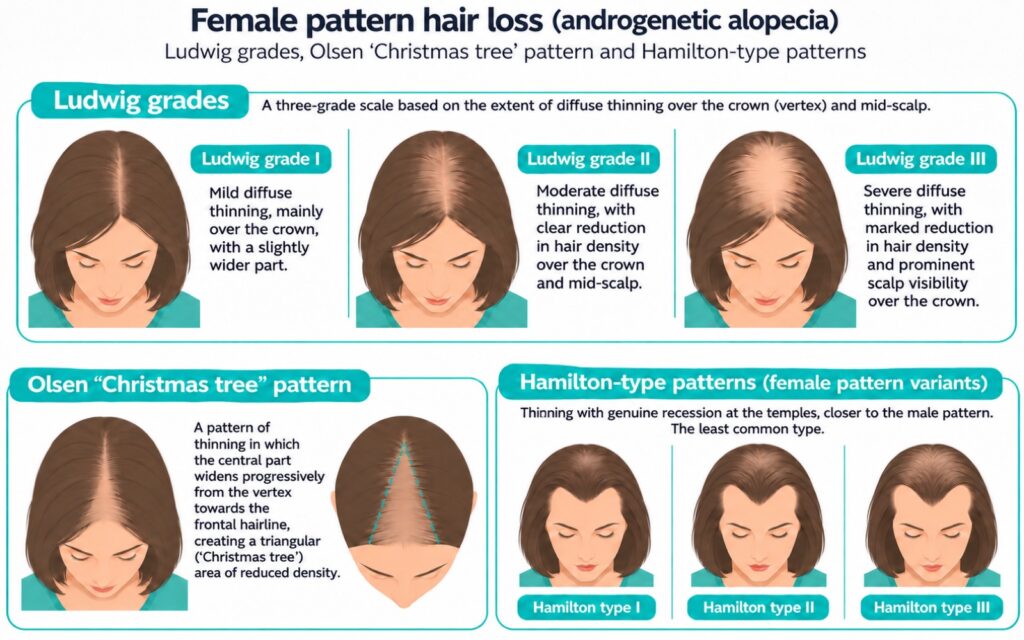
3 presentations are described, and plenty of women show features of more than one.
| Pattern | What you see | Notes |
|---|---|---|
| Ludwig | Diffuse thinning across the crown and mid-scalp, frontal hairline kept | The classic presentation and the most common |
| Christmas tree (Olsen) | Thinning widest at the front of the part, narrowing towards the crown | Often the earliest visible sign. Only obvious with a centre parting |
| Hamilton type | Thinning with genuine recession at the temples, closer to the male pattern | Least common. The one most likely to prompt hormone testing |
In one series of 519 women in Thailand, the Ludwig pattern accounted for just over half of cases, the Olsen pattern for about a third, and the Hamilton pattern for around a sixth. That last group also showed more early onset, more menstrual irregularity and more polycystic ovary syndrome. It is a signal worth acting on, not a diagnosis in itself.
The most useful thing you can do at home is photograph the top of your head in daylight, the part where you normally part it, from directly above, and then do it again in 6 months under the same conditions. Change is what matters. A single photograph tells you almost nothing, and neither does an online stage-picker, because the top of your head is the one part of you that you never see directly.
The Ludwig Scale And The Other Grading Systems
Elisabeth Ludwig published a three-stage classification in the British Journal of Dermatology in 1977, and it is still the system most UK clinicians reach for. All three stages describe thinning over the crown with the frontal fringe retained.
| Grade | What is visible |
|---|---|
| I | Perceptible thinning on the crown, still covered by styling. The part is a little wider than it was |
| II | Pronounced thinning, scalp clearly visible through the hair |
| III | Full or near-full loss across the crown and top, frontal band still present |
3 grades is not many. A woman can spend a decade moving through the back half of Grade I without the scale registering any of it, which is a real problem when the whole question is whether anything is changing. The Savin scale adds finer density gradations and a separate illustration for frontal recession. The Sinclair scale uses 5 grades built around the width of the central part, which maps better onto what women actually notice. BASP is more detailed than any of them and fiddly enough that it mostly lives in research papers.
Shedding Is Not Thinning, And The Difference Decides Everything
This is the distinction that gets missed most often, and getting it wrong is how women end up treating the wrong condition for a year.
Shedding means more hair than usual is leaving your head. You see it in the plughole, on the pillow, in your hands after washing. Normal is somewhere between 50 and 100 hairs a day and nobody can tell 90 from 150 without counting them, which is why almost everyone who thinks they are shedding heavily is judging it against a memory rather than a number.
Thinning means the hair still on your head is finer and covers less. The amount coming out can be completely normal. Your ponytail is narrower, your part is wider, and your brush looks the same as it always did.
Female pattern hair loss is a thinning condition. It can produce a modest increase in shedding while it is progressing, but heavy shedding as the main complaint usually points somewhere else, most often to telogen effluvium. Ask yourself which of the two you are actually describing before you buy anything, because the answer changes the entire plan.
The two also coexist constantly, which is where it gets genuinely difficult. A heavy shed strips out hair that was thinly covering an area that had been quietly thinning for years, and pattern loss that was invisible becomes obvious over a few weeks. Women in that situation describe it as sudden. It was not sudden. The shedding was sudden and the thinning underneath it was not, and only one of those two things is going to settle on its own.
What Else It Might Be
| Condition | How it usually presents | What separates it from pattern loss |
|---|---|---|
| Telogen effluvium | Diffuse shedding starting 2-3 months after a trigger: illness, childbirth, surgery, severe stress, crash dieting, a new medication | Sudden, heavy, whole scalp rather than the top. Usually settles in 6-9 months |
| Chronic telogen effluvium | Heavy shedding lasting more than 6 months, often in middle-aged women, with bitemporal recession that comes and goes | Density holds up on examination despite the shedding. Frequently coexists with pattern loss |
| Alopecia areata | Round or oval smooth patches with normal skin between them, over weeks | Patchy and well defined rather than diffuse. Can take eyebrows and body hair too |
| Traction alopecia | Recession at the temples and front hairline in women who wear tight styles, extensions or weaves | Follows the mechanical stress rather than the pattern. Reversible if caught before scarring |
| Frontal fibrosing alopecia | Hairline retreating as a band, often with eyebrow loss, sometimes redness or scaling around individual hairs | Scarring. The follicular openings disappear. Needs dermatology promptly |
| Lichen planopilaris | Smooth shiny areas with no visible pores, usually with itch, burning or tenderness | Scalp symptoms, and permanent destruction of the follicle |
| Thyroid disease | Diffuse thinning with fatigue, weight change, temperature intolerance | Systemic symptoms alongside the hair. Reversible when the thyroid is treated |
| Iron deficiency | Diffuse shedding, sometimes with fatigue and breathlessness | A blood test finding rather than a scalp pattern, and its role is contested |
If Your Scalp Itches, That Is Not Pattern Loss
Female pattern hair loss is silent. It does not itch, burn or hurt, and it does not produce smooth shiny areas where the pores have disappeared.
So if your scalp is sore or itchy where you are losing hair, or there is redness or scaling around individual hairs, that combination belongs in front of a GP rather than a search engine.
Seborrhoeic dermatitis and scalp psoriasis cause most itchy scalps and both are entirely manageable, so the odds are firmly with you. The exception is the scarring alopecias, which destroy the follicle permanently, and nothing brings back a follicle that has already scarred over. That is the whole reason for the appointment, and it is why the timeline is weeks rather than whenever you get round to it.
What Causes It?
Susceptibility is largely inherited. Follicles on the top of the scalp in genetically susceptible people respond to androgens, mainly dihydrotestosterone, by shortening their growth phase and miniaturising a little more with each cycle. Follicles at the back and sides are usually less sensitive, and that difference is the entire basis of hair transplantation.
Where the female picture departs from the male one is in how reliably that story holds. Many women with unmistakable pattern loss have normal androgens and no other sign of hormone excess whatsoever. Pattern loss in women is multifactorial, which is a less satisfying answer than “it’s your hormones” and a considerably more accurate one.
Which hormone causes hair loss in women? DHT is the one usually named, and in women it is one factor rather than the explanation. Oestrogen appears to be protective, which is the likeliest reason thinning accelerates around the menopause as oestrogen falls and the balance shifts. Thyroid hormones affect the hair cycle independently. In women with irregular periods, acne or unwanted facial hair, polycystic ovary syndrome is worth investigating, and pattern hair loss is a recognised feature of androgen excess in some women with PCOS.
Does stress cause it? Stress causes shedding. Significant physical or emotional stress pushes a large number of follicles into the resting phase at once, and 2-3 months later you notice. It usually recovers within 6-9 months once the trigger has passed. What stress does not do is cause the miniaturisation, though it very reliably reveals it.
Hair Loss Around The Menopause
Thinning that starts or speeds up in the perimenopausal years is one of the commonest presentations there is, and the timing is not coincidence. Oestrogen falls, the relative influence of androgens rises, and follicles that had been coping quietly start to miniaturise faster. The prevalence data show it plainly: the steepest increase in both how common and how severe pattern loss happens after the menopause. A few things get said about this that are worth correcting.
The menopause does not diagnose your hair loss. Attributing thinning to it without an examination is exactly how thyroid disease and iron deficiency get missed, in precisely the age group most likely to have them.
HRT is not a hair loss treatment. It is prescribed for menopausal symptoms. Some women find their hair improves on it and some notice nothing at all, and the evidence for using it specifically for pattern loss is thin. It is also worth knowing that starting or changing HRT can set off a temporary shed a few months later, and that some progestogens, norethisterone and levonorgestrel in particular, are more androgenic than others. None of that is a reason to change anything by yourself. It is a reason to mention your hair to whoever manages your menopause.
Getting A Diagnosis
Diagnosis is clinical and it does not take long. A competent assessment covers when it started, family history, medications, menstrual pattern and any recent illness or upheaval, followed by an examination of the scalp under magnification looking for miniaturisation and variation in hair calibre, a comparison between the density on top and the density at the back, and a check that the follicular openings are still visible.
That last one separates scarring from non-scarring loss and it cannot be done from a photograph. A dermatoscope makes all of it faster and more reliable, which is a good reason to be seen in person rather than relying on photos alone.
What Blood Tests Are Worth Having
Full blood count, serum ferritin and thyroid function. Those three are cheap, they cover the reversible contributors that matter most, and they are worth having before you commit to anything.
Androgen testing is not routine and does not need to be. It earns its place when there is something else pointing at it: irregular or absent periods, hirsutism, acne that will not settle, or a rapid onset. Testing everybody generates a lot of normal results and a steady trickle of borderline ones that cause anxiety without changing what anyone does next.
One practical warning. High-dose biotin, which is in most hair supplements, interferes with a range of laboratory immunoassays including thyroid function tests, and it can produce results that look convincingly abnormal. Tell whoever orders your bloods, and expect to be asked to stop it beforehand.
Can It Be Reversed?
It can’t be reversed as lost ground, but it can, partly, as a state. The distinction gets blurred constantly, usually by somebody selling something.
Follicles that are miniaturising can be pushed back towards producing thicker hair, and that is a real effect measured in real trials. Scalp that has been smooth for years contains follicles that have gone, and nothing in current medicine brings those back.
Which leads to something worth knowing, even if it’s not the answer most people are hoping for: every treatment for pattern hair loss performs better at holding what you have than at restoring what you have lost. The value of starting is highest at the point when you are least motivated to bother. Early really is the only advantage on offer here.
Two things follow from that. Improvement can change how a scalp grades, and a scalp that grades better after a year of treatment is the same stage looking better rather than a stage reversed. And the benefit stops when the treatment stops. Renewed shedding after discontinuation is well recognised, although it is worth knowing that not one of the 47 trials in the Cochrane review actually reported on how long the effect lasts afterwards.
What Treatments Work For Female Pattern Hair Loss?
Topical minoxidil is the only treatment licensed for female pattern hair loss in the UK and the only one with a solid evidence base. Everything else is off-label, weakly supported, cosmetic, or some combination. That is not an argument against considering the rest of it. It is an argument for knowing which category you are buying from.
| Option | UK status for FPHL | What the evidence shows | Honest assessment |
|---|---|---|---|
| Topical minoxidil 2% solution / 5% foam | Licensed, women aged 18 to 65, over the counter | Roughly twice as many women report at least moderate regrowth compared with placebo; around 13 extra hairs per cm² | First-line. Works for some, not all, and only while used |
| Low-dose oral minoxidil | Off-label, private prescription | Growing observational evidence and clinical use, limited randomised data in women | Increasingly prescribed by dermatologists. Needs a prescriber who monitors it |
| Spironolactone | Off-label, prescription only | Observational data and small studies suggest benefit; no adequately powered randomised trials | Commonly used, especially where androgen excess is suspected. Contraception advised |
| Finasteride / dutasteride | Not licensed for women | Three trials of finasteride 1 mg found it no better than placebo in women | Not a routine option. Teratogenic and subject to MHRA safety warnings |
| Low-level laser devices | CE-marked devices, not medicines | Participants reported no benefit over sham; measured hair counts did increase | Inconsistent. The gap between how it feels and what is measured is the whole story |
| Platelet-rich plasma (PRP) | Private procedure, not licensed | Small studies with varied protocols. No standardisation between clinics | Adjunct at best |
| Microneedling | Private procedure | Mostly studied combined with minoxidil rather than alone | Possible additive effect. Not a standalone treatment |
| Iron and vitamin supplements | Over the counter | Correcting a confirmed deficiency is worthwhile. Supplementing without one is not | See the iron question in the FAQs below. The marketing is far ahead of the evidence |
| Caffeine, rosemary oil, growth shampoos | Cosmetic products | Small, short, mostly industry funded studies | Unlikely to harm. Not a substitute for treatment |
| Hair transplantation | Private surgery | Effective where the donor area is genuinely stable | A minority of women qualify. |
Topical Minoxidil
Applied to the scalp, minoxidil prolongs the growth phase of the hair cycle and can increase hair shaft diameter. The 5% foam is applied once daily and the 2% solution twice daily. Both are licensed in the UK for women aged 18 to 65 and are available without a prescription.
The evidence shows a real but modest effect. A Cochrane review pooling six studies found that women using minoxidil were roughly twice as likely as those using placebo to report at least a moderate increase in hair regrowth. Across eight studies, total hair count increased by around 13 hairs per cm² more than with placebo. In the manufacturer’s phase 3 trial of 5% foam, the difference from the vehicle was 9.1 hairs per cm² at 24 weeks.
The practical takeaway is straightforward: minoxidil can improve hair density, but the effect is gradual and limited. It is a treatment for managing female pattern hair loss, not a cure.
What matters if you are about to start:
- Give it 12 to 24 weeks before you judge it. The product information says to stop if there is no improvement by 24 weeks. Assessing at week 6 is assessing nothing.
- Expect a shed. Increased shedding typically appears 2-6 weeks in and settles within a fortnight. If it carries on for the past 2 weeks, stop and get advice.
- 2% and 5% performed the same in women. Four trials compared them and found no benefit from the higher strength, which sits awkwardly beside how the two are marketed.
It is contraindicated in pregnancy and breastfeeding, in women with treated or untreated high blood pressure, and on any abnormal scalp. Unwanted facial hair is a recognised common side effect, usually from the product transferring on your hands, so wash them properly. Hypertrichosis has also been reported in babies after skin contact with a carer’s treated scalp, which is worth knowing if you are holding an infant against your head several times a day.
One line from the product information deserves far more attention than it gets. Topical minoxidil is not indicated where there is no family history of hair loss, where hair loss is sudden or patchy, where it follows childbirth, or where the reason for it is unknown. That is the manufacturer telling you to get a diagnosis first.
Why This Sets The Bar For Everything Else
The Cochrane review of interventions for female pattern hair loss included 47 trials and 5,290 women. 5 of those 47 were rated at low risk of bias. Quality of life, which is the outcome women actually care about, was assessed in exactly one study, and inadequately.
Evidence supported minoxidil at moderate to low quality, found no difference between concentrations, and found finasteride no better than placebo in women. Laser devices produced contradictory results: participants reported no benefit over a sham device, while measured hair counts went up in both trials.
That is the honest state of the field. It is a real effect, just a modest one, and a long way from what the market often implies.
Cosmetic Options Are Not A Consolation Prize
They produce the fastest visible improvement of anything on this page, and they are frequently the sensible first move while medical treatment is given time to work.
| Option | What it does | Worth knowing |
|---|---|---|
| Fibres and root concealers | Reduce the contrast between scalp and hair | Immediate, cheap, and startlingly effective on a widening part. Reapplied after washing |
| Toppers and hairpieces | Partial pieces clipped over the crown, blended with your own hair | Designed for exactly this pattern. Quality and colour matching vary enormously |
| Wigs | Full coverage | Some are available on the NHS, though you may have to pay unless you qualify for help |
| Scalp micropigmentation | Tattooed pigment reducing scalp-to-hair contrast | Works differently in women than men, adding an impression of density rather than a shaved look. Fades, needs refreshing |
| Cut and colour | Shorter layers add apparent volume; less contrast between hair and scalp reduces show-through | The most underrated intervention here. A colourist who understands thinning hair is worth finding |
One styling point affects the diagnosis and not just the appearance. Tight ponytails, buns, braids, weaves and bonded extensions cause traction alopecia, which starts at the frontal and temporal areas women are already worried about. If you are losing hair and you wear tension styles regularly, changing that is free, and it is the only cause on this page you can remove entirely by yourself.
What Can You Get On The NHS?
Not much for the hair, and quite a lot for whatever might be underneath it. Pattern hair loss is treated as cosmetic, so treatment for it is not routinely funded and minoxidil is bought over the counter rather than prescribed. What is available is the part that actually matters: an appointment, an examination, blood tests, treatment of anything found, and referral to dermatology where the diagnosis is unclear, where a scarring alopecia is suspected, or where first-line measures have not worked. A GP can also refer for psychological support where hair loss is causing real distress, which is a recognised reason to ask rather than something to feel awkward about.
The NHS advice is to see a GP before going to a commercial hair clinic. That is not gatekeeping. It is the same sequence any competent private clinic should follow, offered free.
Myths And Facts
| Common belief | Verdict |
|---|---|
| “Female pattern baldness means I will go bald.” | Myth. Women lose density across the top. Total baldness is rare and the frontal hairline is usually retained |
| “My hair is falling out, so it must be pattern loss.” | Myth. Heavy shedding usually means telogen effluvium. Pattern loss often produces entirely normal shedding |
| “It is caused by stress.” | Partly. Stress causes shedding, which can reveal pattern loss that was already there. It does not cause the miniaturisation |
| “Washing my hair less will save it.” | Myth. Hairs shed during washing had already been released. Washing less concentrates the loss into fewer washes |
| “There must be a hormone imbalance.” | Not necessarily. Plenty of women with pattern loss have completely normal androgen levels |
| “A supplement will fix it.” | Myth, unless you have a confirmed deficiency. Correcting a real one is worthwhile. Supplementing without one is not |
| “If it is genetic, nothing can be done.” | Myth. Genetics determine what happens without treatment, not what happens with it |
| “A hair transplant will fix it like it does for men.” | Often not. Suitability depends on donor stability, which is compromised in a substantial proportion of women |
| “It will keep getting worse until I am bald.” | Not necessarily. Progression varies enormously and many women stay at an early grade for decades |
How Fast Does It Progress?
Slowly, and unevenly. Pattern hair loss in both sexes runs over years to decades, with long stretches where nothing much happens and shorter ones where it moves. Earlier onset generally means a longer course, for the straightforward reason that there is more time available.
Nobody can predict your trajectory from one assessment, and anybody offering you a projection is extrapolating from averages. What works instead is photographs on a schedule, compared across years rather than weeks, with the cause confirmed once at the start. Shedding varies with the seasons, with illness and with everything else going on in your life. Real stage change does not happen in a fortnight.
If your hair loss arrived over weeks rather than years, that speed is itself diagnostic information, and it points away from pattern loss.
The Part Nobody Puts in the Leaflet
Female hair loss can affect confidence, emotional wellbeing and quality of life. The time spent styling, concealing, thinning and trying different products is also a genuine burden. Feeling distressed is a valid reason to seek professional support, not something you need to dismiss as vanity. Alopecia UK offers support for people affected by all types of hair loss.
When To Seek Medical Advice?
See a GP if your hair loss is sudden, if you develop bald patches, if hair is coming out in clumps, if your scalp itches or burns, or if you are simply worried about it.
Arrange an assessment promptly, rather than waiting to see whether it settles, if you notice
- A smooth, shiny area where you can no longer see the pores
- Itching, burning or tenderness in the area that is thinning
- Redness or scaling around individual hairs
- A hairline moving backwards as a band, particularly alongside eyebrow thinning
- Round, well-defined patches with normal skin between them
- Hair loss arriving over weeks rather than years
- Hair loss alongside fatigue, weight change, irregular periods or new facial hair
Scarring alopecias destroy the follicle and no treatment recovers what has already scarred over. The timeline for being looked at is weeks.
If you have had treatment arranged through Longevita and something about your scalp is worrying you, contact your clinician’s support team (contact details are in your Appointment Schedule). If you are unsure how urgent it is, call NHS 111. In an emergency, call 999 or go to the nearest A&E.
Considering Treatment For Hair Loss?
Longevita is a UK-registered medical tourism facilitator. We arrange access to treatment with independent clinicians at accredited independent hospitals, and we do not provide clinical care ourselves. All clinical decisions, including the treatment plan and whether a procedure is suitable, belong to the independent clinician.
If you would like to find out whether a hair transplant could be realistic for you, contact Longevita through the contact page or book a free Discovery Call with us. Any assessment of suitability is made by the independent clinician.
Frequently Asked Questions
What is the difference between female and male pattern baldness?
The pattern and the outcome. Men recede at the temples and thin at the crown, and the two areas eventually meet. Women thin diffusely across the top with the hairline usually intact, and rarely go bald. The underlying miniaturisation is the same process as in male pattern baldness, but the distribution differs, which is why the Norwood scale describes men and does not work for women.
Is female pattern hair loss reversible?
Not as lost ground, but partly as a state. Treatment can thicken follicles that are still present and shrinking, and that sometimes changes how a scalp grades. It does not bring back follicles that have gone, and the improvement stops when the treatment does.
How do I know if it is pattern loss or telogen effluvium?
Ask whether you are shedding or thinning. Effluvium is heavy shedding starting 2-3 months after a trigger, affecting the whole scalp, usually settling within 6-9 months.
Pattern loss is gradual thinning on top with normal shedding. They coexist often enough that an examination beats guessing.
Can I use men’s minoxidil?
The 5% products marketed to men are contraindicated in women in their licences, and there is nothing to gain anyway: four trials found no advantage of 5% over 2% in women. Buy the product licensed for women.
Will finasteride help?
It is not licensed for women, and the randomised trials including women found it no better than placebo. It can harm a developing male foetus, and the MHRA has strengthened its warnings covering depression, suicidal ideation and sexual dysfunction that may persist after stopping. The NHS says women should not use it.
Does the contraceptive pill cause or help hair loss?
Both are possible depending on the formulation and on you. Stopping any hormonal contraceptive can trigger a shed a few months later. Neither effect is predictable enough to choose a pill on, and it belongs with your GP.
Should I take iron for my hair?
Only if your ferritin is low. One pilot study found that adding iron to minoxidil in iron-deficient women did no better than minoxidil alone. Get tested rather than guessing, and remember iron overload carries its own risks.
Why is my hair thinning at the front and temples?
Pattern loss usually spares the front, so recession there deserves a second look. Traction alopecia from tight styles and extensions produces exactly this distribution and improves if caught before scarring. Frontal fibrosing alopecia also moves the hairline back as a band, often with eyebrow loss, and it scars, which makes it the reason to be seen rather than to wait. Some women do have a Hamilton-type pattern loss with real temporal recession, and that is a conclusion to reach after excluding the others rather than before.
Can I get treatment on the NHS?
Generally not for the hair loss itself. You can get assessment, blood tests, treatment of anything underlying, referral to dermatology where the diagnosis is uncertain, and support where it is causing distress. Some wigs are available on the NHS, though you may have to pay unless you qualify for help.
How long before I know whether minoxidil is working?
12-24 weeks. The product information says to stop at 24 weeks if nothing has changed, and a shed 2-6 weeks in is expected rather than a failure. Monthly photographs in consistent light will tell you more than a mirror will.
Does it get worse after pregnancy?
Postpartum shedding is a telogen effluvium and it typically resolves within 6-12 months. What sometimes happens is that the shed reveals pattern thinning that had been developing quietly underneath. Minoxidil is not suitable during pregnancy or breastfeeding.
Can a hair transplant fix it?
Sometimes, and only where the donor area is genuinely stable. Where pattern loss extends into the back and sides, transplanted follicles take their susceptibility with them and the result fades. It needs a magnifying examination, not a photograph.
- Last Updated:

Dr Çağla Alkılıç
Hair transplant specialist (FUE, DHI and Sapphire) · Member of SANATDER and MESTDER
Last reviewed
Dr Cagla earned her medical degree at Trakya University’s Faculty of Medicine in Bulgaria and has almost 6 years of hair transplantation experience. She is a specialist in FUE, DHI and Sapphire hair transplants of the scalp, eyebrows and beard and has performed over 6,000 surgeries. Dr Cagla is multilingual, with fluency in English, Bulgarian and Turkish.
Request A Callback For A Discovery Call
With Longevita, you have the option to discuss your goals with us from the comfort of your couch.
- A UK-registered medical tourism facilitator
- Trusted by over 150,000 clients
- A free, no-obligation discovery call