
Telogen Effluvium: Why Hair Sheds, How Long It Lasts and What Actually Helps
Key Takeaways:
- Telogen effluvium is temporary, diffuse shedding that starts roughly three months after a trigger such as illness, childbirth, surgery, weight loss or a new medicine.
- Follicles are not lost. They are resting, and hair typically regrows once the trigger has resolved.
- Shedding usually lasts three to six months, with density recovering over the following six to twelve months.
- No medicine speeds up recovery. Treating the underlying trigger and correcting any confirmed deficiency is what actually helps.
- Shedding that continues past six months, or comes with bald patches, scalp changes or other symptoms, is worth seeing a GP about.
Most people meet telogen effluvium in the shower. The hair in the drain is suddenly more than it used to be. Within a fortnight the brush needs clearing after every use, and the ponytail feels thin between the fingers.
Nothing else looks wrong. The scalp is clear, there are no patches, and for most people nothing hurts. Hair just keeps leaving.
The cause, meanwhile, is somewhere months in the past. That delay is the reason so few people make the connection on their own, and the reason this particular hair loss feels so much like it came out of nowhere.
What Is Telogen Effluvium?
Telogen effluvium is a temporary, non-scarring hair loss in which a large batch of follicles stops growing at the same time and sheds together a few months later. It thins the whole scalp instead of producing patches, and the follicles themselves are left intact. Density recovers for most people once whatever set it off has passed.
The name is a description of the mechanism. Telogen is the resting stage of the hair cycle, effluvium means an outflow, and together they describe a wave of resting hairs leaving the scalp at once.
Proportions explain the rest of it. Scalp hairs are deliberately out of step with each other, which is why nobody notices normal shedding: the British Association of Dermatologists puts roughly 85% of follicles in the growth phase at any moment and roughly 15% in the resting phase, waiting their turn. Enough physical or hormonal strain breaks that staggering.
A large group of follicles abandons growth early, moves into rest together, and around 30% or more of the scalp ends up in the shedding phase at the same time. The loss stops being invisible.
Here is the part that reassures almost everyone who hears it. The hair coming out is being pushed out by a new hair growing underneath it. Shedding and regrowth run at the same time in telogen effluvium. The regrowth is simply too short to see for several months.
How Much Daily Shedding Is Normal?
Losing 30 to 150 hairs a day is normal, according to the British Association of Dermatologists. In telogen effluvium, daily shedding can rise to around 300 hairs, and clinical literature has reported counts of up to 400. Clinical data on telogen effluvium support that upper figure. Those numbers are less useful than they sound. Hair length, colour and how frequently you wash all change how dramatic the same amount of loss looks in the plughole, and nobody counts accurately when they are frightened. Photographs of your parting, taken in the same light every fortnight, will tell you more over 8 weeks than any counting exercise.
Why Does It Start Months After The Trigger?
A follicle that leaves the growth phase early still has to sit through its resting phase before the hair is released, and that takes 2-4 months. So the shedding begins roughly 3 months after the event that caused it. Sometimes as early as 6 weeks, occasionally later.
Which means the useful question is not what happened when the shedding started. It is what happened in the 12 weeks before. A bout of flu, a general anaesthetic, a crash diet, a bereavement, a new prescription, a birth: any of those sitting in that window is a candidate, and working backwards through them before you see a GP will save most of the appointment.
How Does Telogen Effluvium Look And Feel?
Telogen effluvium presents as sudden, diffuse shedding from the whole scalp, with healthy looking skin underneath, no bald patches and no scaling. Hairs come out from the root with a small pale bulb attached. The parting widens, ponytail circumference drops, and the scalp shows through under bright light.
Alongside that, some people describe tenderness, tingling or a burning feeling across the scalp, known as trichodynia. It is uncomfortable and it is not a sign that anything worse is happening.
What the shed hairs look like is worth knowing, because people examine them and worry. A telogen hair has a small, pale, club-shaped bulb at the root. That bulb is normal. It means the hair completed its cycle and was released properly, and it is not a sign that the follicle has come out with it.
Some features point away from this diagnosis. Smooth round bald patches suggest alopecia areata. Redness, scaling, pustules, or areas where the skin looks shiny and the follicle openings have disappeared suggest a scarring process and need a dermatologist. Loss concentrated at the temples and crown, or a parting that has been widening for years instead of weeks, is more consistent with pattern hair loss. Short broken hairs of uneven length usually mean breakage from styling or tension, not shedding at all.
There is also a nail sign, seldom mentioned. A Beau’s line is a horizontal groove running across the fingernails, and one sometimes turns up after the same systemic stress that triggered the shedding. Nails grow at a fairly predictable rate, so the position of the groove gives a rough date for the event you are trying to identify.
What Sets It Off?
Telogen effluvium is a reaction, not a disease in its own right. Almost anything that makes a sudden demand on the body will do it: childbirth, a fever, an operation, rapid weight loss, iron deficiency, thyroid disease, a new medicine, a period of severe emotional strain. In around 1 in 3 cases no cause is ever identified, which changes neither the outlook nor the management.
| Trigger | Usual lag before shedding | What tends to follow |
|---|---|---|
| Childbirth | 2 to 4 months after delivery | Settles over 6 to 12 months as oestrogen levels normalise |
| Febrile illness or infection | About 3 months | Resolves once recovery is complete |
| COVID-19 | Around 10 to 11 weeks, slightly earlier than the classic lag | Recovery reported in most cases |
| Surgery or general anaesthetic | About 3 months | Self-limiting where nutrition and recovery are on track |
| Rapid or extreme weight loss | 2 to 4 months | Continues while intake stays inadequate |
| Bariatric surgery | Within 3 months, or later if nutrient levels fall | Later-onset shedding needs nutritional review |
| Low ferritin or iron deficiency | Variable | Debated as a cause, worth correcting regardless |
| Thyroid disease | Variable | Improves once thyroid function is treated |
| Starting or stopping a medicine | About 12 weeks from the change | Reversible on medical advice |
| Coming off the contraceptive pill | 2 to 4 months | Behaves much like the postpartum pattern |
| Severe emotional stress | About 3 months | Settles as the stressor eases |
Medicines deserve more attention than they get. Anticoagulants, beta blockers, ACE inhibitors, retinoids including high-dose vitamin A, anticonvulsants, antidepressants, antithyroid drugs and hormonal treatments have all been implicated, and the shedding starts around twelve weeks after the change rather than immediately, which disguises the link. None of that is a reason to stop a prescription on your own. Book a review, take the dates with you, and let the prescriber weigh the shedding against the reason you are on the drug in the first place.
Nutrition matters most at the extremes. Very low calorie diets, restrictive eating patterns and inadequate protein are consistent triggers, and rapid weight loss of any sort sits behind a large share of the cases dermatologists see. Eating properly through the shedding phase supports the recovery you are already going to make; it will not speed it up.
Can Stress On Its Own Cause Hair Loss?
Severe stress can trigger telogen effluvium, though the everyday pressure of a demanding job rarely does it alone. The stressors reliably linked to shedding are large and identifiable: a bereavement, a serious accident, major surgery, a hospital admission, an acute mental health crisis. Three months later the hair falls, by which point life has usually moved on and the link goes unrecognised.
Ordinary stress becomes relevant when it stops being ordinary, and particularly when it disrupts sleep and eating for months on end. In that situation the route to shedding tends to run through nutrition and illness as much as through cortisol. Managing it is worth doing for its own sake, and stress-related hair loss improves once the pressure lifts.
Acute, Chronic, And The 6-Month Line
Telogen effluvium is called acute when the shedding settles inside 6 months, and chronic when it carries on past that point. The acute form is far more common and it behaves predictably: a trigger, a three-month gap, 3-6 months of shedding, then regrowth.
Chronic telogen effluvium is a different animal. Whiting defined it in 1996 after studying 355 patients, and the profile has held up since: women between 30 and 60, an abrupt start with or without any recognisable trigger, and a long fluctuating course of heavy shedding. Scalp biopsies in that series showed the follicles were not miniaturised, which is what separates it from female pattern hair loss down the microscope.
The prognosis is better than the duration suggests. Sinclair followed five women for at least 7 years and published the results in 2005. Four continued to experience fluctuating diffuse shedding without a visible reduction in hair density or follicular miniaturisation. One woman developed biopsy-confirmed female pattern hair loss within 18 months.
What Is The Difference Between Telogen Effluvium And Pattern Hair Loss?
The distinction people most need is between telogen effluvium and androgenetic alopecia (male or female pattern hair loss). Telogen effluvium sheds full-thickness hairs from the entire scalp over a matter of weeks and does not shrink follicles. Pattern hair loss thins gradually over years in a defined distribution, and the hairs themselves grow finer as the follicles miniaturise. Both can be happening to the same person at the same time.
| Feature | Telogen effluvium | Androgenetic alopecia | Alopecia areata | Anagen effluvium |
|---|---|---|---|---|
| Onset | Sudden, over weeks | Gradual, over years | Sudden, patchy | Days to weeks after the trigger |
| Pattern | Diffuse, whole scalp | Temples and crown in men, widening parting | Round, well-defined patches | Diffuse and close to total |
| Hair Calibre | Unchanged | Progressively finer (miniaturisation) | Unchanged, with tapered “exclamation mark” hairs at the patch edge | Hairs break at the scalp |
| Usual cause | Illness, birth, surgery, weight loss, medicines | Genetics and androgen sensitivity | Autoimmune | Chemotherapy, radiotherapy, poisoning |
One consequence of that overlap catches people out. Someone with early androgenetic alopecia may also experience telogen effluvium. The sudden shedding can make the underlying pattern hair loss more noticeable, even though telogen effluvium itself does not cause permanent follicle loss. The British Association of Dermatologists notes that the 2 conditions may occur at the same time and that telogen effluvium can lead to an earlier diagnosis of androgenetic alopecia.
Anagen effluvium is easier to distinguish because it follows a different timetable. It damages hairs that are actively growing, so hair loss may begin within days or weeks of the trigger, without the 2-3 month delay typical of telogen effluvium. The weakened hairs commonly fracture near the scalp rather than being released as telogen club hairs.
How Long Does It Last?
Once shedding starts in acute telogen effluvium, it runs for 3-6 months. Regrowth follows as the follicles re-enter their growth phase, visible density improves over the 6-9 months after that, and full recovery of length and volume takes up to a year, sometimes longer. Chronic telogen effluvium fluctuates for considerably longer without causing baldness.
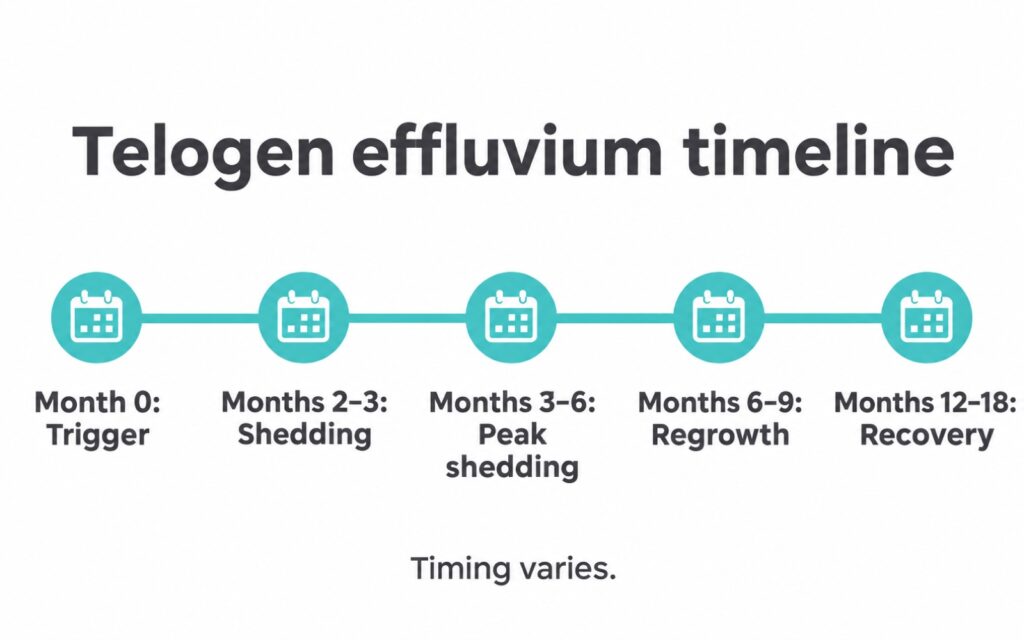
| Time | What is happening |
|---|---|
| Month 0 | The trigger occurs. Nothing is visible yet |
| Months 2 to 3 | Shedding begins, abruptly in most cases |
| Months 3 to 6 | Shedding continues, peaks, then starts to ease. The parting looks wider |
| Months 6 to 9 | Shedding settles. Short new hairs appear along the hairline and parting |
| Months 9 to 12 | Density visibly improves, though regrowth is still shorter than the rest of the hair |
| Months 12 to 18 | Length catches up and volume returns for most people |
Two things reliably stretch that timeline out. One is a trigger that never gets resolved, since shedding carries on while thyroid disease, iron deficiency or a restrictive diet is still in play. The other is a second trigger arriving before the first has finished, which is common enough after a bad year.
What Does Recovery Look Like?
Daily shedding usually drops first. As the active phase resolves, a hair pull test may become negative and short regrowing hairs can appear along the frontal and temporal hairline. Their tapered ends help distinguish genuine regrowth from broken hair shafts.
The regrowth may appear in a recognisable distribution. A five-patient case series published in Anais Brasileiros de Dermatologia described an acute telogen effluvium regrowth triad: a frontal fringe, bitemporal regrowth and an occipital fringe.
In the mirror, these short new hairs may stick up and look like flyaways because they have not yet grown long enough to lie flat with the surrounding hair. Cutting them does not accelerate follicular growth; scalp hair grows gradually, at approximately one centimetre per month.
There can therefore be an awkward transitional stage in which the contrast between short regrowth and the existing length makes the hair look uneven. That appearance does not, by itself, mean shedding is worsening; the more useful signs of recovery are reduced daily shedding, a less active hair pull test and progressively lengthening regrowth.
Getting A Diagnosis In The UK
Telogen effluvium is usually diagnosed clinically, using the history and an examination of the scalp, with targeted blood tests used to look for treatable causes. Your GP is an appropriate first point of contact. Tests commonly considered include a full blood count, ferritin and thyroid function. Vitamin D, vitamin B12, coeliac screening and other investigations should be selected according to symptoms, diet, medical history and examination findings rather than ordered routinely for everyone.
Most of the appointment is history-taking, and the 2-3 months before the shedding began may be more informative than the shedding itself because telogen effluvium commonly appears several months after its trigger. The scalp examination looks for diffuse non-scarring loss and checks for inflammation, scaling, patchy loss or follicular miniaturisation that might suggest another diagnosis. Dermoscopy or trichoscopy may be used to obtain a magnified view of the follicular openings and differences in hair-shaft calibre.
A hair pull test involves gently pulling a small group of hairs to see how many are released. The British Association of Dermatologists notes that washing the hair during the preceding 48 hours may produce a false-negative result, so ask the practice whether they want you to attend with unwashed hair. Occasionally, hairs are plucked and examined under a microscope to identify the proportion in the resting phase. A scalp biopsy is rarely required and is generally reserved for cases in which the diagnosis remains uncertain.
To get the most out of a short appointment:
- Write down when the shedding began, then list illnesses, operations, medication changes, dietary changes and major life events during the preceding twelve weeks.
- Photograph your parting, hairline and crown in consistent daylight, and find an older photograph for comparison.
- Bring a list of every prescription medicine, over-the-counter product and supplement you take, including the doses.
- Mention high-dose biotin specifically. The MHRA warns that biotin can interfere with thyroid immunoassays, potentially producing falsely high or low results. Tell the clinician and laboratory what dose you take and follow their instructions about whether and when it should be paused before testing.
- Ask what the next step will be if the shedding is still continuing at 6 months, the point at which telogen effluvium is classified as chronic.
A word on where else people go with this. Trichology is not a protected title in the UK and trichologists are not medical doctors. Some trichologists may have useful specialist training, and the Institute of Trichologists maintains a register accredited by the Professional Standards Authority. However, the title alone does not establish that someone is a medically qualified doctor. Because thyroid disease, iron-deficiency anaemia, medication reactions and other medical conditions can contribute to diffuse shedding, a GP or dermatologist is the appropriate place to begin the medical investigation.
What Helps, And What Does Not
No medicine shortens telogen effluvium. The evidence-based approach is to find and treat the trigger, correct any deficiency the blood tests turn up, and give the hair cycle the time it needs. The British Association of Dermatologists states plainly that no treatment is normally required and that taking medication does not speed up regrowth.
That is a frustrating thing to read when your hair is coming out in handfuls, so it is worth going through the options people ask about.
Treating the underlying cause is the only intervention that reliably changes the course. Iron deficiency, thyroid disease, an unsuitable medicine, inadequate nutrition: each of these keeps the shedding running until it is dealt with.
Should You Use Minoxidil Or Supplements?
Topical minoxidil is licensed in the UK for pattern hair loss, not for telogen effluvium, so using it here is off-label and a decision for a clinician (see our minoxidil guide). It works partly by shortening the resting phase, which means shedding increases for the first few weeks of use in many people. That is hard to tolerate when you are already shedding heavily, and it is the reason a lot of people abandon it early. Oral minoxidil for hair loss is unlicensed in the UK, prescribed by specialists with monitoring because of its cardiovascular effects. Check any product against its MHRA-approved patient information leaflet before you start.
Supplements are worth taking when a blood test shows a deficiency and not otherwise. Excess vitamin A and excess selenium both cause hair loss in their own right, so unsupervised supplementation carries a real risk of making things worse. Vegan and vegetarian diets, restrictive eating and heavy periods are all good reasons to check iron status instead of assuming it.
The ferritin advice circulating online deserves scrutiny. A controlled study of 381 women published in the Journal of the American Academy of Dermatology in 2010 found iron deficiency common among women generally but no more common in chronic telogen effluvium than in controls, and a 2002 paper in the British Journal of Dermatology reached much the same conclusion. Correcting a deficiency that has actually been demonstrated is sound medicine. Pushing ferritin towards a specific number because a forum recommended it is not supported by the evidence.
Things That Do Not Treat It
Shampoo does not treat telogen effluvium, whatever the packaging says. A gentle volumising formula makes hair look thicker while you wait, which is a reasonable thing to want, and an anti-dandruff shampoo helps if you have a scalp condition alongside the shedding.
PRP has been studied mainly in androgenetic alopecia. Evidence in telogen effluvium is thin, and because the condition resolves by itself, improvement after treatment is difficult to attribute to the treatment.
Finasteride is not a treatment for this. It blocks the conversion of testosterone to DHT, which is the mechanism behind pattern hair loss and has nothing to do with what is happening here. It also carries its own risk profile, including sexual side effects and reported mood changes, and needs a prescriber’s assessment.
Hair transplant surgery is not appropriate during active shedding, for reasons set out further down.
Getting Through The Shedding Phase
Wash your hair as often as you normally would. Skipping washes does not keep hair on your head, it collects the shed hairs so that several days of loss come out together, which feels considerably worse. Plenty of people delay washing out of fear and then panic at what comes out. Two or three washes a week is fine, daily is fine if that suits your scalp.
Beyond that, handle wet hair gently, use a wide-tooth comb and ease off the heat tools, bleaching, relaxing and tight styles that pull at the roots. None of those caused the shedding. All of them add breakage on top of it, at the point when you can least afford it.
For coverage while density comes back, hair fibres, volumising products and a shorter cut all do a reasonable job. Severe cases occasionally warrant a wig, available on the NHS with a consultant prescription, sometimes with a contribution towards the cost.
If you smoke, stopping supports scalp health along with everything else, and your GP can help with it.
The last point is not cosmetic. Watching your hair fall out has a real psychological weight, and being told it will grow back does not remove that. If the shedding is affecting your mood, your sleep or your willingness to leave the house, raise it with your GP alongside the hair.
When To See A Doctor?
Telogen effluvium is not dangerous in itself. Some of the conditions that trigger it are, and thyroid disease and anaemia both need treating in their own right, so a GP appointment is worth making if:
- Shedding has continued past 6 months, or is getting heavier instead of lighter
- There are distinct bald patches, or the scalp is red, scaly, painful, or shiny with lost follicle openings
- Eyebrows, eyelashes or body hair are affected
- The shedding comes with fatigue, weight change, heavy periods, breathlessness, or intolerance of heat or cold
- It began after a new medicine was started, so the prescription can be reviewed properly
- A child or teenager is affected
- Your mental health is suffering
Call 999 or go to A&E if a new medicine causes swelling of the face, lips or throat, a widespread rash, or difficulty breathing. That is an allergic reaction and needs emergency care.
Hair Transplants And Telogen Effluvium
A hair transplant does not treat telogen effluvium and is not appropriate while shedding is active. The follicles have not been lost in this condition, they are resting, and surgery cannot restart a cycle that is going to restart anyway. Surgeons look for a stable diagnosis and a stable donor area before considering anyone for a procedure, and during a heavy shed neither of those exists.
The donor area is the practical obstacle. Telogen effluvium affects the whole scalp, back and sides included, so the hair that would be used for grafting is itself in an abnormal state, and any assessment made during the shedding phase will misjudge both density and pattern.
Surgery becomes a conversation later, if at all. Where shedding has settled and it turns out androgenetic alopecia was sitting underneath it, an assessment on a stable scalp months after the effluvium resolved is the right way to look at that.
Separately, shedding after a hair transplant is a recognised and temporary event, sometimes called shock loss. Transplanted grafts commonly shed in the first weeks and regrow from the same follicles, and the trauma of surgery occasionally provokes telogen effluvium in the surrounding native hair. Anyone planning a procedure should raise it with their surgeon beforehand.
Longevita is a UK-registered medical tourism facilitator. We arrange access to hair transplant and cosmetic treatments through accredited independent clinics and clinicians, and we do not perform procedures or make clinical diagnoses ourselves. If your shedding is diffuse and recent, a GP or dermatologist is the right call, not a surgical consultation.
If you have already been through telogen effluvium, your hair has settled and thinning has stayed, we can talk you through what an assessment with an independent clinician involves and what information the clinician will want to see. Contact Longevita through the contact page or book a free Discovery Call. Every clinical decision, including whether a procedure is suitable at all, rests with the treating clinician. Results vary between people and individual outcomes are not guaranteed.
Frequently Asked Questions
How much hair will I lose?
Daily loss commonly rises from a normal 30 to 150 hairs to 300 or more, with up to 400 documented in clinical series. Over a full shedding phase that adds up to a noticeable share of your density, which is why the parting widens and the ponytail thins. Visible baldness is not an expected outcome.
Can telogen effluvium make you bald?
No. Diffuse thinning is expected, baldness is not, and even chronic cases followed over years show fluctuating shedding without a measurable drop in density.
Does the hair grow back?
In the great majority of cases, yes. The follicles stay intact and re-enter their growth phase once the trigger clears. Where density ends up short of where it was, an underlying pattern hair loss that the shedding revealed is the usual explanation.
How do I know when it is ending?
Shedding drops off first, then short new hairs appear along the hairline and parting a few weeks later, and a pull test releases fewer hairs than before.
Can it happen twice?
Yes. It is a reaction to a trigger, so a new trigger produces a new episode. Repeat episodes after successive pregnancies or recurrent illness are common.
How often should I wash my hair?
As often as you usually do. Washing does not cause the shedding, and putting it off simply concentrates several days of loss into one wash.
What is the best shampoo for telogen effluvium?
There isn’t one that treats it. A mild volumising formula improves the appearance of thickness while regrowth catches up, which is as much as any shampoo will do here.
Do vitamins help?
Only where a deficiency has been confirmed by testing. Hair supplements taken without a deficiency have no established benefit, and too much vitamin A or selenium makes hair loss worse.
Can it affect eyebrows or body hair?
It happens in more severe cases, since the condition acts on hair follicles generally. Loss confined to the eyebrows, or occurring in patches, points somewhere else and deserves review.
Is it hereditary?
No. Unlike male and female pattern hair loss, telogen effluvium has no genetic basis and does not run in families.
Does it cause a receding hairline?
It thins the frontal and temporal areas, so the hairline can look sparser while the shedding is under way. A recession that persists after recovery fits androgenetic alopecia better.
Can men get it?
Yes, with the same triggers. It is reported more frequently in women, partly because postpartum shedding is so common and partly because women seek medical advice for hair loss more readily.
Should I take minoxidil for it?
That is a decision for a clinician. Topical minoxidil is licensed in the UK for pattern hair loss and not for this, and it tends to increase shedding during the first weeks of use.
Telogen Effluvium: The Short Version
Sudden, diffuse shedding without patches or scalp changes is very often telogen effluvium: a reaction to something that happened roughly 3 months earlier, not a sign that the follicles themselves are damaged. Most people regrow their density fully once the trigger has been found and dealt with, on a timeline measured in months rather than weeks. If shedding is still heavy past 6 months, or something about it does not fit that pattern, that is the point to see a GP rather than wait it out. If you would like to talk through what an assessment involves once your hair has settled, contact Longevita through the contact page or book a free Discovery Call with us.
- Last Updated:

Dr Çağla Alkılıç
Hair transplant specialist (FUE, DHI and Sapphire) · Member of SANATDER and MESTDER
Last reviewed
Dr Cagla earned her medical degree at Trakya University’s Faculty of Medicine in Bulgaria and has almost 6 years of hair transplantation experience. She is a specialist in FUE, DHI and Sapphire hair transplants of the scalp, eyebrows and beard and has performed over 6,000 surgeries. Dr Cagla is multilingual, with fluency in English, Bulgarian and Turkish.
Request A Callback For A Discovery Call
With Longevita, you have the option to discuss your goals with us from the comfort of your couch.
- A UK-registered medical tourism facilitator
- Trusted by over 150,000 clients
- A free, no-obligation discovery call