
Overharvested Donor Area: Signs, Causes, Repair Options And How To Avoid It
Key Takeaways
- Extracted follicles do not regrow. Overharvesting is permanent, and prevention is worth far more than any repair.
- Safe planning works to a single-pass excision density of 10 to 15 follicular units per square centimetre and aims to leave 40 to 50 units per square centimetre in place.
- Graft numbers quoted without an assessment of donor density are estimates, not clinical recommendations.
- Shock loss usually recovers within three to four months; overharvesting does not recover at all. Judge the donor area over 12 months.
- Repair improves appearance through blending and camouflage. Restoring original density is not achievable.
- The most protective questions you can ask before surgery concern your measured donor density, the planned excision density, and who will be performing the extractions.
Every hair transplant is a redistribution, not a creation. The follicles that fill a receding hairline are taken from a fixed, non-renewing reserve at the back and sides of the head, and once a follicle has been excised from that reserve, nothing puts it back. That single fact governs almost everything that follows.
Most people preparing for surgery think hard about the recipient area: the hairline shape, the density, the number of grafts quoted. Far fewer think about what the donor area will look like afterwards, at a number one guard, in overhead lighting, five years and possibly two procedures later. Overharvesting is what happens when nobody in the room did that thinking either.
This guide covers how to tell overharvesting apart from temporary post-surgical shedding, the density arithmetic that experienced surgeons work to, what realistically improves an overharvested donor area, and the questions that protect you before anything is extracted. For the wider picture, see our guide to hair transplant complications.
What Is An Overharvested Donor Area?
An overharvested donor area is one from which too many follicular units have been excised, leaving the back and sides of the scalp visibly thin, patchy or moth-eaten. Extracted follicles do not regrow, so the thinning is permanent. It tends to show in one of three ways.
Diffuse Overharvesting
Extractions were spread across the whole safe zone, but at too high a density. The donor area keeps its shape and has no obvious bald patches, yet the whole region reads as thin and light passes through it. This one tends to surface slowly, as the person notices photographs looking different rather than seeing a defect in the mirror.
Focal Or Patchy Overharvesting
Punches were clustered, leaving low-density islands next to normal-density hair. The distance between follicular units normally ranges from 1.0 to 1.4 mm, and excising a unit leaves a much wider gap to its neighbour. Clustered punches multiply those gaps in one place, and the eye reads the resulting contrast as a hole.
Focal Donor Necrosis
A third presentation, less common but more serious, is focal donor necrosis, where excisions were placed so close together that the blood supply to a patch of scalp failed. That leaves scarred, permanently hairless skin instead of thinned skin.
Overharvesting is a density problem, not a graft-count problem
No graft number is inherently safe or unsafe. What determines the cosmetic outcome is residual follicular unit density, meaning how many units remain per square centimetre after extraction, and how evenly the remaining units are spread. A 2,000-graft procedure over a small, low-density donor zone can overharvest, while a 5,000-graft procedure over a large, high-density zone need not. A graft number given before anyone has assessed donor density is an estimate, not a plan.
Is It Overharvesting Or Shock Loss? How To Tell The Difference
Shock loss and overharvesting look alike in the early weeks and are completely different in what happens next. Shock loss is a temporary shedding of existing hair triggered by the trauma of surgery, and it recovers. Overharvesting is the permanent absence of follicles that were physically removed, and it does not. The distinction usually resolves itself by the six-month mark, because shed hair regrows on its own timetable while extracted follicles never return.
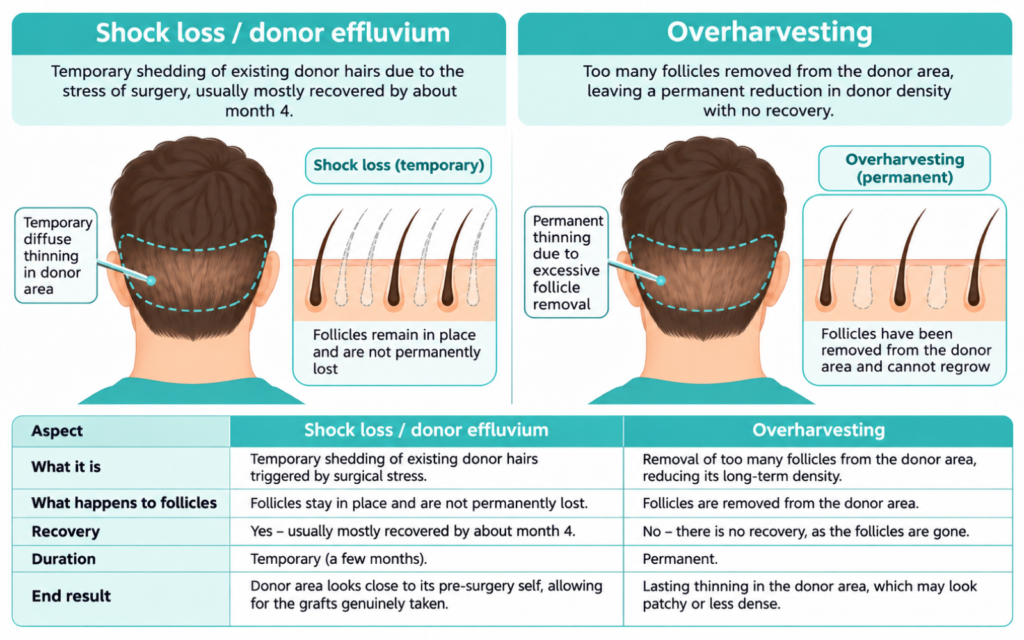
Donor area effluvium after extraction is well documented. Kerure and Patwardhan describe post-surgical donor effluvium appearing anywhere from a few days to a few weeks after the procedure, presenting as diffuse loss, and resolving within three to four months in most cases. They name overharvesting and compromised blood supply as its most common causes, which is precisely why the two problems are so easily confused: aggressive extraction produces both at once. A four-case series in the same journal documented donor area acute effluvium that mimicked alopecia areata on trichoscopy, complete with black dots and exclamation mark hairs, in patients who had recently undergone FUE.
| Shock loss / donor effluvium | Overharvesting | |
|---|---|---|
| Onset | Days to a few weeks after surgery | Visible once swelling settles and shed hair regrows |
| Appearance | Diffuse thinning, sometimes patchy, hair pull test positive | Thin or moth-eaten zones that match the extraction pattern |
| Underlying cause | Existing follicles pushed into shedding | Follicles physically removed |
| Recovery | Density improves from around month three, mostly resolved by month four | No spontaneous recovery |
| 12-month outlook | Donor area looks close to its pre-surgical self, allowing for the grafts genuinely taken | Thinning is fixed and will need camouflage or repair |
| Treatment | Time, and sometimes topical minoxidil to speed recovery | Repair grafting, scalp micropigmentation, medical therapy for surrounding hair |
Do not draw conclusions about your donor area before month six, and do not accept reassurance beyond month twelve. Between those two points, the picture becomes clear. If a clinic is still telling you at month 10 that “it will fill in”, ask what specifically they expect to fill it in.
How Many Grafts Can Safely Be Taken From The Donor Area?
Most experienced FUE surgeons work to a single-pass excision density of 10 to 15 follicular units per square centimetre in a person whose baseline donor density falls in the normal 65 to 75 range, and they aim to leave a residual density of 40 to 50 units per square centimetre. Those two figures, published by Keene, Rassman and Harris in Hair Transplant Forum International, are the closest thing the field has to a safe-limits guideline, and the same paper notes that formal guidelines to prevent overharvesting did not exist at the time of writing.
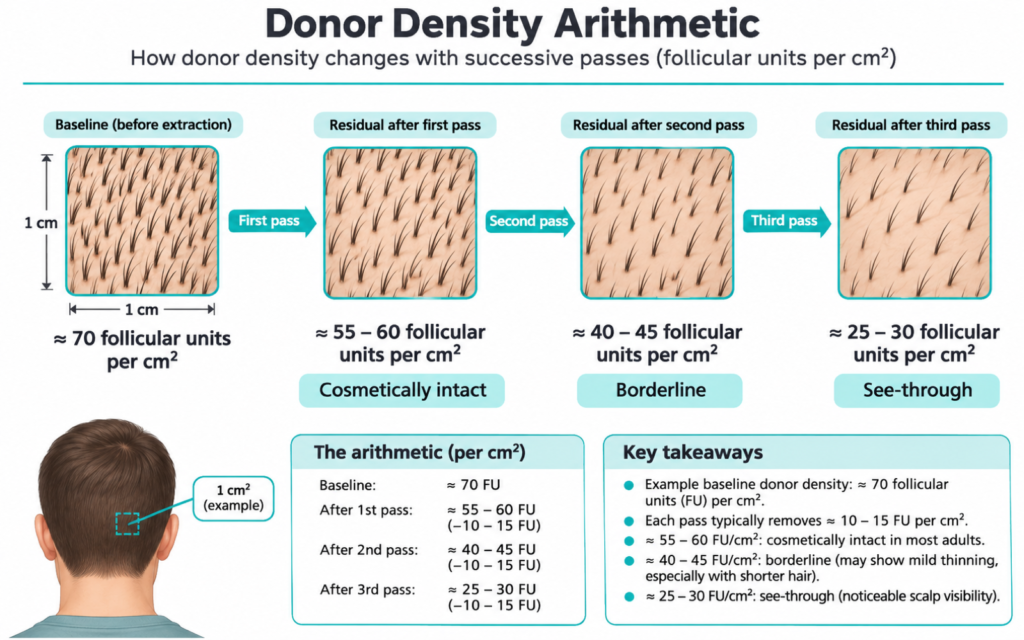
The arithmetic is worth seeing, because it explains why second and third procedures carry so much more risk than first ones. Starting from a baseline of 70 follicular units per square centimetre:
| Procedure | Excision density | Residual density | What that looks like |
|---|---|---|---|
| First pass | 10 to 15 FU/cm² | 55 to 60 | Cosmetically intact for nearly all hair types |
| Second pass | 10 to 15 FU/cm² | 40 to 45 | Borderline; outcome depends on hair calibre, curl, contrast and hair length |
| Third pass | 10 to 15 FU/cm² | 25 to 30 | See-through, thin and mottled |
Those figures come from the same body of surgical work. A third session at a conservative density still lands the donor area in territory that Keene and colleagues describe as see-through and to be avoided. If you are already considering another procedure, our guide to a second hair transplant explains how remaining donor supply is assessed.
Capacity is the other half of the calculation. In the same paper’s worked example, a safe donor area measuring 27 cm by 7 cm, so 189 cm², with a baseline density of 65, supports 1,890 to 2,835 grafts at a conservative excision density. That yield suits Norwood class II to IV patterns. People presenting at Norwood V to VII frequently need 3,000 to 5,000 grafts or more, which over that same donor area demands excision densities of 16 to 26 and drives residual density below 50. This is the uncomfortable arithmetic at the heart of the whole subject: the larger the area needing coverage, the smaller the donor supply relative to the need. Some goals are simply not deliverable from the donor area available, and a competent surgeon says so at the consultation. Our guide to the Norwood scale explains the stages, and our guide to mega session hair transplants covers who very large sessions actually suit.
A separate, simpler benchmark appears in the complications literature: do not extract more than one in every four follicular units, leaving at least three of every four in place within any given area of the donor zone.
Why Graft Numbers Alone Are A Poor Safety Measure
Ask how many grafts you need and you get a number. Ask what your baseline donor density is, and you find out whether anyone measured. Donor density can be measured with a densitometer, TrichoScan or dermatoscope, ideally at several points across the back and sides, because density is not uniform across the scalp. Average donor density varies by ethnicity as well, with reported figures of 65 to 85 in the occipital donor area in a study of Caucasian patients and 61 to 64 in Asian patients.
Without that measurement, a graft quote is guesswork wearing a lab coat. Any graft figure given before your donor area has been assessed is a starting point for the conversation, not a substitute for the operating clinician’s own donor assessment.
The residual density threshold
Surgical consensus places the minimum residual donor density for acceptable coverage at 40 to 50 follicular units per square centimetre. Keene and colleagues describe residual densities of 25 to 30 as see-through in most cases, especially where the remaining units contain only one or two hairs each. People with a higher proportion of three- and four-hair units tolerate lower residual densities at longer hair lengths. Density alone does not settle the question; hair shaft diameter, curl, hair-to-scalp colour contrast and chosen hairstyle all shift the threshold.
What Causes Overharvesting?
Overharvesting usually reflects planning decisions rather than a technical accident, and the planning failures fall into a small number of recognisable categories: extraction densities set too high for the measured baseline, punches clustered instead of distributed, harvesting from outside the safe donor zone, and graft targets driven by a sales conversation instead of a clinical one.
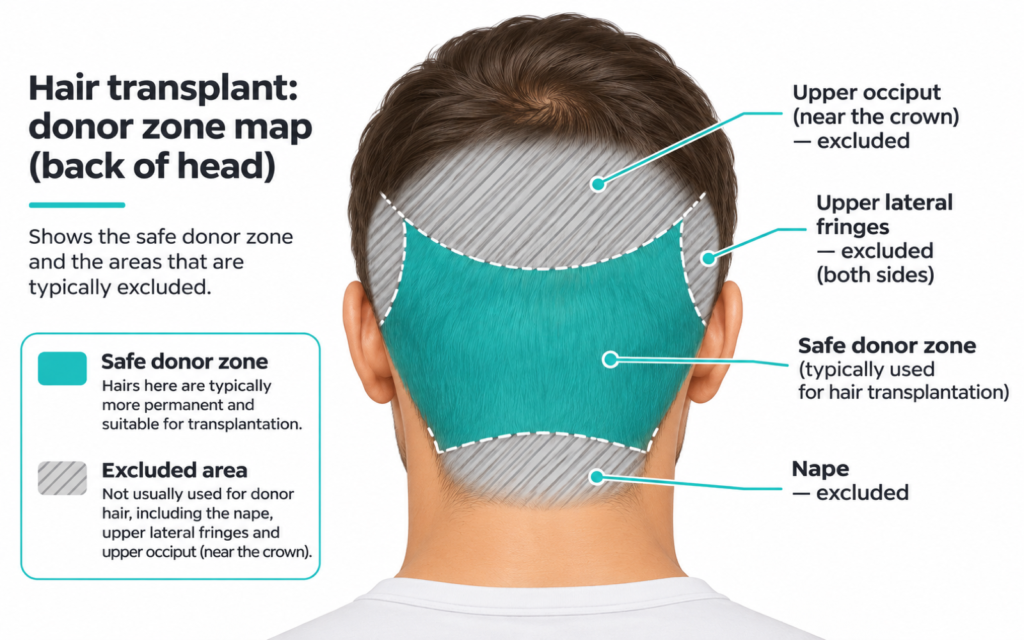
Extracting from outside the safe donor zone. The safe zone usually excludes the nape of the neck, the superior lateral fringes and the upper occiput near the crown, because hair in those regions is vulnerable to androgenetic alopecia and will thin with time regardless of what was harvested. Grafts taken from there produce a donor defect that widens over the following decade, and they perform poorly in the recipient area for the same reason.
Failing to plan for future hair loss. A 24-year-old at Norwood III today is not a 24-year-old at Norwood III permanently. Planning that treats the current pattern as the final pattern spends donor supply that will be needed later. Keene and colleagues frame this as a master plan problem, arguing that surgical planning has to account for hair that will be lost to natural progression as well as hair lost to the surgery itself. Understanding where you sit on the Norwood scale and where your family history suggests you are heading is part of that.
Volume-driven graft targets. Very high graft quotas are commercially attractive and clinically dangerous. The ISHRS has issued a consumer alert about clinics where incisions and excisions are delegated to unlicensed personnel, stating that a licensed provider must perform all surgical incisions or excisions, and stating plainly that scarless hair transplantation does not exist. In the society’s 2025 Practice Census, 6.9% of members’ hair restoration patients were seeking repair of previous surgery from another physician or a black-market hair transplant. Members also reported that, on average, 10% of their cases were repairs of a previous black-market hair transplant.
Punches too large, or placed too close. Larger punch diameters leave more scar volume and greater vascular compromise of the donor area. Contiguous excisions, where adjacent punch holes merge, produce both empty skin and a risk of local devascularisation and focal donor necrosis.
Hair And Scalp Characteristics That Raise The Risk
| Factor | Lower risk | Higher risk |
|---|---|---|
| Hair-to-scalp contrast | Blonde or grey hair on fair skin; dark hair on darker skin | Dark hair on fair skin |
| Hair shaft diameter | Coarse | Fine |
| Curl | Wavy or tightly curled, worn long enough for the curl to show | Straight |
| Exit angle | Acute, producing natural shingling | Obtuse |
| Preferred hairstyle | Longer, layered | Grade 1 to 2 clipper, or stubble |
| Baseline donor density | 80 and above | 65 and below |
Two of these deserve a word of caution. Curl is a real advantage, but it disappears when hair is wet, wind-blown or cut short, so it should never be treated as a licence to extract more aggressively. And hairstyle preference is a decision you are making now on behalf of your future self, who might want a shorter cut in ten years and will not be able to have one. Our guide to hair types and hair transplant suitability looks at these characteristics in more detail.
What Are The Signs Of An Overharvested Donor Area?
The reliable signs are visible after month six and settled by month 12: scalp showing through the back and sides in ordinary light, bare or low-density patches that follow the pattern of extraction, a hard edge where harvested scalp meets unharvested scalp, and donor hair that no longer covers when clipped short. Photographs taken from behind under overhead lighting reveal all of this far better than a bathroom mirror does.
A self-check you can do at home
- Overhead light, dry hair, no product. Stand under a ceiling light, not a bathroom side light, which flattens contrast and hides thinning.
- The two-mirror or phone method. Have someone photograph the back of your head from about a metre away, then from directly above and behind. Take the same three shots monthly.
- The clipper test, if you are willing. Thinning that hides at 15 mm and appears at 6 mm is thinning that limits your hairstyle permanently.
- Look for edges, not just gaps. A visible boundary line between harvested and unharvested scalp is a stronger indicator of overharvesting than diffuse thinness alone, which could still be effluvium.
- Compare against your pre-surgery photographs. If your clinic did not take standardised donor photographs before surgery, that omission is itself informative.
Two findings warrant contacting a clinician promptly instead of monitoring: skin in the donor area that looks dusky, dark or purplish during the first postoperative fortnight, and any combination of spreading pain, heat, swelling, discharge or fever. Both point towards impaired blood supply or infection rather than a cosmetic problem. Donor-site necrosis after FUE is uncommon but documented in the medical literature, including a reported case that led to cicatricial alopecia in the left half of the occipital region and required two-stage reconstruction with tissue expanders. Necrosis affecting the recipient area is also described, with timely diagnosis and treatment identified as important for preventing serious complications.
If you become acutely unwell, with high fever, confusion, rapidly spreading redness or severe pain, go to A&E or call 999. If you are in the UK and unsure how urgent a symptom is, call NHS 111.
The 12-month rule
Donor area appearance should not be judged before 6 months and should be considered final at 12 to 18 months. Shedding triggered by surgery recovers within 3 to 4 months in most cases. Density that has not improved by month 12 reflects follicles that were removed, not follicles that are resting. Standardised photographs of the donor area, taken before surgery and monthly afterwards under consistent lighting, are the single most useful record you can keep.
What Happens If The Donor Area Is Overharvested?
The consequences fall into four groups: a permanent cosmetic defect at the back and sides, the loss of donor capacity for any future procedure, occasional wound-healing complications including focal necrosis, and a psychological burden that is easy to underestimate.
The cosmetic defect is permanent and restricts hairstyle. An overharvested donor area sets a floor on how short you are able to wear your hair for the rest of your life. Some people describe the reversal bluntly: the area they went in to fix now looks better than the area they never worried about.
Future surgery becomes harder or impossible. This is the consequence people grasp last and regret most. Donor supply is finite and non-renewing. A first procedure that spends it recklessly forecloses the second procedure that progressive hair loss will eventually make desirable. Anyone weighing a second hair transplant needs their remaining donor density measured before any discussion of graft numbers begins.
Wound-healing complications. Focal donor necrosis, described above, is the serious end of this. Localised donor effluvium sits at the milder end and resolves.
Psychological impact. Distress after a visible, permanent, self-elected change in appearance is understandable and is not a sign of vanity. If this is where you are, it is worth speaking to your GP. Support is available, and it is more effective when sought early rather than after a second procedure taken in frustration.
Can An Overharvested Donor Area Be Repaired?
Partial improvement is realistic; restoration of the original density is not. Repair works by reducing contrast and blending edges, using some combination of carefully placed grafts from any remaining safe donor supply, scalp micropigmentation, medical therapy to protect the hair that is left, and adjustments to hair length and styling. What is achievable in a given case depends on how much stable donor hair remains, the quality of the existing scarring, hair and skin characteristics, and whether the recipient area also needs work. Our guide to hair transplant correction surgery covers repair more broadly.
| Option | What it does | Best suited to | Limitations |
|---|---|---|---|
| Redistribution grafting from remaining scalp donor | Moves follicles from higher-density areas into visible defects | Focal, patchy overharvesting with adequate density elsewhere | Takes from a supply already depleted; unsuitable where residual density is low |
| Beard or body hair grafts | Adds coverage using non-scalp donor hair | Cases with insufficient scalp donor but good beard density | Different calibre, texture and growth characteristics; lower yields than scalp hair; results less predictable |
| Scalp micropigmentation | Deposits pigment in the upper dermis to mimic follicles and cut hair-to-scalp contrast | Diffuse thinning, close-cropped styles, blending scars | Camouflage only; it is a form of tattooing, so ask the practitioner about how long it lasts, top-ups and risks |
| Medical therapy (finasteride, minoxidil) | Protects remaining native hair and slows further loss | Nearly all cases, as an adjunct | Does nothing for extracted follicles; requires ongoing use; oral finasteride is prescription-only in the UK |
| Growing the hair longer | Uses layering and shingling to cover defects | Diffuse thinning with reasonable residual density | Not a solution for anyone who wants short hair; ineffective when hair is wet or wind-blown |
| Scar revision | Improves texture of specific scars before camouflage | Cobblestoned or atrophic scarring | Surgical, staged, and only addresses texture |
Our guides to finasteride and minoxidil cover both medicines, including the MHRA safety warnings for finasteride.
A Sensible Sequence For Repair
Repair rarely means choosing one option. A common pathway runs: measure and document first, stabilise remaining hair with medical therapy, allow at least twelve months from the last surgery before intervening, then camouflage or graft, and reassess at 6 to 12 months after each step. Rushing a repair into an unhealed, unmeasured donor area is how second-stage damage happens.
Why repair aims at contrast, not density
The visibility of an overharvested donor area is driven as much by optical contrast as by follicle count. Reducing the difference between hair colour and scalp colour, through pigmentation or by allowing hair to grow long enough to shingle and block light, improves appearance without adding a single follicle. This explains why two people with identical residual densities can report completely different levels of distress, and why people with blonde or grey hair tolerate lower donor densities than dark-haired people with fair scalps.
What To Do First If You Think Your Donor Area Has Been Overharvested
Start by documenting rather than deciding. Take standardised photographs, gather your surgical records including graft counts and any donor density measurements, arrange an in-person assessment with a qualified clinician who was not involved in the original surgery, and wait until at least twelve months post-surgery before committing to any corrective procedure.
Month By Month
| Timeframe | What to do |
|---|---|
| Weeks 0 to 2 | Follow your clinician's post-operative instructions. Report dusky skin, spreading pain, discharge or fever to a clinician the same day. A&E or 999 if you are acutely unwell. |
| Months 1 to 3 | Expect shedding in both areas. Photograph monthly. Avoid conclusions. |
| Months 3 to 6 | Regrowth of shed hair should be under way. Begin comparing photographs side by side. |
| Months 6 to 9 | If the donor area is not improving, request a written explanation and your full surgical record from the original clinic. |
| Months 9 to 12 | Arrange an independent assessment including densitometry of the remaining donor zone. |
| Month 12 onwards | Discuss repair options with the assessing clinician, allowing at least 12 months from your last surgery before any corrective procedure. |
Questions To Put To The Assessing Clinician
- What is my current residual donor density, measured, and in which zones?
- Which parts of my donor area are still within the safe zone?
- What is the maximum number of grafts that could be taken from what remains without making this worse?
- Is scalp micropigmentation, grafting, or a combination the better fit for my hair and skin characteristics?
- What would you expect the result to look like at a grade 2 clipper length?
- What will this look like in ten years if my hair loss progresses?
If your procedure was arranged through Longevita and you have concerns about your donor area, contact your clinician’s support team (contact details are in your Appointment Schedule) with your photographs and treatment dates. Longevita arranges access to treatment with independent clinicians and does not perform surgery; any clinical review or assessment is carried out by the clinician.
How To Reduce The Risk Before Surgery
The protective steps are unglamorous and effective: insist on a measured donor density assessment, ask for the intended excision density rather than only the graft total, confirm who will physically perform the extractions, and be sceptical of any quote that scales the graft number up to justify a price. Nothing about this list is exotic, and an overharvested donor area usually involves at least one of these steps being skipped.
Pre-Surgery Checklist
- Donor density measured at multiple points, and the figures given to you in writing
- Safe donor zone mapped and shown to you, with the excluded areas identified
- Planned excision density stated in follicular units per square centimetre, alongside the graft total
- Projected residual donor density after this procedure stated
- Your family history of hair loss discussed and factored into a long-term plan
- Any future procedure explicitly budgeted for in the donor plan
- Standardised pre-operative photographs of the donor area taken
- The name and qualifications of the clinician performing the extractions confirmed
- Medical therapy for ongoing hair loss discussed
- No guarantees offered, because no responsible clinician offers them
Red Flags To Watch For
- A final graft number fixed before anyone has assessed your donor area
- A quote that rises with the price tier rather than with clinical need
- Reluctance to name the operating clinician
- Guaranteed results, guaranteed density, or guaranteed graft survival
- Talk of “scarless” surgery, which the ISHRS has specifically identified as false advertising
- Pressure to book while a discount lasts
- Refusal to discuss what happens if your hair loss progresses
Does It Matter Whether You Have Surgery In The UK Or In Turkey?
Geography is not the variable that matters; who operates and how they plan is. Well-run clinics and poorly run clinics exist in both countries, and the ISHRS has warned that unlicensed personnel worldwide are performing substantial parts of hair restoration surgery. What distinguishes safe planning in either setting is measurement of donor density, a named and qualified operating clinician, conservative excision densities, and an honest conversation about what the donor area is able to supply. Longevita isn’t arranging UK hair transplants at the moment; hair transplants are currently arranged with independent clinicians in Istanbul.
There are two practical differences worth planning around. Distance complicates follow-up, so establish before you travel how the clinic’s follow-up will work, who reviews your photographs at three, six and twelve months, and what happens if there is a complication after you return home. Our guide to post-operative care after returning to the UK covers this. And short trips create pressure towards large single sessions, which is precisely the pattern that risks aggressive extraction. A plan that stages surgery across two visits is frequently the safer plan, even though it is the less convenient one.
Myths And Facts
| Myth | Fact |
|---|---|
| “The donor area grows back.” | It does not. Hair that sheds after surgery regrows because those follicles are still present. Follicles excised during extraction have been removed from the scalp, and nothing regenerates them. |
| “Overharvesting only happens with FUE.” | Strip harvesting carries its own donor complications, including widened scars. FUE dominates the conversation because the extractions are distributed across a wide field, making it easier to take too many without any single site looking alarming during surgery. |
| “Robotic extraction prevents it.” | Automation does not set the plan. Device-assisted extraction operates within a defined field and under clinician supervision. Decisions about density and distribution remain human ones. |
| “More grafts means a better result.” | More grafts means more donor depletion. Beyond what the donor area can safely supply, additional grafts trade a visible improvement at the front for a visible defect at the back. |
| “Minoxidil or finasteride will fix it.” | Medical therapy protects the hair you still have and slows further loss. Neither treatment regrows an extracted follicle. |
| “SMP will make it look like it never happened.” | Scalp micropigmentation reduces contrast and can improve the appearance considerably in the right candidate. It is camouflage, not new hair, so ask the practitioner how long it lasts and what upkeep it needs. |
Donor area planning is the part of hair transplant surgery that decides how good your result still looks in ten years, not just in the first 12 months. The density and excision figures in this guide are the numbers worth asking for before you agree to anything, not after the fact.
Frequently Asked Questions
How long before I know if my donor area was overharvested?
Between 6 and 12 months. Shed hair recovers within 3 to 4 months in most cases, so density that has not improved by month 6 is unlikely to improve later. Judge the final result at 12 to 18 months.
Is an overharvested donor area painful?
No. It is a cosmetic and structural problem, not a painful one. Pain, heat, swelling, discharge or fever in the donor area points to infection or impaired blood supply and needs same-day clinical assessment.
How much hair can be taken in one session without overharvesting?
There is no universal number. A conservative single-pass excision density of 10 to 15 follicular units per square centimetre is widely regarded as safe in people with normal baseline density, and the resulting graft yield depends entirely on the size and density of your particular safe donor zone.
Can beard hair repair a donor area?
In selected cases, yes. Beard grafts differ in calibre, texture and growth pattern from scalp hair, so matching and placement matter a great deal, and outcomes are less predictable than with scalp donor hair. It is an option worth assessing when scalp donor supply is exhausted.
Will a second transplant fix the first one?
Sometimes, and only after the remaining donor supply has been measured. A second procedure planned without densitometry on an already-depleted donor area risks converting a repairable problem into an unrepairable one.
Does Longevita perform hair transplant surgery?
No. Longevita is a UK-registered medical tourism facilitator. We arrange access to treatment with independent clinicians at accredited independent hospitals and clinics, and all clinical decisions and procedures are the responsibility of the treating clinician and their facility. If you are considering a hair transplant in Istanbul, contact us or book a free Discovery Call with us.
- Last Updated:

Dr Çağla Alkılıç
Hair transplant specialist (FUE, DHI and Sapphire) · Member of SANATDER and MESTDER
Last reviewed
Dr Cagla earned her medical degree at Trakya University’s Faculty of Medicine in Bulgaria and has almost 6 years of hair transplantation experience. She is a specialist in FUE, DHI and Sapphire hair transplants of the scalp, eyebrows and beard and has performed over 6,000 surgeries. Dr Cagla is multilingual, with fluency in English, Bulgarian and Turkish.
Request A Callback For A Discovery Call
With Longevita, you have the option to discuss your goals with us from the comfort of your couch.
- A UK-registered medical tourism facilitator
- Trusted by over 150,000 clients
- A free, no-obligation discovery call