
How Much Fat Can Liposuction Remove And When Is Staging Needed?
Key Takeaways:
- Nobody can give you a personal limit online. The safe amount is a clinical judgement made after examining you.
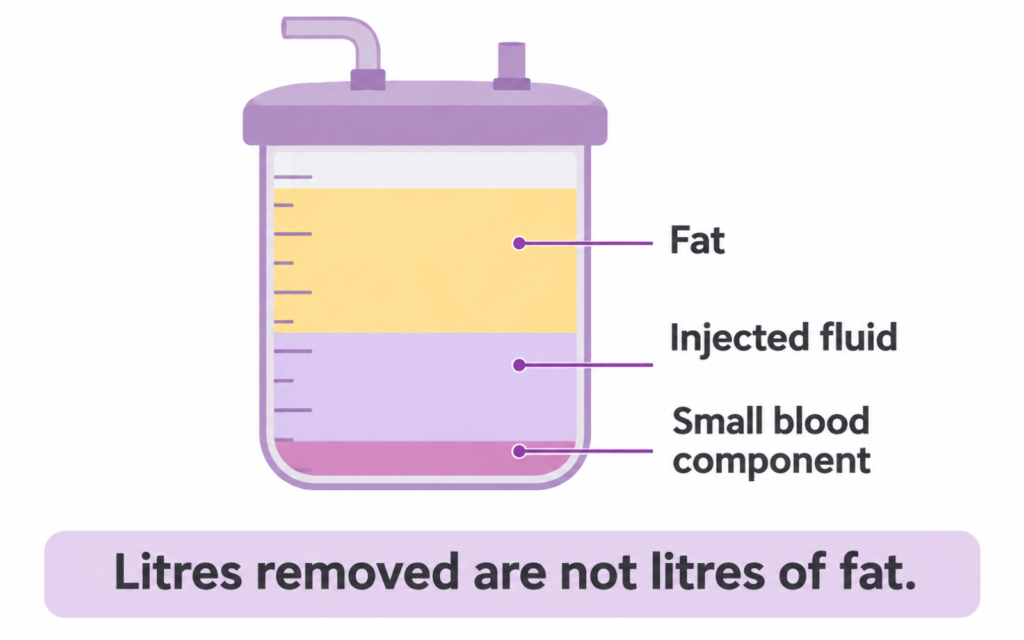
- What’s sucked out is a mixture. NICE describes fat and injected fluid being removed together, so litres in the canister are not litres of fat.
- Litres removed are not kilos lost on the scales. Fat is lighter than water, and much of the canister isn’t fat in the first place.
- The more fluid used, the more areas treated and the longer the operation, the more the risk climbs. NHS Wales links fluid on the lungs directly to the fluid injected during liposuction.
- NHS 111 Wales says liposuction “is not a treatment for obesity”. If the goal is weight loss, a bigger volume isn’t the answer.
“How many litres can you take out?” is one of the first things people ask, and it’s a fair question with an unsatisfying answer. Clinics quote figures. Forums trade them. Some people even pick a clinic because it promises the biggest number.
The trouble is that the number on its own tells you very little. It doesn’t say how much of it was fat. It doesn’t say what it did to your shape. And it certainly doesn’t tell you whether your body was happy about losing that much in one afternoon. So let’s take the number apart: what’s in it, what puts a ceiling on it, and why two modest operations sometimes beat one heroic one.
What Does The Removed Volume Include?
When a surgeon quotes litres removed, they usually mean the total aspirate: everything collected in the canister. That’s fat, the fluid that was injected into the area before suction started, and a small amount of blood. It is not a measure of pure fat. The rest leaks out through the small cuts over the next day or 2, or is absorbed by your body.
Why Fluid Goes In First
Before any fat comes out, the area is pumped full of a solution. The NHS says this solution contains anaesthetic and medicine to reduce blood loss, bruising and swelling. NICE explains that the fluid also allows the cannula to glide through the tissue with minimal damage to blood vessels and lymphatics. Some of the fluid is suctioned out with the fat, while excess fluid is drained after the procedure.
What’s In The Liposuction Canister
| What's in it | Where it comes from | What it means for you |
|---|---|---|
| Fat | The treated area | The part that changes your shape |
| Injected fluid | The solution put in before suction | Makes the volume look bigger than the fat removed |
| Blood | Small vessels disturbed during suction | Kept low by the solution; more volume means more loss |
Next time someone on a forum says they “had 6 litres out”, it’s worth asking: 6 litres of what? 2 people with the same canister figure can have had quite different amounts of fat removed.
Litres In The Canister Aren’t Kilos On The Scales
A lot of people step on the scales the week after liposuction and feel cheated. The number has barely moved, and sometimes it’s gone up. Part of what’s removed is injected fluid, not fat. Pure fat is lighter than water anyway, so a litre of it doesn’t even weigh a kilo. Swelling, and the fluid your body soaked up during surgery, are both standing on the scales with you. Liposuction is about shape. Your jeans will tell you more than your bathroom scales ever will.
Why Is There No Personal Limit Calculator?
Because the answer lives in your body, not in a formula. A surgeon has to examine you, ask about your health, and think through the areas, the technique, the anaesthetic and the hours on the table before any number makes sense. The same 4 litres could be routine for one person and reckless for the next. You won’t find a maximum for cosmetic liposuction on the NHS website or in NICE guidance either.
You’ll see numbers quoted online, often a few litres, and sometimes presented as a rule. They aren’t a UK standard, and they’re no substitute for an assessment. A clinic that tells you how many litres it can take out before it has examined you is answering the wrong question.
What the UK sources are clear about is that the risks aren’t theoretical. Three of them sit on the NHS’s own list for liposuction: fluid building up in the lungs, a clot in the lungs, and damage to internal organs. The NHS goes a step further and says the fluid on the lungs comes “from the fluid injected into the body”. More fluid in, more for your body to clear.
What Affects The Treatment Plan?
Three things, mostly: the body you’ve got, how healthy it is, and what you want it to look like afterwards. At consultation, expect a surgeon to pinch, measure and ask. Where’s the fat? How much of it? Does your skin snap back? What tablets are you on, and do you smoke? Only then can they say how much, from where, and whether it’s one operation or two.
Your Body
By the NHS’s account, the ideal patient isn’t overweight and has skin that’s still “firm and elastic”. Picture someone at a steady weight with a pocket of fat that ignores every diet, under skin that still bounces back. Empty a lot of fat out from under tired skin and you can be left looking deflated. Our guide to loose skin after liposuction explains why.
Your Health
If your heart, lungs or kidneys aren’t at full strength, or you have diabetes or take blood thinners, the safe amount comes down. Sometimes a long way down. Smoking counts too. The Royal Marsden tells its own patients it raises the risk of complications. Expect to be asked about your BMI. If you’re wondering why, our guide to BMI and plastic surgery explains.
The Technique And Anaesthetic
You’ll hear plenty of names: power-assisted, ultrasound-assisted, Vaser liposuction. Whatever the machine, it’s your body that sets the limit, not the device. Then there’s the anaesthetic. According to the NHS, most liposuction is done asleep under a general anaesthetic, and most people stay the night.
How Do Areas And Surgical Duration Interact?
Each area you add is another stretch of time asleep, another lot of fluid pumped in, a bit more blood lost and one more patch of you to heal. NICE puts a single procedure at anywhere from 1 to 4 hours, depending on how big the area is.
Now imagine tummy, flanks, back and thighs all on one list. That’s a long day in theatre, and a long few weeks afterwards.
That’s the hidden cost of “full body” liposuction. The phrase sounds like one procedure. In reality, it can mean several areas treated during one operation, each adding to the amount of tissue being treated and the recovery involved. It’s also why 360 liposuction, which treats the waist all the way around, can be a more extensive procedure than the name suggests.
| More of this | What it adds |
|---|---|
| Areas treated | Operating time, fluid, blood loss, swelling, recovery |
| Volume removed | Fluid shifts, blood loss, risk of uneven contour |
| Time under anaesthetic | Strain on the body, risk of blood clots |
| Combined procedures | All of the above, plus the second operation's own risks |
Recovery also scales with the extent of the procedure. The NHS says the time needed to return to work depends partly on how much of the body was treated.
When Is Staging Discussed?
Staging just means doing the job in instalments: two or more operations, with weeks or months in between. It tends to come up once a plan starts to look ambitious. The idea is simple. Each operation stays small enough for your body to take in its stride.
There’s no fixed trigger. It’s a judgement, and surgeons draw the line in different places. But staging tends to be raised when:
- You want several separate areas treated
- The total volume would be large for your body size
- The operation would run long under general anaesthetic
- Liposuction is being combined with another operation, such as a tummy tuck
- You have health factors that reduce how much surgery you can safely have at once
Staging has real downsides too: 2 recoveries, 2 anaesthetics, 2 lots of time off work and, if you’re travelling, 2 trips. That’s why it’s a conversation to have, not a default. In its patient information on liposuction for lipoedema, NICE notes plainly that “the procedure may need to be repeated”, and suggests patients ask “How many appointments will I need?”. The same question applies to cosmetic plans.
Two Smaller Operations Can Be The Better Plan
A clinic that offers to do everything in one go can seem more convenient, and sometimes it’s cheaper. Your body doesn’t care about convenience. It counts the hours, the litres and the areas. So when a surgeon says “let’s do this in two goes”, that’s caution talking, not inexperience. Ask why, then weigh the answer against a second recovery and a second trip.
Questions worth asking about volume and staging:
- Roughly how much are you planning to take out, and how much of that is actually fat?
- Why these areas together, in one session?
- How many hours will I be asleep?
- Have you thought about splitting it up, and what would make you do that?
- Who keeps an eye on my fluids and blood loss, during and after?
- Where do I recover, and on what date can I get on a plane?
How Does This Differ From Weight Loss?
Liposuction moves the outline, not the number on the scales. Your body goes on storing fat the way it always has, and if you’re overweight, this isn’t the fix. NHS 111 Wales doesn’t soften it: liposuction “is not a treatment for obesity, and it will not remove cellulite or stretch marks.” It also says it’s “only really suitable for people who have tried changing their lifestyle and found this has not helped”.
That’s why pushing for a bigger volume to “lose more weight” misses the point. A larger volume brings more risk, and the scales won’t move as much as the canister suggests. If weight is the main concern, the conversation should start with your GP. Our guide to liposuction vs weight loss surgery explains why the two aren’t interchangeable.
After large weight loss the problem is often loose skin, not fat, and liposuction can’t fix that. Our guide to plastic surgery after weight loss covers the options.
When Should You Get Help After Liposuction?
For most people, nothing goes badly wrong. Still, some things shouldn’t wait until tomorrow. A swelling that keeps growing or feels tight as a drum. A cut that’s red, hot or leaking more than yesterday. A temperature of 38°C or above. Pain that’s climbing instead of easing. Ring your surgical team that day. And if a lot of fluid was used, don’t shrug off getting out of breath.
Call 999 or go to A&E for sudden breathlessness, chest pain, coughing up blood, a hot, swollen calf, or abdominal pain that keeps getting worse. Long flights soon after surgery raise the risk of blood clots, which BAPRAS has highlighted for people having cosmetic surgery abroad.
In the UK, in an emergency: call 999 or attend the nearest A&E.
If your procedure was arranged through Longevita, contact your clinician’s support team (contact details are in your Appointment Schedule). Longevita arranges access to treatment with independent clinicians and doesn’t operate, so anything urgent goes to a clinician, NHS 111 or A&E first. Our guide to liposuction risks and complications covers the warning signs in detail. For how a treatment plan comes together, see liposuction in Turkey.
Myths And Facts
| Myth | Fact |
|---|---|
| “The more litres, the better the result.” | Volume isn't the goal. Shape is. More volume means more risk and doesn't guarantee a better contour. |
| “5 litres out means 5 kilos lost.” | The canister holds fat plus injected fluid and blood. Fat is lighter than water. The scales tell you little. |
| “There's a standard safe limit everyone can use.” | Neither the NHS nor NICE sets one for cosmetic liposuction. It's a judgement made for each person. |
| “Full body lipo is one operation.” | It's several areas treated at once, each adding time, fluid and recovery. |
| “Staging means the surgeon isn't good enough.” | Staging is usually a safety decision. Ask why it's been suggested. |
| “Liposuction is a quick way to lose weight.” | NHS 111 Wales says it isn't a treatment for obesity. |
Frequently Asked Questions
What is the maximum amount of fat liposuction can remove?
There isn’t one, at least not one that fits everybody. Neither the NHS nor NICE gives a figure for cosmetic liposuction. It’s your surgeon’s call, made after they’ve examined you.
How much weight will I lose after liposuction?
Less than most people expect. The canister holds fluid and blood as well as fat, and fat is lighter than water. Swelling can also hide changes for weeks. Give it time, too. The NHS says the area can take up to 6 months to settle.
Is large-volume liposuction dangerous?
It can be. More volume means more fluid going in, more blood coming out and longer on the table. The NHS links fluid on the lungs to the fluid injected during liposuction, and lists clots and organ injury too. Whether your planned volume makes sense is a question to put to your surgeon directly.
Can I have liposuction on several areas at once?
Often, yes, up to a point. Each area adds operating time, fluid and recovery. If the plan becomes large, your surgeon may suggest splitting it into stages.
How long between staged liposuction operations?
There’s no fixed interval. It depends on how you’ve healed and what the next stage involves. Your surgeon should be able to tell you how they’ll judge it.
Can liposuction remove loose skin after weight loss?
No. Liposuction only takes fat, then counts on the skin to tighten. Loose skin is a job for a different operation, such as a tummy tuck.
- Last Updated:

Dr. Mustafa Ekrem Güleş
Specialist in plastic, reconstructive and aesthetic surgery · Member of the Turkish Society of Plastic, Reconstructive and Aesthetic Surgeons
Last reviewed
Dr. Mustafa Ekrem Güleş is a highly experienced independent Specialist in Plastic, Reconstructive and Aesthetic Surgery, with a strong focus on breast and body contouring procedures. With extensive clinical training and international exposure, he is known for his precise, patient-focused approach and commitment to achieving natural-looking results tailored to individual goals. Dr Ekrem performs his procedures in Istanbul.
Request A Callback For A Discovery Call
With Longevita, you have the option to discuss your goals with us from the comfort of your couch.
- A UK-registered medical tourism facilitator
- Trusted by over 150,000 clients
- A free, no-obligation discovery call