
Rib Cartilage Rhinoplasty: Why It Is Used And What To Consider
Key Takeaways:
- Surgeons get nose cartilage from the septum, the ear or a rib, and none of them is perfect.
- Rib is chosen for quantity and strength. It isn’t the best material for everyone.
- Taking rib cartilage adds a chest wound. UK consent forms warn about pneumothorax, where air leaks in around the lung.
- Carved rib can warp, slowly bending out of shape, and the nose can change with it.
- Graft plans can change during surgery. Agree in advance which alternatives you consent to.
In most nose jobs, nobody goes looking beyond the nose for cartilage. The septum, that wall between your nostrils, usually has enough. Sometimes it can’t. Maybe there isn’t enough left after an earlier operation, or the nose needs a lot of support rebuilding, and a small piece of septum won’t do the job.
That’s when rib cartilage comes up. Don’t underestimate it. You go in for your nose and come out with a sore chest as well. Below, we look at why a surgeon might want rib, what else they could use, and what the chest part actually feels like. Longevita, a UK-registered facilitator, doesn’t operate on anyone. Independent surgeons decide whether you’re suitable, pick the graft material and do the surgery. Rhinoplasty arranged through Longevita takes place in Istanbul, with independent clinicians at accredited independent hospitals.
What Is Rib Cartilage Rhinoplasty?
Rib cartilage rhinoplasty is a nose job where some of the building material comes from a rib. The surgeon carves that cartilage into small pieces, called grafts. One might stiffen the middle of the nose. Another might hold up the tip, add length or raise a low bridge. You may see it called a costal cartilage graft. Costal just means rib. Usually it’s your own rib, though some clinics can use donor cartilage instead.
Why Would A Surgeon Recommend Rib Cartilage?
Mostly, it’s a question of supply. Either the nose needs more cartilage than the septum and ear can spare, or it needs something sturdier.
Not Enough Septal Cartilage
The septum is the first choice for many surgeons because it’s already in the surgical field. But it’s limited. A previous rhinoplasty or septoplasty may have used up much of it, and some people simply have a small or weak septum to start with. Whether to have further surgery at all is a separate decision, covered in our revision rhinoplasty guide. Here, the only question is what earlier surgery leaves to work with.
The Job The Graft Has To Do
Some grafts just add a bit of definition. Others have to hold the tip up, or rebuild a middle section that’s caved in. If the graft has to take real weight, or the surgeon needs several at once, rib may be the only place with enough strong cartilage.
Changes Some Noses Need
Raising a very flat bridge takes a lot of cartilage. So can making a short nose longer, or propping up a tip that’s lost its support. Our guide to nose tip surgery covers tip reshaping itself.
How Does Rib Cartilage Compare With Septal And Ear Cartilage?
Rib gives the most, and the strongest. It also means a wound somewhere else, and it has a habit of warping. Septum is straight and right there, but there’s only so much of it. Ear cartilage is curved and softer. Good for some jobs, not for others.
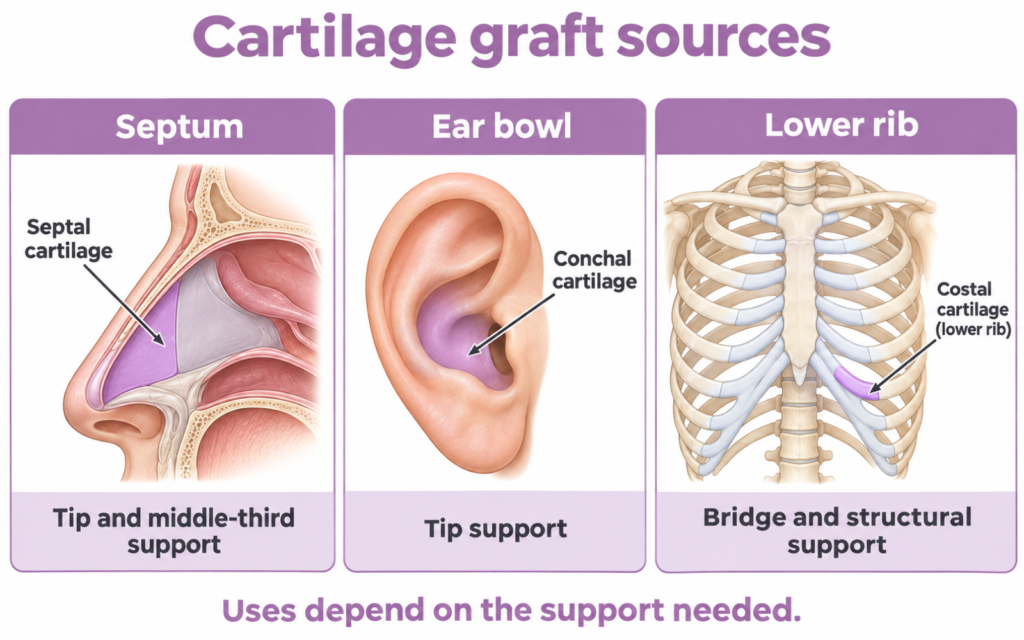
| Graft source | Why it is considered | Main limitations | Separate donor site? |
|---|---|---|---|
| Septum (inside the nose) | Straight, firm, already in the operating area | Limited amount; may be used up by earlier surgery | No |
| Ear (usually the concha, the bowl of the ear) | Curved and flexible, useful for some tip grafts | Softer and curved, so less suited to strong structural grafts | Yes, the ear |
| Your own rib | Plenty of strong cartilage for larger or load-bearing grafts | Can warp; chest wound, pain and scar; small risk of pneumothorax | Yes, the chest |
| Donor rib cartilage | Strong material without a chest wound | Behaviour depends on how it was processed; less evidence than for your own rib | No |
None of these is best for everyone. The right source depends on how much cartilage is needed, what it has to do and what’s already been used.
For ear grafts, UK consent guidance from Getting It Right First Time and the Royal College of Surgeons notes numbness over the ear that “usually resolves over 2 months”, rarely permanent, and a risk of the ear changing shape, especially after infection.
Does Rib Cartilage Always Come From The Patient’s Own Body?
Rib cartilage doesn’t always come from the patient’s own body. There are 3 categories worth keeping apart.
Your Own Rib Cartilage
This is called autologous cartilage. It’s your own tissue, so your body accepts it, but taking it means an extra wound on the chest.
Donor Cartilage
Donor cartilage is taken from someone who has died, supplied through a tissue bank and treated before use, sometimes with radiation. It avoids a chest wound. Not every product is prepared the same way, so one isn’t a stand-in for another. Ask which one they’d use, where it came from and how it was treated. Longevita doesn’t supply graft products. Your surgeon and clinic choose the material.
Synthetic Implants
Implants are man-made, so they aren’t cartilage of any kind. They come with their own risks and they’re a different thing from a rib graft. If someone suggests one, ask what it’s called and have it explained separately.
What Does Cartilage Harvesting Involve For The Patient?
If it’s your own rib, the surgeon makes a cut on your chest, usually over the lower ribs, takes out a piece of cartilage and stitches you up. It’s done under the same general anaesthetic as the nose surgery.
The Chest Scar
You’ll have a scar on the chest. The more cartilage they need, the longer it tends to be. For women, some surgeons tuck it in or near the fold under the breast. Ask where yours will go and how long it’s likely to be.
Pain And Breathing
Plenty of people find the chest hurts more than the nose to begin with. Laughing hurts. So does coughing, and so does a deep breath. NHS teams who use rib cartilage to rebuild ears, which is a different operation, warn patients that coughing gets harder afterwards and give them breathing exercises.
2 Wounds, 2 Sets Of Problems
A graft-related problem shows up in the nose: a graft that bends, shrinks or becomes infected, or a shape that isn’t what was planned. A donor-site problem is on your chest: pain, a scar that heals badly, or, rarely, a pneumothorax. Tell your surgeon which one you mean. They’re dealt with differently.
What Risks And Limitations Should You Discuss?
Think of the risks in 2 piles. Some belong to the graft sitting in your nose. Others belong to the chest it came from. On top of these sit the usual risks of nose surgery, which the NHS lists, including permanent breathing difficulty, an altered sense of smell and heavy nosebleeds.
Graft Risks
Warping is the one people hear about most. Rib cartilage is under a kind of built-in tension, and once it’s been carved it can slowly curl. In your nose, that might mean the bridge creeping to one side. Surgeons have tricks for carving and preparing it to cut that risk down, but nobody can get it to zero. A graft can also shrink a little as the body absorbs it, get infected, move, or show through thin skin.
Donor-Site Risks
The GIRFT and Royal College of Surgeons consent for septorhinoplasty puts it plainly: “If cartilage or bone is harvested from the rib during the operation, there is a risk of a pneumothorax occurring.” It happens if the thin lining round the lung gets nicked. You might need a chest drain and a few more days in hospital. Beyond that, the chest can hurt, the wound can get infected, the scar can thicken or stretch, and you may be left with a slight dip.
Why Rib Doesn’t Guarantee The Result
Rib cartilage gives a surgeon more to work with. Your result still isn’t locked in. Swelling plays a part, and so do your skin, how you heal and what the graft does over the years. Most rib graft studies are small, and they prepare the cartilage in different ways. A number from one of them isn’t your number.
How Does A Rib Graft Affect Recovery Planning?
A rib graft adds a second wound to your recovery, and the chest may well be the part that limits what you can do in the first days, more than the nose.
That changes some practical plans. Lifting, carrying luggage, twisting and anything that pulls on the chest may be uncomfortable. Pain relief needs to cover both areas. The chest wound needs its own check, separate from the nose. If you’re travelling for treatment, ask your surgeon how the chest wound affects when you can fly and what you’ll be able to carry. Our rhinoplasty in Turkey page explains how treatment is arranged through Longevita, and our rhinoplasty recovery guide covers the nose side of healing.
Get help if you’re in the UK and you notice:
- You suddenly can’t catch your breath, or your chest hurts, especially in the days after surgery.
- The chest wound turns red, hot or puffy, starts leaking, or you run a temperature.
- Your nose bleeds heavily and won’t stop.
In the UK, in an emergency: call 999 or attend the nearest A&E. If you’re not sure whether something is urgent, NHS 111 can advise.
Did Longevita arrange your treatment? Contact your clinician’s support team (contact details are in your Appointment Schedule). Anything urgent goes to 999, A&E or NHS 111 first.
What Should You Ask Before Agreeing To A Rib Graft?
Ask why your nose needs rib, what else could work, and what the chest part means for you. They’re worth asking before you’re anywhere near an operating table.
- Why do I need rib cartilage, and not septal or ear cartilage?
- How much cartilage do you think you’ll need, and where’s it going?
- Would it be my own rib or donor cartilage? If donor, which product and how is it processed?
- Where would the chest scar be, and how long?
- How do you reduce the risk of warping?
- What would happen to the nose if a graft warped or was absorbed?
- If the plan changes during surgery, which other graft sources am I agreeing to?
- How will the chest wound affect when I can fly and what I can carry?
That 7th question matters. In the UK, septorhinoplasty consent forms list taking cartilage from the ear or rib as possible extra steps, so you sign up to them beforehand. Once the operation is under way, a surgeon may find there’s less septum than they hoped. Your consent should spell out what they can fall back on, and what they can’t. Nobody wants to wake up with a chest wound they never agreed to.
If you’d like Longevita to arrange a consultation with an independent clinician, contact us or book a free Discovery Call with us.
Myths And Facts
| Myth | Fact |
|---|---|
| “Rib cartilage is always better because it's stronger.” | Strength suits some grafts. The best source depends on what the graft has to do and how much is needed. |
| “Using my own rib means no extra risks.” | The chest becomes a second surgical site, with pain, a scar and a small risk of pneumothorax. |
| “Donor cartilage is all the same.” | Products differ in how they're processed. Ask what would be used. |
| “A rib graft fixes the shape for good.” | A graft can bend or shrink over the years, and how you heal still counts. |
Frequently Asked Questions
Is rib cartilage rhinoplasty only used for revision surgery?
It’s common in revisions, where the septum may already be used up. But some first-time noses need so much support that rib comes into it too.
How big is the scar on the chest?
That depends on how much cartilage they take. Your surgeon can tell you roughly how long it’ll be and where it’ll sit.
What is graft warping?
It’s when carved rib slowly bends away from the shape it was cut into. Your bridge, or some other part of your nose, can end up looking crooked.
Can I choose donor cartilage to avoid a chest wound?
Donor cartilage can avoid a chest wound, but it isn’t offered everywhere and products vary. Whether it suits your nose is a decision for your surgeon after examining you.
- Last Updated:

Prof. Dr. Fuat Yüksel
Board-certified plastic surgeon (TSPRAS) · ISAPS member · 34+ years' experience
Last reviewed
Known around the world for his surgical prowess, Prof. Dr. Fuat is a board-certified plastic surgeon and an active member of the International Society of Aesthetic Plastic Surgery (ISAPS). He has performed over 25,000 surgical procedures in his illustrious 34-year career. A number of his research articles have been in well-reputed medical journals, and he has authored a book as well as written a book chapter. His expert opinion is also often sought-after in the media. Prof. Dr. Fuat can speak both English and Turkish fluently.
Request A Callback For A Discovery Call
With Longevita, you have the option to discuss your goals with us from the comfort of your couch.
- A UK-registered medical tourism facilitator
- Trusted by over 150,000 clients
- A free, no-obligation discovery call