
Liposuction Recovery: What to Expect as You Heal
Key Takeaways:
- You’ll be walking on day 1. The treated area needs up to 6 months to settle.
- Swelling keeps rising for 10 to 14 days before it starts to fall.
- The compression garment stays on for several weeks, and your surgeon decides how many.
- NHS guidance: gentle exercise at around 3 to 4 weeks, nothing strenuous for 10 to 12.
- Had surgery abroad? The NHS says wait 5 to 7 days before you fly home.
How Long Does Liposuction Recovery Take?
Most people are back to everyday life within a few weeks of liposuction. The treated area itself takes longer, and the NHS allows up to 6 months for it to settle completely. Think of it as a short recovery and a long one running side by side.
How short is the short one? That’s where it gets personal. Somebody who had a small area treated under local anaesthetic and sits at a desk all day is in a very different position from somebody who had abdomen, flanks and thighs done together and spends their shifts on their feet. The NHS doesn’t offer a standard number of days off. It says the answer depends on your job and on how much was treated. So get a date from your surgeon before you book leave, and ask them what they’re basing it on.
What Does Recovery Look Like Stage By Stage?
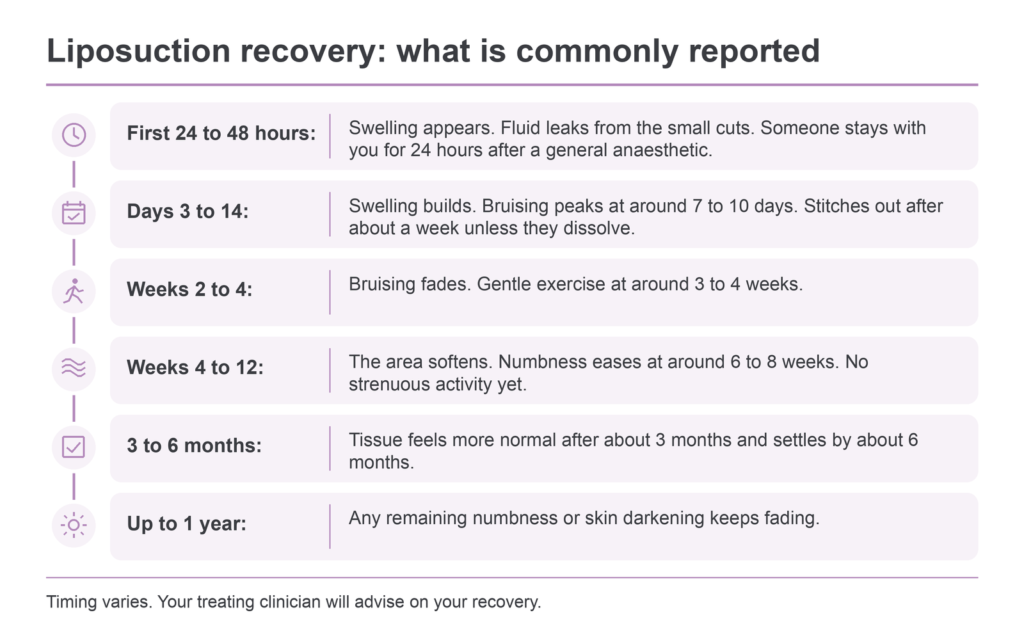
Liposuction recovery goes in a fairly reliable order. First swelling and some leaking from the cuts, then bruising, then weeks of the area slowly softening. What isn’t reliable is the timing, so use the table below to see what comes next and don’t worry if your dates are off. As a rule, the more areas treated, the longer each stage lasts.
| Stage | What is commonly reported |
|---|---|
| First 24 to 48 hours | Swelling appears. Fluid leaks from the small cuts. After a general anaesthetic you need someone with you for 24 hours. |
| Days 3 to 14 | Swelling carries on building. Bruising peaks at around 7 to 10 days. Stitches come out after about a week unless they dissolve. |
| Weeks 2 to 4 | Bruising fades. Gentle exercise becomes possible at around 3 to 4 weeks. |
| Weeks 4 to 12 | The treated area starts to soften. Numbness eases at around 6 to 8 weeks. Strenuous activity is still off limits. |
| 3 to 6 months | Tissue feels more normal after about 3 months. The area finishes settling by about 6 months. |
| Up to 1 year | Any remaining numbness or skin darkening continues to fade. |
Running a week or 2 behind the table is nothing to worry about. A symptom that’s heading the wrong way is, and that’s when to ring your surgeon.
Why Do You Look Bigger Before You Look Smaller?
You look bigger before you look smaller after liposuction because of swelling, and because that swelling doesn’t peak when you’d expect. You’d assume day 2 or 3. In fact a 2013 review in the Indian Journal of Plastic Surgery found it shows up within 24 to 48 hours and then goes on mildly increasing for the first 10 to 14 days. The upshot is that 2 weeks in, right when you were hoping to see something, you’re at your most swollen.
It’s a horrible moment if nobody warned you. Old jeans come out of the wardrobe around day 10, they’re tighter than before the operation, and the obvious conclusion is that it hasn’t worked. It has. The fat really is gone. Fluid is sitting where it used to be, and fluid drains.
Expect the area to feel hard as well. That eases from about week 4, according to the same review. What we’re describing here is temporary firmness during healing. Lumpy or uneven results that are still there months later are another thing entirely (the NHS lists them among the complications), and there’s more on those further down and in our guide to hard lumps after liposuction.
Bruising and swelling run on different clocks after liposuction. Bruising is worst at 7 to 10 days and has generally cleared by 2 to 4 weeks. Swelling is still climbing at 10 to 14 days and then takes months to go. So anything you see in the first fortnight is swelling. It says nothing about your result.
How Long Do You Wear The Compression Garment?
A compression garment is worn for several weeks after liposuction, and at the beginning that means day and night. The NHS wording is an elasticated support corset or compression bandages worn constantly for several weeks to help with swelling and bruising. A 2013 review gives 4 to 6 weeks in most cases, and 8 to 12 if loose skin is a worry. Whatever your surgeon tells you overrides both, so ask for the number of weeks and hours a day in writing.
Our guide to compression garments after liposuction covers how long to wear one, how it should fit, what a stage 2 garment is and what to ask before you leave the hospital. Whether a garment also helps skin tighten is a separate question, covered in our guide to loose skin after liposuction.
When Can You Work, Drive, Exercise And Fly?
Walking and light activity are fine from the start after liposuction, according to the NHS. Gentle exercise comes back at around 3 to 4 weeks, and anything strenuous waits 10 to 12 weeks. Nobody will give you a standard date for work or driving, because both hang on your job, the areas treated and the anaesthetic. If the operation was abroad, NHS advice is to wait 5 to 7 days before flying home.
| Activity | What the guidance says |
|---|---|
| Walking and light movement | Fine from the start |
| Work | Depends on your job and how much was treated. Agree on a date with your surgeon. |
| Driving | Up to your surgeon, who will go by your treatment and anaesthetic. Check your insurance policy as well. |
| Gentle exercise | At around 3 to 4 weeks |
| Strenuous activity | Avoid for 10 to 12 weeks |
| Flying home after surgery abroad | Wait 5 to 7 days after liposuction |
Why the wait before flying? Blood clots. The NHS page on cosmetic surgery abroad points out that surgery raises the risk of a clot and so does air travel. Had a tummy tuck at the same time? Then the wait on that page goes up to 7 to 10 days. Either way, run your flight date past your surgeon before you pay for the ticket. For what kind of exercise to restart with, see our guide to exercise after surgery.
Flying after liposuction: NHS guidance for people having cosmetic surgery abroad is to wait 5 to 7 days after liposuction before flying, and 7 to 10 days after a tummy tuck. The reason is blood clots. Air travel and major surgery each raise the risk, and together they raise it further.
What Is Normal During Recovery, And What Isn’t?
A lot is normal after liposuction. Expected side effects include bruising, swelling, numbness, scars, fluid coming from the cuts and, where the legs were treated, swollen ankles. For bruising and swelling together it gives an outer limit of 6 months, and for numbness 6 to 8 weeks. Those are outer limits, though. Bruising has generally faded by 2 to 4 weeks in the 2013 review, which also found that feeling in the skin is close to normal by the end of the first year.
Complications are a different list, and a shorter one than a late-night search would have you believe. In 2024, Aesthetic Surgery Journal published a meta-analysis that pooled 39 studies and 29,368 patients. The overall complication rate was 2.62%. (Each complication was pooled separately, so don’t expect the rows below to add up to that figure.)
| Complication | Pooled rate (Comerci et al., 2024) |
|---|---|
| Uneven contour | 2.35% |
| Skin darkening | 1.49% |
| Seroma (a pocket of fluid) | 0.65% |
| Haematoma (a collection of blood) | 0.27% |
| Infection | 0.020% |
| Blood clot in a vein | 0.017% |
Look at the top row. Uneven contour is the most common problem and also the hardest to judge early, because the true surface is hidden while it’s swollen. Dixit and Wagh’s 2013 review advises leaving at least 6 months before anyone plans a correction. If there’s a dip or a ridge bothering you at week 6, take a photo and raise it at your next review. Then wait and see what it does.
A 2024 meta-analysis covering 29,368 liposuction patients found a complication in 2.62% of them. Uneven contour was the most frequent at 2.35%. Infection (0.020%) and blood clots (0.017%) were far rarer, though those 2 are the ones that need treating urgently.
Does Lymphatic Drainage Massage Help?
Nobody knows yet whether lymphatic drainage massage helps after liposuction. Lymphatic drainage massage is recommended all over the place after liposuction, but hardly anyone has tested it. The study we found, published in The American Journal of Cosmetic Surgery in 2020, had just 20 women in it, all recovering from abdominoplasty with liposuction. Swelling fell by an average of 9.8 cm in the massage group and 6.6 cm in the other, but the difference wasn’t statistically significant. 20 people is too few to conclude much. If you fancy trying it anyway, ask your surgeon first. Our guide to lymphatic drainage massage after cosmetic surgery explains the technique and who shouldn’t have it.
When Will You See The Final Result?
You’ll see the final result of liposuction once the swelling has gone, and the NHS allows up to 6 months for that. It also warns that results aren’t always noticeable until then.
There will be signs along the way. At some point after the first month, as the swelling starts to come down, a waistband sits differently or a top hangs better. Enjoy those, but don’t read too much into any single day. A better habit is a set of photos every 4 weeks, same light, same underwear. When you’re having a bad day in front of the mirror, the photos are more honest.
What Does Longevita Do During Your Recovery?
Longevita doesn’t handle the medical part of your recovery. It’s a UK-registered facilitator, so it doesn’t operate and it doesn’t give clinical advice. Liposuction arranged through Longevita takes place in Istanbul, with independent clinicians at accredited independent hospitals.
Once your Appointment Schedule is issued, you deal with the clinician directly about your treatment. Questions about your recovery, with photos if they help, go to your clinician’s support team (contact details are in your Appointment Schedule). Our guide to post-treatment support once you are back in the UK explains what to expect once you’re home. For the procedure itself, see the liposuction page.
When Should You Get Urgent Help?
Go straight to 999 or A&E if you have chest pain, trouble breathing, you’re coughing up blood, a calf is hot, swollen and painful, you’re bleeding and it won’t stop, or you feel faint and confused. Don’t message the clinic first and wait for a reply. Blood clots and fluid in the lungs both appear on the NHS list of liposuction risks, and these are the symptoms they cause.
Call 999 or go to A&E
- Chest pain or shortness of breath
- A hot, swollen, painful calf
- Bleeding that soaks through dressings and doesn’t slow with pressure
- Feeling faint, confused or very unwell
Contact your surgeon the same day
- Severe pain, or pain that is getting worse
- Redness that is spreading, skin that is hot to touch, or a temperature
- Pus or a bad smell from a wound
- A wound that is opening up (see wound dehiscence after plastic surgery)
- A swelling that is growing on 1 side
- Skin that turns dark, dusky or blistered
The NHS line on this is simple: severe pain or anything unexpected, contact the clinic that operated on you as soon as possible. If you can’t tell whether something counts, NHS 111 will help you decide, and it’s open through the night. If your procedure was arranged through Longevita, contact your clinician’s support team (contact details are in your Appointment Schedule). For anything urgent, use 999 or A&E.
Before You Book Your Time Off
3 conversations with your surgeon will save you a lot of guesswork later. Ask when you’re likely to be back at work given the areas being treated. Ask for the garment instructions on paper. And settle the date of your flight home before you buy it.
If you’d like Longevita to arrange a consultation with an independent clinician, contact us or book a free Discovery Call with us.
Frequently Asked Questions
Can I shower after liposuction?
Yes. The NHS says the bandage or corset can be taken off while you shower. How soon after the operation is something to check with your surgeon.
When do the stitches come out?
Stitches come out about a week after surgery. Dissolvable stitches don’t need removing.
How long does numbness last after liposuction?
Numbness should go within 6 to 8 weeks, according to the NHS. Full feeling takes longer to return. Dixit and Wagh’s 2013 review puts it at close to normal by the end of 1 year.
How soon after liposuction am I able to fly?
The NHS advises 5 to 7 days after liposuction and 7 to 10 if a tummy tuck was done as well. Your surgeon should confirm the date.
What if the result looks uneven?
Tell your surgeon, and then give it time. A swollen surface looks uneven for months. The 2013 review by Dixit and Wagh advises waiting at least 6 months before a corrective procedure is planned.
- Last Updated:

Dr. Mustafa Ekrem Güleş
Specialist in plastic, reconstructive and aesthetic surgery · Member of the Turkish Society of Plastic, Reconstructive and Aesthetic Surgeons
Last reviewed
Dr. Mustafa Ekrem Güleş is a highly experienced independent Specialist in Plastic, Reconstructive and Aesthetic Surgery, with a strong focus on breast and body contouring procedures. With extensive clinical training and international exposure, he is known for his precise, patient-focused approach and commitment to achieving natural-looking results tailored to individual goals. Dr Ekrem performs his procedures in Istanbul.
Request A Callback For A Discovery Call
With Longevita, you have the option to discuss your goals with us from the comfort of your couch.
- A UK-registered medical tourism facilitator
- Trusted by over 150,000 clients
- A free, no-obligation discovery call