
Revision Rhinoplasty: What to Know Before Further Nose Surgery
Key Takeaways:
- Revision rhinoplasty is further surgery on a nose that has already had a rhinoplasty, and it is harder than a first operation.
- For cosmetic concerns, many surgeons wait about 12 months. Breathing problems are reviewed sooner.
- Scar tissue, altered anatomy and limited cartilage put limits on the result, and a graft from the ear or rib is sometimes needed.
- An independent clinician decides whether revision is suitable. Longevita arranges access to treatment.
- A revision is never automatically free, so get the cost terms in writing.
A revision rhinoplasty is a second (or third) operation on a nose that a surgeon has already worked on. Nobody finds it easier than the first one. The inside of the nose isn’t how nature left it, scar has grown through it, and the cartilage a surgeon would normally borrow has, more often than not, been spent already. How it looks gets judged late, once the swelling is truly gone, and for plenty of people that’s the best part of a year. Trouble breathing, or something obviously out of place, gets seen sooner. Whether you’re a candidate is for a surgeon to say after examining you. What you’re aiming for is better. Perfect isn’t on offer from anyone.
Chances are you’re here because the first operation let you down. That’s a hard position to be in, and it makes a fast fix look very tempting. So this guide slows things down: how surgeons weigh up a second operation, why it isn’t a repeat of the first, and where its limits are. Take it into your next appointment.
What Is Revision Rhinoplasty?
Call it revision rhinoplasty, secondary rhinoplasty or a second nose job, it’s the same thing: surgery on a nose that has had at least 1 rhinoplasty already. Some people want it to look better. Some want to breathe through it again. Plenty want both. And the size of the job varies hugely. At one end a surgeon tidies a single spot. At the other, the framework is rebuilt with cartilage borrowed from an ear or a rib.
| Scale of revision | What it involves | Example |
|---|---|---|
| Minor | 1 limited area, little or no grafting | Smoothing a small bump left on the bridge |
| Moderate | Reshaping plus some support grafts | Correcting a drooping or asymmetric tip |
| Major | Rebuilding lost structure, graft from ear or rib | Restoring a bridge that was over-reduced |
Needing further surgery is not rare. How common? Depends who you ask. A 2018 paper in Plastic and Reconstructive Surgery Global Open puts the surgical revision rate reported in the literature at 5% to 15%. A much larger US study in JAMA Facial Plastic Surgery followed 175,842 people for 3 years or more. First-time operations were revised in 3.1% of cases. For noses already revised once, it was 11.0%. That second figure deserves attention. Each operation makes another more likely. If you’re going to revise, that’s the reason to be fussy about when, and about whether.
Why Do People Consider A Second Nose Job?
People consider a second nose job for 3 main reasons: the nose doesn’t look the way they were told it would, they can’t breathe through it properly, or it took a knock before it had healed. A fair few people have 2 of these at once. Sorting out which problem matters most to you is the first job of any assessment, because the surgical plan follows from it.
Appearance concerns include a bump that was left behind, a bridge taken down too far, a tip that sits unevenly, or fullness above the tip known as a pollybeak deformity. Breathing complaints tend to trace back to the septum or to the narrow valve areas inside the nose, which is why some revisions are planned as a septorhinoplasty. A knock during healing is the third route, covered in our guide to hitting your nose after rhinoplasty.
Breathing is the factor people underestimate. The same 2018 paper looked at who ended up back in theatre. Patients with a breathing disorder before their first operation had about 3 times the odds.
Seeing a surgeon about a revision doesn’t sign you up for one. In a series of 275 people who attended a revision consultation, presented as a conference abstract in Plastic and Reconstructive Surgery Global Open in 2024, 34.2% went on to have surgery. The rest were advised to wait, chose not to proceed, or did not return.
A revision consultation is an assessment, and surgery is not its only possible outcome. In a published series of 275 people seeking revision rhinoplasty, about 1 in 3 proceeded to an operation. If the answer is “wait”, or “this won’t help”, you haven’t wasted the appointment. Some of the time that’s the best thing you’ll hear.
When Can Revision Rhinoplasty Be Considered?
For cosmetic concerns, many surgeons work to a rough rule of about 12 months after the last operation. That isn’t a fixed date, and the surgeon who examines you decides. The logic is simple: a shape that’s still moving shouldn’t be operated on. A blocked airway, a graft that has moved or a fresh injury won’t be left that long.
Why so slow? Because a swollen nose is misleading. The NHS says swelling takes up to 6 months to go completely, and surgeons will tell you the tip keeps refining after that, especially under thick skin. Something that looks like a surgical mistake at month 4 is sometimes gone by month 10. Our rhinoplasty swelling guide walks through what’s normal and when.
| What you notice | What it could be | What generally happens next |
|---|---|---|
| Fullness or unevenness in the first few months | Swelling that is still settling | Review with your surgeon, then watch and compare photos |
| Breathing that stays blocked or gets worse | Internal swelling, or a septum or valve problem | Earlier clinical review, without waiting a year |
| Shape changed after a knock | Possible movement of bone, cartilage or a graft | Prompt review by the treating surgeon |
| A concern that has not changed for several months, a year or so on | Likely the settled result | Revision assessment |
Worth remembering: the timing of a revision rhinoplasty is set by the surgeon who examines the nose, not by the calendar. Cosmetic concerns wait until swelling and scar tissue have settled. Breathing obstruction and structural problems are assessed earlier.
A Photo Habit Worth Starting Today
Pick a spot in the house with decent light. Every month, 3 photos there: straight on, side on, and from below. A year of those, with dates, beats anything you’ll manage to describe in the consulting room.
Why Is A Revision Harder Than The First Operation?
The surgeon is no longer working on a normal nose. Everything difficult about a revision follows from that, and there are 3 main reasons.
- The map is wrong: Bits of cartilage have been trimmed, sewn, shifted or removed altogether. How, exactly? The new surgeon finds out when the nose is open and not before. That’s why the notes from your earlier operation matter. Ask the first clinic for a copy.
- Scar tissue: Scar sticks the skin down to whatever lies beneath and buries the landmarks surgeons navigate by. A 2013 review in Acta Otorhinolaryngologica Italica describes how, after a first operation, dissection is tedious and “landmarks are lost”. Then, once the revision is done, the body heals with scar again. That limits what any surgeon can promise.
- The skin itself: It has less blood supply than it did and less stretch. Thin skin shows every edge beneath it. Thick or scarred skin is stubborn. Ask it to shrink over a smaller frame and it mostly won’t, so making a nose smaller a second time is hard going.
Surgical skill doesn’t get round scar tissue. During the operation it hides anatomy that has already been altered. Afterwards the body lays down fresh scar, as it does after any surgery. So surgeons talk about improving a named problem, and a careful one won’t promise you an exact final shape.
Will You Need A Cartilage Graft?
Many revisions need a cartilage graft. If the first operation took away too much support, something has to replace it, and that something is your own cartilage.
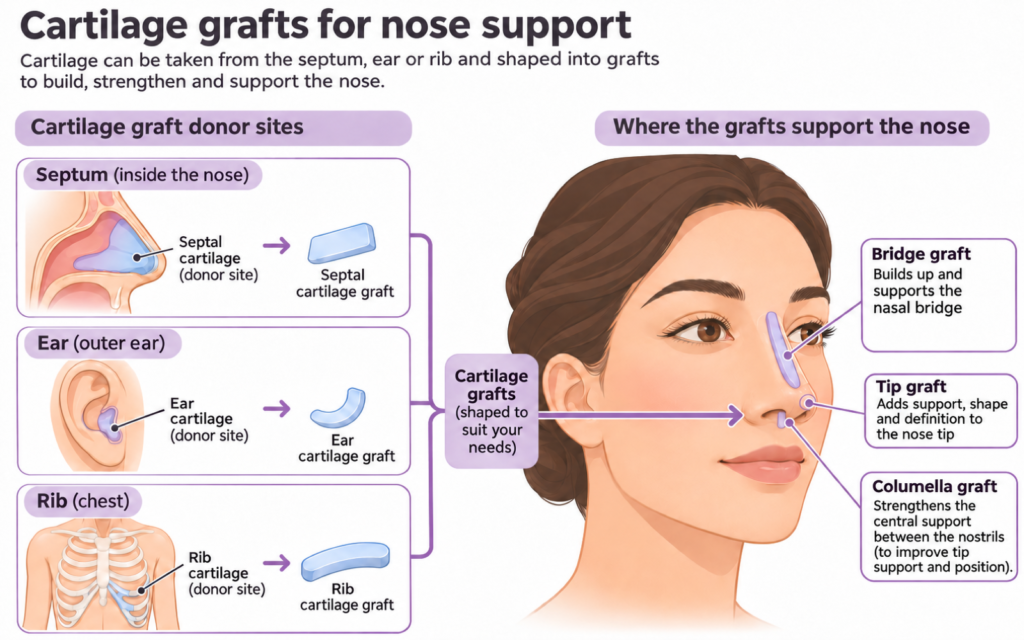
The septum is the first choice because the cartilage is straight and already inside the nose. The catch is that the first surgeon has frequently used it up. Next comes the ear, which gives softer, curved pieces that suit contour work. For a big rebuild, surgeons take a section of rib. That means a longer operation, a scar on the chest and a sore ribcage for the first few weeks.
A question to put to your surgeon: “If my septum turns out to be no use once you’re in there, what’s plan B?” Settle the answer before the day.
Do Rib Grafts Warp?
Rib grafts have a reputation for warping, so here are the figures. When Wee and colleagues pooled the studies for JAMA Facial Plastic Surgery in 2015, warping came out at 3.08%, infection at 0.56% and resorption at 0.22%. A 2022 update in Aesthetic Plastic Surgery landed on almost the same warping rate, 3.05%.
What Happens At A Revision Rhinoplasty Assessment?
A revision rhinoplasty assessment establishes 3 things: what was done before, what’s wrong now, and whether another operation stands a decent chance of helping. Expect it to take longer than your first consultation did. That means a full history, a look inside the nose as well as at it, a check of the airway and a close study of your photos. You’ll leave with 1 of 3 answers: operate, wait, or leave it alone.
Bring these with you:
- Operation notes or the discharge summary from every previous nose surgery
- Dated photos, including some from before the first operation
- A note of your breathing symptoms and which side is worse
- Details of any injury since surgery
- Your medicines, and an honest answer about smoking or vaping
- The 1 or 2 changes you want most, in order
That last point is not a formality. A list of 5 small complaints almost never gets 5 fixes in a single operation.
You’ll be asked how much the nose is on your mind day to day. Don’t take it personally. A meta-analysis found that 32.7% of people seeking rhinoplasty screened positive for body dysmorphic disorder, although the studies varied a lot, and an operation doesn’t treat that.
Same surgeon or a new one? Either is fine. About 3 in 10 revision patients switched surgeons in a 2020 study of a Florida surgery database, published in Laryngoscope Investigative Otolaryngology. The original surgeon knows what was done. A new one sees the nose without any history attached.
What Will A Revision Fix, And What Won’t It?
A revision will improve a problem that someone is able to point at. A collapsed valve. A visible dent. A tip with nothing holding it up. It won’t give you back the nose you had before the first operation, and it won’t deliver perfect symmetry or the nose in a saved photo. The NHS is blunt that the results of nose reshaping cannot be guaranteed. That applies even more to a revision.
The research agrees. In a study of 54 revision and 54 first-time patients, satisfaction went up in both groups. It went up less in the revision group.
Try this before you commit. Say what you want changed in a single sentence. If the surgeon says it back to you and agrees it’s doable, good. If your sentence keeps getting longer, you’re not ready to book.
Revision rhinoplasty does improve patient satisfaction, but by less than a first rhinoplasty, and about 1 in 9 revised noses in the largest published dataset went on to further surgery. Expect improvement. Don’t expect perfection.
What Are The Risks Of Revision Rhinoplasty?
All the risks of a first rhinoplasty still apply. The NHS page on nose reshaping lists breathing difficulty that doesn’t go away, damage to the septum, a sense of smell that isn’t what it was and heavy nosebleeds. Then the ones every operation carries, namely bleeding, infection, a blood clot or a bad reaction to the anaesthetic.
| Risk | Why it is more relevant in revision |
|---|---|
| Slow or poor skin healing | Earlier surgery has reduced the blood supply to the nasal skin |
| Visible or shifting graft | Grafts sit under skin that is thinner or tighter than before |
| Graft bending or shrinking | Mainly a concern with rib cartilage |
| Donor-site problems | Scar, discomfort or numbness at the ear or chest |
| Persistent swelling | Scarred tissue drains fluid more slowly |
| A further operation | More likely after a revision than after a first operation |
Be straight with your surgeon about cigarettes and vapes. NHS Fife’s advice on smoking and surgery lists better wound healing and fewer wound infections among the benefits of stopping before an operation. Mention filler too, if you’ve ever had any in your nose. People forget, and the surgeon needs to know before operating, not during.
How Does Recovery Differ After A Revision?
For the first 2 weeks you’d struggle to tell it from a first rhinoplasty. Splint on for about a week. Bruises fading over 2 to 3. Back to hard exercise at 4 to 6 weeks, which is what the NHS advises. After that they part ways. A scarred nose holds its swelling longer, so you wait longer for the real result, and if a graft was taken there’s a second site healing as well.
Don’t judge a revision at 3 months. It’s a poor guide after a first operation and a worse one now. Had rib cartilage taken? Your chest will complain when you cough, laugh or lift anything for the first few weeks. As for flying and the gym, go by what your surgeon tells you.
Who Decides What When Treatment Is Arranged Through Longevita?
Longevita doesn’t operate on anyone. It’s a UK-registered facilitator, and revision rhinoplasty arranged through Longevita takes place in Istanbul, with independent clinicians at accredited independent hospitals. Longevita handles your enquiry, passes on the clinician’s treatment plan, quote and suitability decision, then confirms your dates and issues your Appointment Schedule. From then on, you deal with the clinician directly about your treatment. Examining you, deciding whether you’re suitable, choosing a technique, giving medical advice: none of that is Longevita’s job. With a revision rhinoplasty, the independent clinician who assesses you makes every clinical decision, whether to operate at all included, and follow-up too.
| Task or decision | Who is responsible |
|---|---|
| Reviewing your history, photos and operation notes | Independent clinician |
| Deciding whether revision is suitable, and when | Independent clinician |
| Choosing the technique and any graft | Independent clinician |
| Medical advice during recovery | Independent clinician |
| Arranging your consultation and passing on the clinician's treatment plan and quote | Longevita |
| Confirming your dates and issuing your Appointment Schedule | Longevita |
| Questions about your treatment after the Appointment Schedule | The clinician's support team |
| Booking and paying for travel and accommodation | You, arranged separately |
Cost is where expectations most need to be clear. Nobody is in a position to promise a free revision. A clinician is able to waive their own fee in some circumstances, while hospital, anaesthetic, medication and travel costs remain payable. Ask for this in writing before a first operation, which is also what the Royal College of Surgeons advises for any cosmetic surgery. Our guide to post-treatment support once you are back in the UK explains what to expect once you’re home.
If your first operation took place elsewhere, the same rule applies. The clinician will want your earlier notes before giving an opinion. Readers weighing up treatment abroad will find the wider picture in our guide to rhinoplasty in Turkey.
A facilitator and a clinician do different jobs. Longevita arranges access to treatment. An independent clinician carries out the assessment, decides whether revision rhinoplasty is appropriate, performs the surgery and directs medical follow-up. A revision is never automatically free: a clinician might waive their own fee, and other costs, including travel and accommodation, stay with the client.
When Should You Contact Your Surgeon Or Seek Urgent Help?
Contact your treating surgeon the same day if pain, redness or swelling is getting worse, if you have a fever, or if the shape of your nose changes after a knock. Call 999 or go to A&E for heavy bleeding that will not stop, difficulty breathing, chest pain, or a swollen, painful calf. Waiting to see whether these settle is not safe after any nose surgery.
Call 999 or go to A&E
- Bleeding that soaks through dressings and does not slow with pressure
- Struggling to breathe, or chest pain, particularly after a rib graft or a flight
- A hot, swollen, painful calf
- Sudden change in vision, or swelling of the lips, tongue or throat
Contact your surgeon the same day
- Skin on the nose turning dusky, dark or blistered
- Pus, a foul smell or a rising temperature
- Both sides of the nose blocked together with increasing pain and pressure
- A knock followed by new bruising, bleeding or a change in shape
For anything in between, NHS 111 is available at any hour. If your procedure was arranged through Longevita, contact your clinician’s support team (contact details are in your Appointment Schedule). For anything urgent, use 999 or A&E.
Thinking About A Revision? Start Here
If your nose has settled and something still bothers you, the next step is an assessment, not a booking. Gather your operation notes and dated photos, write down the 1 change you want most, and put your questions to a surgeon. If you’d like Longevita to arrange a consultation with an independent clinician, contact us or book a free Discovery Call with us. The clinician will tell you whether a revision is worth considering, and when.
Frequently Asked Questions
How long after rhinoplasty can I have a revision?
For cosmetic concerns, many surgeons wait about 12 months for swelling to settle. Breathing obstruction or a displaced graft is assessed earlier. Your surgeon sets the timing after examining you.
Is a second nose job more expensive than the first?
In most cases, yes. The operation takes longer, calls for more experience and sometimes includes a graft from the ear or rib. Each case is quoted individually after assessment, so treat any fixed figure given before an examination with caution.
Could filler fix the problem instead?
For a small dip or ridge, some surgeons do use hyaluronic acid filler in place of more surgery. A London surgeon’s review of his own practice, published in Aesthetic Surgery Journal Open Forum in 2023, reported it in 10.6% of 800 rhinoplasty patients. It wears off, it does nothing for breathing or structure, and it carries real risks in an operated nose.
How many revisions can one nose have?
There’s no fixed number of revisions one nose can have. Each operation adds scar tissue, uses up graft material and raises the odds of needing another. Surgeons grow more cautious with every round, and at some point advise stopping.
Is revision rhinoplasty available on the NHS?
Revision rhinoplasty isn’t available on the NHS for cosmetic reasons. The NHS says nose surgery is sometimes provided when it is needed to help you breathe, so speak to your GP if breathing is your main problem.
- Last Updated:

Prof. Dr. Fuat Yüksel
Board-certified plastic surgeon (TSPRAS) · ISAPS member · 34+ years' experience
Last reviewed
Known around the world for his surgical prowess, Prof. Dr. Fuat is a board-certified plastic surgeon and an active member of the International Society of Aesthetic Plastic Surgery (ISAPS). He has performed over 25,000 surgical procedures in his illustrious 34-year career. A number of his research articles have been in well-reputed medical journals, and he has authored a book as well as written a book chapter. His expert opinion is also often sought-after in the media. Prof. Dr. Fuat can speak both English and Turkish fluently.
Request A Callback For A Discovery Call
With Longevita, you have the option to discuss your goals with us from the comfort of your couch.
- A UK-registered medical tourism facilitator
- Trusted by over 150,000 clients
- A free, no-obligation discovery call