
Liposuction Vs Weight Loss Surgery: What Changes And Which Comes First?
Key Takeaways:
- What the scales say, how much fat you carry and where it’s stored can each change without the other 2 following.
- Liposuction can only reach fat under the skin. The fat wrapped round your organs, deep in the tummy, stays put.
- In a well-known study, removing a large amount of tummy fat by liposuction didn’t improve blood sugar control, blood pressure or cholesterol.
- Skin that hangs is its own problem. Lipo takes fat, and leaves the skin where it was.
- A steady weight matters more for planning than any single “ideal” number.
People often weigh up these 2 options as though they were faster and slower versions of the same thing. They aren’t aimed at the same target. One changes weight. The other changes contour, meaning the outline of one part of the body.
Working out which of those you’re really after decides who you should be talking to next. This guide is about making that choice clearer. For how liposuction itself is arranged, see liposuction in Turkey. Longevita, a UK-registered facilitator, doesn’t operate or prescribe. Independent clinicians do the assessing, diagnosing and recommending. Liposuction arranged through Longevita takes place in Istanbul, with independent clinicians at accredited independent hospitals.
What Is The Difference Between Liposuction And Weight Loss?
Losing weight brings your whole weight down. Liposuction takes fat from one chosen area to alter how it looks.
What Weight Loss Changes
When you burn more energy than you eat, your body dips into its reserves. Fat goes from all over, with some water and other tissue too. It won’t come off evenly, and it rarely starts where you’d like. What it can do is help with health problems linked to weight, which is why the NHS puts it first for obesity.
Weight management isn’t one single treatment. The NHS lists several kinds of help: eating and activity changes, weight management programmes, medicines, and surgery for some. Which one fits you comes down to an assessment of you.
What Liposuction Changes
Liposuction is cosmetic surgery. The surgeon makes a few small cuts and uses a thin tube to suck fat out from under the skin in one area. The NHS sees it as a way to change body shape, and says it “is not a treatment for obesity”.
| Aspect | Liposuction | Weight management |
|---|---|---|
| Primary objective | Change the contour of a specific area | Reduce overall body weight, often for health reasons |
| What is assessed | The fat under the skin there, how firm the skin is, your health | Your weight, any health conditions, your habits, sometimes where you store fat |
| Contour or overall weight | Localised contour | Overall weight, with no control over where fat comes off |
| Weight-related health goals | Not designed for them | Often the main reason for treatment |
| Limitations | Doesn't remove skin or fat deep inside the abdomen; surgical risks | Shape may still be uneven; some areas resist change |
| Ongoing care | Weight changes afterwards can affect the result | Usually needs long-term support to keep weight off |
Why Does The Location Of Body Fat Matter?
Fat’s location matters because liposuction can only reach fat lying under the skin, while fat stored deep inside the abdomen is linked to health risks and responds to weight loss, not surgery.
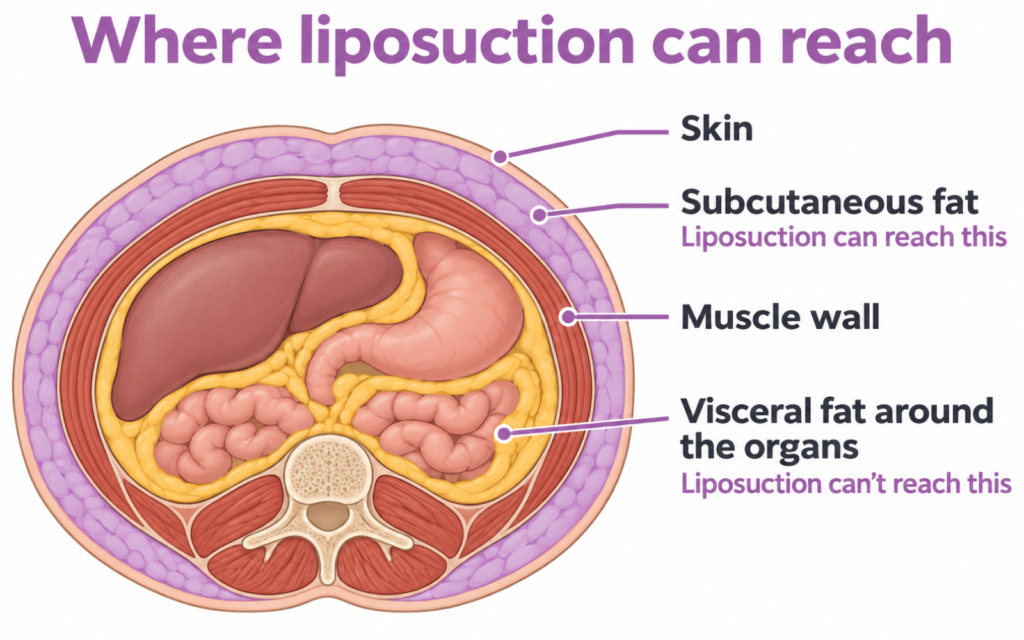
2 Kinds Of Abdominal Fat
Fat between your skin and muscle is called subcutaneous fat. It’s the soft layer you can grab, and lipo targets it. Visceral fat is deeper, inside the abdomen, packed in among the organs. That’s the fat more closely tied to type 2 diabetes and heart disease, and a liposuction cannula can’t get to it.
Why A Round Tummy Doesn’t Explain Itself
A tummy that sticks out might be fat under the skin, fat deep inside, loose skin, stretched muscles, or several at once. They can look much the same from outside. Telling them apart takes an examination, and some causes, a hernia for one, need a GP or surgeon to check. That’s a reason not to judge it from a mirror, a photograph or a tape measure at home.
Where BMI Fits
BMI compares weight with height. It’s a useful screening tool, but it doesn’t measure body fat directly or show where fat is stored. 2 people with the same BMI can carry fat very differently. A clinician will look at BMI alongside your health and an examination, so a number on its own doesn’t decide whether liposuction is suitable. Our guide to body mass index and plastic surgery explains more.
Weight, Fat And Shape Are 3 Different Things
Weight is what the scales say. Body fat is how much of that is fat. Shape is where the fat sits. Weight loss mainly changes the first 2. Liposuction mainly changes the third, in one area. Asking which of these you want to change is the most useful question in this whole decision.
Does Removing Fat Mean Meaningful Weight Loss?
Removing fat by liposuction usually changes the scales far less than people expect, and it hasn’t been shown to bring the health benefits of losing a similar amount of fat by diet.
Some of what comes out during the operation is fluid that was injected beforehand, not fat. Swelling afterwards can even push the scales up for a while. Our guide to swelling after liposuction explains why.
The health side is clearer still. In a 2004 study in the New England Journal of Medicine, researchers took large amounts of tummy fat out of 15 women with obesity, some with type 2 diabetes. When they were checked 10 to 12 weeks on, their insulin sensitivity, blood pressure and cholesterol had barely moved. The researchers concluded that removing fat alone doesn’t bring the metabolic benefits of weight loss. It was a small study of one group of patients, but it fits with how liposuction works: it takes out fat cells under the skin and leaves the rest of the body’s fat stores as they were.
Should You Lose Weight Before Considering Liposuction?
That comes down to what you’re aiming for and how healthy you are. Either way, surgeons generally plan liposuction around a weight that’s stopped moving.
While the scales are still going up or down, your shape keeps shifting too, and a plan made for today’s body might not fit next year’s. Expect a surgeon to ask how long your weight has held steady. Steady doesn’t mean perfect. There’s no magic number everyone has to reach, and no one BMI that suits all. The point is that the result is planned around a body that isn’t still on the move.
If your weight is affecting your health, that conversation comes before any cosmetic one. And losing weight doesn’t create an obligation to have surgery afterwards. Plenty of people find they’re happy as they are once things settle.
What If Your Main Concern Is Loose Skin?
If your main concern is loose or hanging skin, liposuction usually isn’t the answer, because it removes fat and relies on the skin to shrink back afterwards.
The NHS says liposuction works best “in areas where the skin is firm and elastic”. Lose a lot of weight and your skin often loses its spring. Take more fat from under it and it can sag further. Skin that hangs usually needs a procedure that removes skin, which is a different discussion with its own scars and recovery. Our guide to loose skin after liposuction looks at that in more detail, and our guide to plastic surgery after weight loss covers the skin-removal options.
Where Do Weight-Management Medicines And Bariatric Surgery Fit?
Weight-management medicines and bariatric surgery are treatments for obesity and weight-related health problems, and they’re reached through clinical assessment, not as alternatives to cosmetic surgery.
The NHS says weight loss medicines “are usually prescribed alongside diet and lifestyle advice”. It describes weight loss surgery, also called bariatric surgery, as surgery that makes the stomach smaller so you don’t eat as much. Your GP can refer you. Being referred means someone will assess you. It doesn’t mean you’ll be offered the treatment.
Plenty of people lose weight with neither. Medicines and surgery can’t stand in for liposuction, and it can’t stand in for them, because they’re solving different problems. Already on a weight-management medicine? Leave it as it is and speak to whoever prescribed it before any cosmetic plans.
How Should You Discuss Your Goal With A Clinician?
Start by saying plainly what you want to change. Your weight? Your health? One area? Loose skin?
- Reducing overall weight or addressing weight-related health concerns: Book in with your GP or a weight management service. They’ll talk through food, activity and programmes, and medicines or surgery if they fit.
- A persistent area of fullness at a weight that’s been steady: This is where a cosmetic surgeon comes in. They can check if it’s fat under the skin, how firm the skin is, and whether lipo would work there.
- Hanging or excess skin: Get a surgeon to look at the skin. Removing some of it may come up.
- A recent, unexplained or changing concern about your body: See your GP. Any new swelling or change in shape you can’t account for needs a doctor before a cosmetic surgeon.
Say What You Want To Change
“I want to lose 10 kilos” and “I want the bulge above my jeans gone” send you to different appointments. Say which one you mean. You’ll get pointed the right way sooner, and you’re less likely to end up with a treatment that doesn’t match your goal.
At a cosmetic assessment you’ll be asked how your weight has changed over the years, about your health, and what exactly bothers you. In the UK, the General Medical Council expects doctors offering cosmetic procedures to ask why you want it and what you’re hoping for.
If you’re thinking about liposuction and would like Longevita to arrange a consultation with an independent clinician, contact us or book a free Discovery Call with us. Whether liposuction suits you is the clinician’s call.
Frequently Asked Questions
Is liposuction a way to lose weight?
Liposuction isn’t designed for weight loss. It reshapes an area by removing some fat from under the skin, and the NHS says it “is not a treatment for obesity”. The change on the scales is usually small.
Can liposuction remove the fat around my organs?
Liposuction can’t remove the fat around your organs. That deep fat, called visceral fat, sits inside the abdomen, beyond where a cannula works. Losing weight is what reduces it.
Should I reach a certain BMI before liposuction?
There’s no single BMI everyone has to reach. Surgeons look at your weight alongside your health, how steady your weight has been and the area you want treated. Your own surgeon will tell you what applies to you.
Can I have liposuction while taking a weight loss medicine?
Tell both the clinician who prescribed the medicine and the surgeon assessing you. They’ll decide together whether and when surgery makes sense. Don’t stop or change the medicine yourself.
What happens if I put on weight after liposuction?
Fat cells removed from the treated area don’t grow back, but the ones left there and elsewhere can still get bigger. A large weight gain can change the result, which is why a stable weight matters before and after.
- Last Updated:

Dr. Mustafa Ekrem Güleş
Specialist in plastic, reconstructive and aesthetic surgery · Member of the Turkish Society of Plastic, Reconstructive and Aesthetic Surgeons
Last reviewed
Dr. Mustafa Ekrem Güleş is a highly experienced independent Specialist in Plastic, Reconstructive and Aesthetic Surgery, with a strong focus on breast and body contouring procedures. With extensive clinical training and international exposure, he is known for his precise, patient-focused approach and commitment to achieving natural-looking results tailored to individual goals. Dr Ekrem performs his procedures in Istanbul.
Request A Callback For A Discovery Call
With Longevita, you have the option to discuss your goals with us from the comfort of your couch.
- A UK-registered medical tourism facilitator
- Trusted by over 150,000 clients
- A free, no-obligation discovery call