
Ultrasonic Rhinoplasty: What Is Piezo Surgery?
Key Takeaways:
- “Ultrasonic” describes the tool used on bone. The rest of the operation is planned in the usual way.
- Closed and preservation rhinoplasty are something else. They’re about how the surgeon gets in and what they keep, not the tool.
- The trials followed patients for about a week. Nothing in them shows a better final result.
- The bone still gets cut. You’ll still swell and bruise, and the normal risks of a nose job haven’t gone anywhere.
Lowering a bridge or bringing in the sides of the nose means working on bone. For years, surgeons did that with rasps and small chisels called osteotomes. Ultrasonic rhinoplasty swaps those tools for a powered instrument on the bony parts of the operation.
That’s the whole change. Adverts often claim a lot more. Here we separate what the studies back up from what they don’t. Longevita, a UK-registered facilitator, doesn’t operate on anyone. Independent surgeons decide whether you’re suitable, pick the tools and technique, and do the surgery. Rhinoplasty arranged through Longevita takes place in Istanbul, with independent clinicians at accredited independent hospitals.
What Is Ultrasonic Rhinoplasty?
It’s a rhinoplasty where a piezoelectric device, piezo for short, does the cutting and shaping of bone. Clinics also call it piezo rhinoplasty or an ultrasonic nose job.
How The Instrument Works
Inside the handpiece, electricity becomes tiny, very fast vibrations at the tip. Those vibrations cut or file down bone. They’re designed to be less damaging to the soft tissue the tip touches, such as the lining of the nose, which is one reason surgeons use them.
What It Replaces
It takes the place of osteotomes and rasps for specific steps. It doesn’t replace the surgeon’s plan, and it isn’t a different kind of operation.
Which Parts Of The Operation Involve Piezo Instruments?
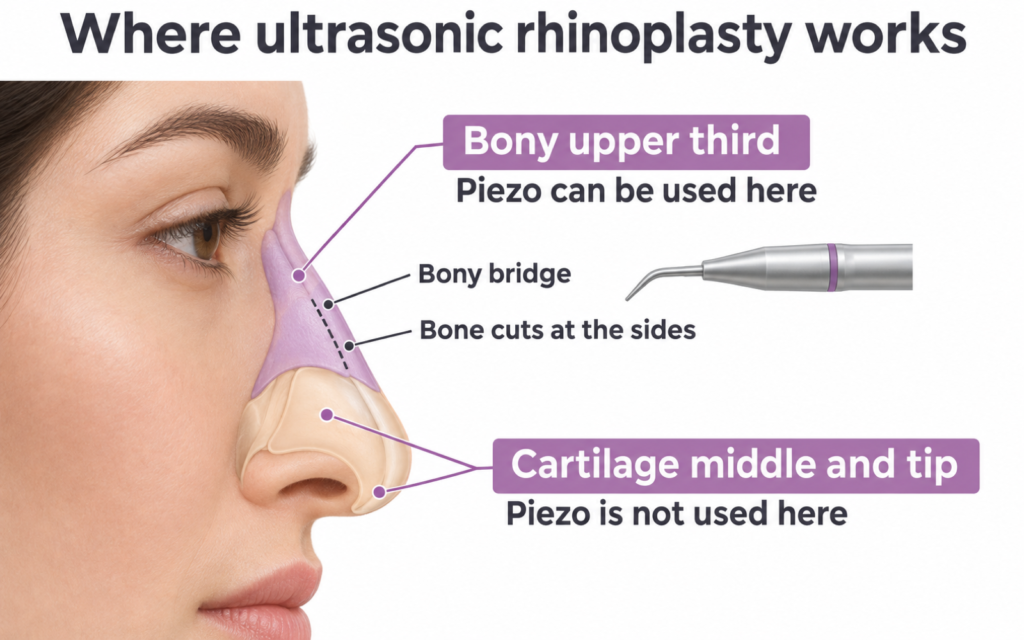
Piezo instruments are used on the bony upper part of the nose, mainly to lower or smooth the bony bridge and to make the cuts that narrow or straighten the nasal bones.
The NHS describes nose reshaping as changing the shape of the nose “by breaking the nose bone and rearranging the cartilage”. A piezo device changes how the first part is done. The bones are still cut and moved. Only the tool is different.
What It Doesn’t Touch
Below the bony top third, the nose is mostly cartilage, tip included. Surgeons shape that with scalpels, stitches and grafts. A bone tool has nothing to do there. If your main concern is the tip, the device may play no part at all. Our guide to nose tip surgery covers that area. The septum, and any graft material, are separate decisions too.
| Part of the nose | Usually involves bone? | Can piezo be used? |
|---|---|---|
| Bony bridge | Yes | Yes, to lower or smooth it |
| Sides of the upper nose | Yes | Yes, for the cuts that narrow or straighten it |
| Middle section | Mostly cartilage | Limited |
| Tip | No | No |
Who Might Be Offered Ultrasonic Rhinoplasty?
It tends to come up when bone work is on the plan, say taking down a bony hump, or narrowing or straightening the top of the nose. If no bone work is planned, there’s little for the device to do.
Whether it’s offered also depends on the surgeon. Some use piezo routinely, some for selected cases, and some prefer conventional instruments. That’s a matter of training and judgement. It shouldn’t be read as a sign that one surgeon is more up to date than another. Not every clinic has the equipment, so ask before assuming it’s available.
How Does Ultrasonic Bone Work Compare With Conventional Instruments?
In randomised trials against osteotomes and rasps, piezo came out slightly ahead in the first week after surgery: a bit less swelling, bruising and pain, and less harm to the lining inside the nose. Operations didn’t take noticeably longer.
Most of what we know comes from a 2024 systematic review and meta-analysis in the Journal of Clinical Medicine. It brought together 12 randomised trials: 292 operations with piezo and 338 with osteotomes, which were mostly small chisels 2 to 4 mm wide.
What It Found
Swelling scores were lower with piezo on day 2 and day 7 after surgery, though not on days 1, 3 or 4. Bruising scores were lower on days 2, 4 and 7. Pain was lower on the first 2 days, in a small number of trials, and fewer patients needed painkillers. Injury to the lining of the nose was less common in the 2 trials that reported it. There was no significant difference in operating time.
How Much Weight It Carries
The authors call the certainty of evidence low. Swelling and bruising were scored by eye, which is subjective. All 12 trials had “some concerns” about bias. Follow-up was about a week, and the review did not analyse patient satisfaction or long-term results. The authors themselves describe their findings as “hypothesis-generating” and say long-term studies are still needed.
| Aspect | Piezo instruments | Conventional instruments | What the comparison does not establish |
|---|---|---|---|
| Swelling | Lower scores on days 2 and 7 | Higher scores on those days | A better final shape |
| Bruising | Lower scores on days 2, 4 and 7 | Higher scores on those days | Faster return to work for every patient |
| Pain | Lower on days 1 and 2 in a few trials | Higher on those days | Less pain after the first days |
| Lining of the nose | Less injury in 2 trials | More injury in those trials | Better long-term breathing |
| Operating time | No significant difference | No significant difference | Lower cost |
| Long-term results | Not measured | Not measured | Fewer revisions or higher satisfaction |
Does Ultrasonic Rhinoplasty Mean Less Swelling Or Faster Recovery?
Piezo was linked with a little less swelling and bruising that first week. Whether it gets you back to normal sooner, or makes the nose settle faster, hasn’t been shown.
A lower swelling score on day 7 is a real finding. It’s also a measure taken by eye, a week after surgery, in a small number of patients. Work, the settled look, how it’ll look in a year: it can’t answer any of those. Noses stay swollen for months whatever tools are used. Our guide to rhinoplasty swelling walks through how that changes, and our rhinoplasty recovery guide covers the rest of healing.
What The Trials Measured, And What They Didn’t
The trials looked at swelling, bruising and pain over about a week, plus damage to the nasal lining and time in theatre. They didn’t look at how the nose ended up, breathing years on, revision rates or whether people were happy. A benefit in the first group says nothing either way about the second.
Is Ultrasonic Rhinoplasty The Same As Preservation Or Closed Rhinoplasty?
No. Each of those words describes a different part of the operation, and one nose job can involve all of them.
- The instrument: what touches the bone, piezo or the older tools.
- The access: how the surgeon gets in. Open means a small cut across the skin between the nostrils. Closed means the cuts stay inside the nose.
- The strategy: the overall game plan. Preservation keeps more of your own bridge in one piece. Structural approaches take more apart and rebuild it.
- Graft material: where any extra cartilage comes from, whether septum, ear or rib. Our guide to rib cartilage rhinoplasty explains the options.
So “ultrasonic” doesn’t mean “closed”, and it doesn’t mean “scar-free”. The trials in the 2024 review included both open and closed approaches. Some surgeons prefer an open approach for piezo work because it gives them a clear view of the bone, and an open approach leaves a small scar between the nostrils. Others use the device through a closed approach. Ask which access your surgeon plans. Our guide to open vs closed rhinoplasty explains the difference.
What Risks And Limitations Should You Understand?
Broadly, the risks are those of any nose job. Bone still gets cut, and everything else about the operation stays the same.
On the NHS list for nose reshaping you’ll find permanent breathing difficulty, damage to the wall between the nostrils, a changed sense of smell and heavy nosebleeds. The usual risks of any surgery sit alongside those. A different instrument on the bone doesn’t remove these.
There are limits specific to the device too. It only helps where bone is being worked on. Its benefits in the trials were modest and short-term. Your result rests on the surgeon’s plan and hands, and on your nose and how you heal, much more than on the tool.
A nosebleed that won’t stop, suddenly struggling to breathe, or swelling that’s quickly getting worse? Get urgent help.
In the UK, in an emergency: call 999 or attend the nearest A&E. If you’re not sure whether something is urgent, NHS 111 can advise.
For anything else, contact your treating medical team first. If Longevita arranged your treatment, that’s your clinician’s support team (contact details are in your Appointment Schedule).
What Should You Ask The Surgeon Before Choosing This Technique?
Ask where exactly the device would go, what it would and wouldn’t change, and what backs up the benefit you’re being sold.
- Which planned part of my operation would use the device?
- What will you still do with other tools?
- Why piezo for my nose and what I want?
- Where’s the evidence for that benefit?
- If you didn’t use it, what would be different?
- Will my operation be open or closed, and why?
If you’re researching treatment abroad, our rhinoplasty in Turkey page explains how treatment is arranged through Longevita. If you’d like Longevita to arrange a consultation with an independent clinician, contact us or book a free Discovery Call with us.
Frequently Asked Questions
Is ultrasonic rhinoplasty better than traditional rhinoplasty?
In the first days, piezo has been linked with a bit less swelling, bruising and pain than the older tools. Beyond that, trials haven’t shown a nicer final nose, better breathing in the long run or fewer revisions.
Does ultrasonic rhinoplasty avoid breaking the nose?
If your plan includes bone work, the bone is still cut and moved. Only the tool doing the cutting changes.
Is ultrasonic rhinoplasty scar-free?
Not because of the device. Whether you have a small external scar depends on whether the surgeon uses an open or closed approach, not on the instrument.
- Last Updated:

Prof. Dr. Fuat Yüksel
Board-certified plastic surgeon (TSPRAS) · ISAPS member · 34+ years' experience
Last reviewed
Known around the world for his surgical prowess, Prof. Dr. Fuat is a board-certified plastic surgeon and an active member of the International Society of Aesthetic Plastic Surgery (ISAPS). He has performed over 25,000 surgical procedures in his illustrious 34-year career. A number of his research articles have been in well-reputed medical journals, and he has authored a book as well as written a book chapter. His expert opinion is also often sought-after in the media. Prof. Dr. Fuat can speak both English and Turkish fluently.
Request A Callback For A Discovery Call
With Longevita, you have the option to discuss your goals with us from the comfort of your couch.
- A UK-registered medical tourism facilitator
- Trusted by over 150,000 clients
- A free, no-obligation discovery call