
Alarplasty: What Can Nostril Reduction Change?
Key Takeaways:
- “Wide nostrils” can mean big openings, sides that bow outwards, or a base that sits wide on the face. Each one is handled differently.
- Alarplasty only works on the nostrils. A broad or round tip is cartilage, and that’s a job for tip surgery.
- You’ll have a fine scar in the crease beside the nostril, just inside it, or both. They usually heal well. Invisible they aren’t.
- Over-narrowing is the hardest mistake to put right. Pinched nostrils can make breathing feel tighter.
- The NHS lists permanent breathing difficulty among the risks of nose reshaping, so ask how your airway will be protected.
Ask people what bothers them about their nose and a surprising number point at the bottom of it. They don’t mind the bridge. It’s the nostrils they notice in photos: too round, too wide, spreading out every time they smile.
Alarplasty deals with that part, and nothing else. It’s a small operation. Sometimes it’s done by itself, and quite often it’s the last few minutes of a rhinoplasty. Small isn’t the same as simple, though. A couple of millimetres can decide whether the result looks natural or obviously done, and nostrils that have been taken in too far are very hard to let back out.
Below, we go through what a surgeon looks at, what alarplasty can and can’t change, where the cuts go and which risks matter most. If you’re looking into treatment in Turkey, our rhinoplasty in Turkey page explains how it’s arranged through Longevita. Longevita is a UK-registered facilitator and doesn’t perform surgery: treatment arranged through Longevita takes place in Istanbul, with independent clinicians at accredited independent hospitals.
What Is Alarplasty?
The alae are the curved wings of skin and soft tissue that form the outer walls of your nostrils. Alarplasty is surgery on them. The surgeon cuts out a measured wedge or strip and stitches the edges together, and the nostril ends up smaller, less flared, or sitting closer in to the face.
You’ll see it called alar base reduction, nostril reduction or nostril narrowing. Surgeons sometimes say “Weir excision” too, though strictly that’s the name for one particular cut.
It isn’t a niche idea. The NHS says nose reshaping can change “the shape of your nose (including the nostrils)”, and BAPRAS, the UK association for plastic surgeons, lists altering “the width of the nostrils” among the things a rhinoplasty can do.
On Its Own Or As Part Of A Rhinoplasty
Both happen. If the nostrils are the only thing you want changed, alarplasty can be done by itself as a short procedure. Some surgeons do this under local anaesthetic; ask which yours will be.
When it’s added to a rhinoplasty, it usually comes at the very end. There’s a good reason for that. Changing the tip can change how the nostrils sit, so a careful surgeon looks at the new tip first and only then decides how much, if anything, to take from the nostrils.
How Are Nostril Shape And Base Width Assessed?
“My nostrils are too wide” can describe at least 3 different things. The first job in any consultation is working out which one you’ve got, because the fix depends on it. Expect your surgeon to look at your nose from the front, from the side and from underneath, and to take photographs from set angles.
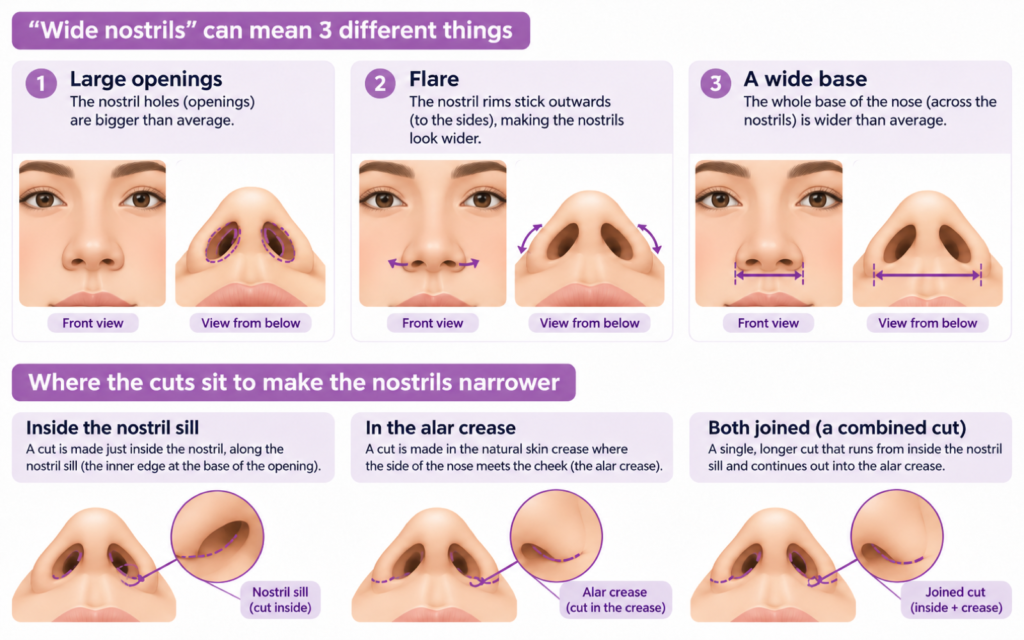
Size Of The Opening
Tilt your head back in front of a mirror. That view from below shows the openings themselves. Some people have large, rounded nostrils. Others have long, narrow ones. If the openings are what bother you, the work is mostly inside the nostril.
Flare
Flare is how far the sides of the nostrils curve outwards past the point where they join your face. You can have small openings and still have a lot of flare, so the nose only looks wide at its widest point. It often shows more when you smile.
Where The Base Sits
Then there’s the base, where each nostril meets the cheek. If that sits wide, trimming flare alone won’t change much.
| What you notice | What it might be | What it may involve |
|---|---|---|
| Nostrils look big and round from below | Large openings | Taking tissue from the floor of the nostril, just inside |
| The sides curve outwards, more so when you smile | Flare | A small wedge from the outer wall, with the scar in the crease |
| The whole bottom of the nose sits wide | A wide base, often with flare | Sometimes both cuts together |
| The tip looks broad or bulbous | Tip cartilage, not the nostrils | Tip surgery, a separate procedure |
| One nostril is bigger than the other | Uneven nostrils, sometimes linked to the tip or septum | Needs examining. Alarplasty alone may not even it out |
The Inside Matters Too
Your nostrils are also the way air gets in. Before taking anything away, a surgeon should look inside your nose and ask how you breathe through each side. The NHS lists “permanent breathing difficulty” among the risks of nose reshaping. Narrowing the entrance to a nose that’s already a bit blocked is asking for trouble. Our guide to breathing problems after rhinoplasty explains why the airway matters in nose surgery.
What Can Alarplasty Change And What Can It Not Change?
Smaller openings, less flare and a slightly narrower base are all realistic. In some people it can also make two nostrils that differ in size look more alike. The changes are measured in millimetres, so they’re often clearer in photos than in the mirror at first.
The list of things it can’t do matters just as much. The tip is shaped by cartilage, and taking skin from the nostrils won’t reshape it. If your tip is broad, round or droopy, our guide to nose tip surgery explains that procedure. A hump on the bridge or a crooked nose needs a rhinoplasty. Nostrils that show a lot from the front usually come down to the tip and the strip of skin between the nostrils, and alarplasty won’t help there either. It doesn’t change skin thickness, and it won’t make a big nose small.
If keeping features that matter to your heritage is part of your thinking, say so early. Our guide to ethnic rhinoplasty looks at how that conversation fits into planning.
Smaller Isn’t Always Better
The alarplasty results people regret most often come from taking too much. Over-narrowed nostrils can look pinched or notched, and an airway that’s been tightened is hard to open back up. BAPRAS warns that “too much surgery can weaken and damage” the nose. A surgeon who suggests taking a little less than you’d hoped isn’t being timid.
Where Are Incisions Placed?
That depends on what’s being changed. There are two main places, and plenty of people have both.
Inside The Nostril
Shrinking the opening means taking tissue from the nostril sill, the floor of the nostril right at the entrance. The scar runs just inside. You won’t see it from the front. From below, close up, you might.
In The Crease Beside The Nostril
Reducing flare means taking a small wedge from the outer wall of the nostril. The cut is placed in the natural crease where the nostril meets the cheek, which hides a good deal. It doesn’t hide everything, so expect a fine line that can be spotted at close range.
Both Together
For a base that sits wide, the two cuts are often joined up. It’s the same idea, just more tissue and a longer scar.
The stitches are tiny. For nose reshaping generally, the NHS says they can come out after about a week, unless they’re dissolvable. Scars start pink and slightly raised, then fade over the following months. Some people form thicker scars than others, so mention it if you’ve had raised scars before.
Which Risks Affect Function And Symmetry?
Any operation carries general risks. For nose reshaping, the NHS lists bleeding, infection, a blood clot in a vein and a reaction to the anaesthetic. The risks below are the ones that belong to alarplasty in particular.
Breathing
Make the nostril smaller and you make the doorway smaller. A careful reduction shouldn’t change how you breathe. An aggressive one can leave the nose feeling tight, especially during exercise or when you’ve got a cold.
Asymmetry
Hardly anyone’s nostrils match perfectly to begin with. Small differences that were there before can still be there afterwards, and swelling can make one side look different for a while. The NHS says it “might be several months” before you see the full effect of nose surgery, so judging symmetry at week 2 isn’t fair on anyone.
Notching And An Unnatural Shape
If the edges don’t line up neatly, the scar can leave a small step or dent in the rim of the nostril. Take too much from the wrong place and a round nostril can end up looking triangular or tight.
Scars
Most heal into fine lines. A few stay red, thicken or sit slightly lower than the skin around them. Scars in the crease are usually easier to hide than ones on the face of the nostril.
| Risk | What it looks or feels like | What to ask |
|---|---|---|
| Over-narrowing | Pinched nostrils, tighter breathing | How much will you take, and how do you protect my airway? |
| Asymmetry | One nostril looks different from the other | Are mine uneven already, and will that still show? |
| Notching | A small step or dent in the edge of the nostril | Where will the scar run, and how will it be closed? |
| A visible scar | A fine line in the crease or under the nostril | Can I see healed scars on your own patients? |
| Not liking the result | The shape isn't what you expected | What would further surgery involve, and what would it cost? |
BAPRAS suggests establishing with your surgeon in advance “what the conditions for a re-operation would be”. Do that before you book. Nobody can promise a free revision. A surgeon may waive their own fee, but other costs such as the hospital and anaesthetic can still apply, and travel is something you’d plan and pay for separately.
When Should You Get Help?
Some swelling, a bit of crusting along the stitches and a little blood in the first few days are all expected. The NHS mentions “light nosebleeds for the first few days” after nose reshaping.
A wound that’s getting redder, hotter or more painful, a discharge that smells, stitches that come apart, or a temperature of 38°C or more need a call to your clinic that day. The NHS says to contact the clinic where you had the operation “as soon as possible if you have severe pain or any unexpected symptoms”.
Bleeding is different. The NHS advice on nosebleeds is to go to A&E if one “lasts longer than 10 to 15 minutes”, seems excessive, or comes with difficulty breathing or feeling weak or dizzy. Don’t drive yourself.
In the UK, in an emergency: call 999 or attend the nearest A&E. If you’re not sure whether something is urgent, NHS 111 can advise.
If Longevita arranged your treatment, contact your clinician’s support team (contact details are in your Appointment Schedule). Anything urgent goes to 999, A&E or NHS 111 first.
What Should You Ask In Consultation?
UK guidance from the General Medical Council says the doctor who will carry out a cosmetic procedure should take your consent personally, and should ask why you want it and what you’re hoping it will do (GMC). The Royal College of Surgeons recommends at least 2 weeks to think it over before you sign. Surgeons abroad aren’t bound by either, so it’s fair to ask how a clinic handles both.
For alarplasty itself, these are the questions that tend to matter:
- Which part are you changing: the openings, the flare or the base?
- Will the cuts be inside the nostril, in the crease, or both?
- How much tissue do you plan to remove?
- Are my nostrils uneven now? Will that still show afterwards?
- Have you looked inside my nose and checked how I breathe on each side?
- If this is part of a rhinoplasty, will you decide on the nostrils after the tip is done?
- When will I be able to judge the result properly?
- If I’m not happy, what would further surgery involve, and what would it cost?
Bring photos of what you don’t like, and be honest if it’s really the tip or the overall size that bothers you. That one conversation can stop you having the wrong operation. Our rhinoplasty consultation guide covers what else to ask.
If you’d like Longevita to arrange a consultation with an independent clinician, contact us or book a free Discovery Call with us.
Myths And Facts
| Myth | Facts |
|---|---|
| “Alarplasty makes the whole nose smaller.” | It only changes the nostrils. The tip, bridge and overall size need other surgery. |
| “It's scarless.” | The cuts heal into fine lines in the crease or inside the nostril. Up close, they can usually be found. |
| “The narrower, the better.” | Over-narrowing can look pinched and make breathing feel tight. BAPRAS warns that too much surgery can weaken and damage the nose. |
| “Wide nostrils and a wide tip are the same problem.” | A broad tip is down to cartilage, and that's dealt with by tip surgery. |
| “I'll see the final shape when the stitches come out.” | The NHS says it might be several months before you see the full effect of nose surgery. |
| “If I don't like it, it can easily be reversed.” | Tissue that's been removed can't simply be put back. That's why the amount matters so much. |
Frequently Asked Questions
Is alarplasty the same as nostril reduction?
Near enough. Both names describe surgery on the sides or floor of the nostrils to make them smaller or less flared. Alar base reduction is another name for it.
Can alarplasty be done without a rhinoplasty?
Yes. If the nostrils are the only thing you’d change, it can be done by itself. If your tip is also being reshaped, the nostrils are usually left until the end of that operation.
Will people be able to see the scars?
Most people won’t notice them in everyday life. They sit in the crease beside the nostril or just inside it, and they fade over months. Someone looking closely, or from below, may spot them.
Can alarplasty affect my breathing?
It can if too much is taken, because the nostril is the entrance to your airway. That’s why your surgeon should check how you breathe before planning anything.
How long does it take to heal?
For nose reshaping in general, the NHS says stitches can come out after about a week, and bruises, swelling and redness may have faded by 3 weeks. The final shape takes longer. Scars keep maturing for months.
Will alarplasty fix a wide nose?
Only if the width is in the nostrils. If it’s the tip or the bones of the nose, alarplasty on its own won’t change it.
- Last Updated:

Prof. Dr. Fuat Yüksel
Board-certified plastic surgeon (TSPRAS) · ISAPS member · 34+ years' experience
Last reviewed
Known around the world for his surgical prowess, Prof. Dr. Fuat is a board-certified plastic surgeon and an active member of the International Society of Aesthetic Plastic Surgery (ISAPS). He has performed over 25,000 surgical procedures in his illustrious 34-year career. A number of his research articles have been in well-reputed medical journals, and he has authored a book as well as written a book chapter. His expert opinion is also often sought-after in the media. Prof. Dr. Fuat can speak both English and Turkish fluently.
Request A Callback For A Discovery Call
With Longevita, you have the option to discuss your goals with us from the comfort of your couch.
- A UK-registered medical tourism facilitator
- Trusted by over 150,000 clients
- A free, no-obligation discovery call