
Breathing Problems After Rhinoplasty: What’s Normal And What Isn’t
Key Takeaways:
- A blocked nose after rhinoplasty is expected. The NHS says breathing through it may be hard for about a week.
- Swelling inside the nose can keep it stuffy for weeks, often worse on 1 side and worse at night.
- About 1 in 10 people report leftover or new breathing problems after a first rhinoplasty, in one older review.
- A blockage that won’t clear can come from the septum, the nasal valve, scar tissue, the turbinates or rhinitis. Only an examination can tell which, and photos can’t.
- Feeling short of breath isn’t the same as a blocked nose. It’s an emergency.
- Being assessed doesn’t commit you to more surgery.
Breathing problems after rhinoplasty are common in the first weeks and usually come from swelling inside the nose, which slowly settles. The NHS says you may find it hard to breathe through your nose for about a week, so most people spend those first nights breathing through their mouth. A blockage that gets worse, or that hasn’t improved after several weeks, is different and needs a proper look.
This guide is about the airway, the inside of your nose. It covers why it blocks up, how long that normally lasts, what can cause a blockage that won’t clear and what a surgeon checks. For how the outside of your nose settles, see our rhinoplasty swelling guide. Longevita is a UK-registered facilitator and doesn’t perform surgery: rhinoplasty arranged through Longevita takes place in Istanbul, with independent clinicians at accredited independent hospitals.
Breathing After Rhinoplasty At A Glance
| Mostly mouth breathing | About a week (NHS) |
|---|---|
| Stuffiness after that | Several weeks, longer after septum work |
| 1 side worse | Common while swelling settles |
| Leftover or new breathing problems | About 1 in 10 after a first rhinoplasty (GMS review) |
| Breathing outcome judged | At least 12 months after surgery |
Why Can Breathing Change After Surgery?
Breathing can change after surgery because the airway is a narrow space, and rhinoplasty affects nearly everything in it. Some of those changes are temporary. Some aren’t.
Swelling Inside The Nose
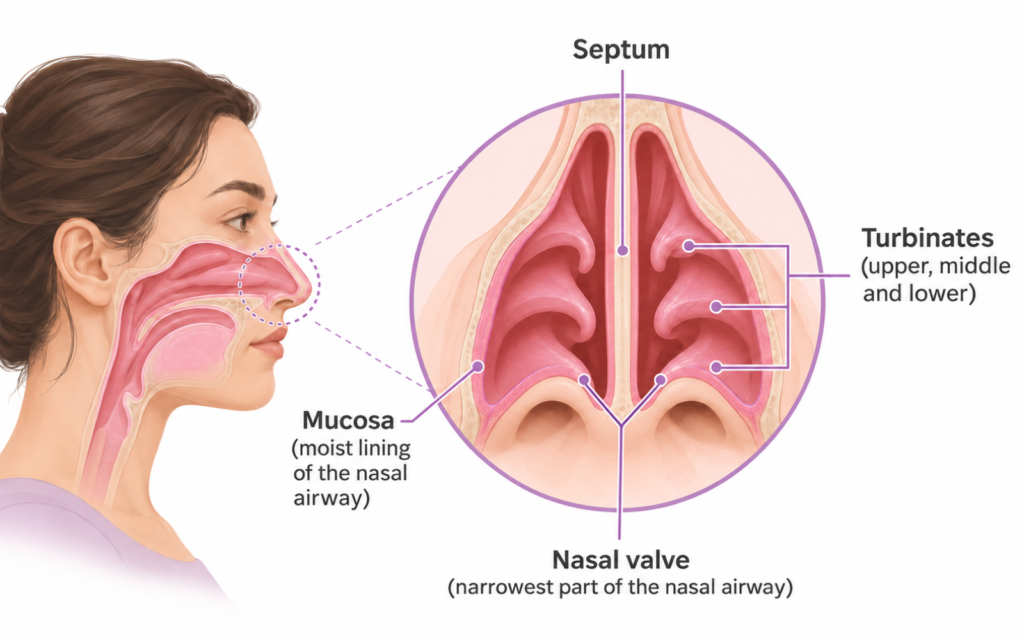
Swelling inside the nose is the main reason for a blocked nose in the first weeks. The lining, called the mucosa, puffs up after surgery just as skin does after a knock. There isn’t much room in there to begin with, so a little swelling goes a long way.
Crusts, Splints And Packing
Crusts, splints and packing take up space early on. Dried blood and mucus collect, and any splints or packing make the passage narrower still for the first few days. Our guide to cleaning your nose after rhinoplasty covers crust care. Follow your surgeon’s instructions first.
Changes To The Structure
Changes to the structure can affect airflow too. The bone and cartilage that shape your nose also hold the airway open. Narrowing the nose, or removing cartilage, can change how air moves through it, occasionally enough to notice.
Why It’s Worse At Night And On 1 Side
It’s worse at night because lying flat lets fluid settle in the lining. Sleeping with your head raised on an extra pillow often helps. And 1 side is often worse simply because swelling rarely settles evenly. If the blocked side swaps around during the day, that’s typical of swelling.
How Long Normal Stuffiness Lasts
Normal stuffiness usually improves over several weeks, with good days and bad days. Colds and hay fever can make it feel worse for a while. Septum work and grafts often take longer to settle. The full recovery picture is in our rhinoplasty recovery guide.
What Causes Need Assessment?
Causes that need assessment are the ones that don’t settle with time. A review of rhinoplasty complications found that about 1 in 10 people report leftover or new breathing problems after a first rhinoplasty. The paper is over a decade old, and rates vary a lot between surgeons and techniques. Some of these causes were already there before the operation.
The Septum
The septum is the wall between your nostrils. It may still be bent after surgery, or it may have shifted as it healed. Straightening it is part of a septorhinoplasty, and a cosmetic rhinoplasty alone won’t fix it unless that was in the plan.
The Nasal Valve
The nasal valve is the narrowest part of the airway, just inside each nostril. If removing cartilage or bone leaves it less supported, it can pinch inwards when you breathe in hard. It can’t be diagnosed from photos, or from how your nose looks from the outside. A nose can look perfectly symmetrical and still have a valve problem, and the reverse.
Scar Tissue
Scar tissue can form small bands, called adhesions, between the septum and the side wall of the nose. They can narrow the airway on 1 side.
The Turbinates
The turbinates are ridges along the side wall of the nose that warm and moisten the air. If they were enlarged before surgery and weren’t treated, they still will be.
Rhinitis And Allergies
Rhinitis and allergies make the lining swell, whether or not you’ve had surgery. A healing nose with hay fever can feel far worse than either on its own.
A Septal Haematoma Or Infection
A septal haematoma, a collection of blood inside the septum, is uncommon but needs seeing quickly. So does infection. Both can cause a blockage that gets worse, with pain, and sometimes a soft swelling inside a nostril.
When Should You Contact A Clinician?
You should contact a clinician the same day if a blockage is getting worse, especially with pain, fever or a swelling inside a nostril. Shortness of breath, chest pain or a heavy nosebleed that won’t stop need emergency help. The table sorts the common signs into 3 groups.
| Usually part of healing | Contact your surgeon the same day | Emergency |
|---|---|---|
| Blocked nose, breathing through the mouth | A blockage getting worse | Struggling to breathe, or unable to finish a sentence |
| 1 side more blocked than the other | A soft, painful swelling inside a nostril | Chest pain or tightness |
| Crusting and a dry mouth | Fever, or a smelly discharge that keeps coming | Lips or skin turning blue or grey |
| Whistling early on | Pain your painkillers aren’t controlling | A heavy nosebleed that won’t stop |
| Snoring at night | 1 leg painful or swollen | Sudden confusion |
In the UK, in an emergency: call 999 or attend the nearest A&E. Abroad, call the local emergency number, which is 112 in Turkey and across the EU. Don’t drive yourself.
A suspected septal haematoma needs to be seen by a specialist that day. For anything in the middle column, contact your surgeon. If your procedure was arranged through Longevita, contact your clinician’s support team (contact details are in your Appointment Schedule). If you’re not sure and it isn’t an emergency, NHS 111 can advise.
A Blocked Nose Or Shortness Of Breath?
A blocked nose and shortness of breath can feel alike, but they’re very different. With a blocked nose, air won’t pass easily through your nose, so you breathe through your mouth and still get enough air. Being short of breath means you can’t get enough air in however you breathe. After any operation, that can come from causes nothing to do with your nose, including a blood clot in the lungs. Never put it down to congestion.
A Blockage That Isn’t Improving
A blockage that isn’t improving after several weeks, or that’s stuck on the same side every day, is worth raising at your next follow-up. It isn’t urgent unless it’s getting worse. It may well still be swelling. It may not, and that’s what an assessment is for.
What Does An Assessment Involve?
An assessment involves working out where the airway is narrowed and why. That means a conversation, an examination and sometimes a few extra tests. No single test settles it.
The Conversation
The conversation covers what was done in the operation, how well you breathed beforehand, and how things have changed since. Allergies, medicines, smoking and any knock to the nose come up too. If you’ve banged your nose, our guide to hitting your nose after rhinoplasty covers that separately.
The Examination
The examination starts outside the nose and moves inside, using a light. The valve area is often checked without instruments, because a speculum can change its shape. Many surgeons also use a nasal endoscope, a thin camera that sees further back. Some spray a decongestant and look again. If the airway opens up a lot, swelling is probably a big part of the problem.
Questionnaires And Tests
Questionnaires and tests help in some cases. You might be asked to fill in the NOSE scale, a short questionnaire that scores how much the blockage affects you. Scans, allergy tests and airflow measurements are only needed for some people.
Why Photos Aren’t Enough
Photos aren’t enough because most of the causes are inside the nose. A recent literature review found that no single test reliably separates valve problems from other causes, even in a clinic. A photo of the outside tells even less. If you’re seeking advice remotely, expect to be asked to come in for an examination.
What Treatments Depend On The Cause?
The treatment depends on the cause, which is why the cause comes first. Most aren’t surgical.
- Swelling And Crusts: Swelling and crusts usually settle with time and the care your surgeon recommends. Saline sprays are commonly advised, though when and how varies. Decongestant sprays should only be used if your surgeon says so. Even in general use, the NHS advises against using them for more than 5 days at a time, because longer use can make stuffiness worse.
- Rhinitis And Allergies: Rhinitis and allergies are treated with medicines, often steroid nasal sprays or antihistamines, prescribed by your surgeon or GP.
- Scar Tissue: Scar tissue bands can sometimes be released in a small procedure, depending on where they are and how thick.
- Septum, Valve Or Turbinate Problems: Septum, valve or turbinate problems that don’t settle may need surgery, though not always, and not soon. Surgeons wait for the tissues to settle first.
Being assessed early and having more surgery are 2 separate things. You can ask to be seen at any point.
What Records Should You Bring?
You should bring anything that shows how your breathing has changed, along with the details of your operation. A few lines a day for a week or 2 is plenty.
- Your operation date and any surgical or discharge notes, especially about the septum, turbinates or cartilage
- How well you breathed through your nose before surgery
- When the problem started, and whether it’s better, worse or the same
- Which side is blocked, and whether that changes lying down, at certain times of day or in certain places
- Anything else: pain, fever, discharge, bleeding, crusting, whistling, a change in smell, snoring
- Any knock to your nose since surgery
- Every medicine and nasal spray you’ve used, including ones from a chemist, and for how long
- Allergies or hay fever, and whether you smoke or vape
If you’ve noticed a change in your sense of smell, mention it. Our guide to smell after rhinoplasty covers that separately.
Breathing After Rhinoplasty: Myths And Facts
| Myth | Fact |
|---|---|
| “A nose job will fix my breathing.” | Only if the airway is part of the plan. Cosmetic reshaping alone doesn’t treat a bent septum |
| “Still blocked at 3 weeks means something’s wrong.” | Not necessarily. Stuffiness can last several weeks |
| “A blocked side means the septum is crooked.” | Myth. Uneven swelling is the usual cause early on |
| “A surgeon can spot valve collapse from my photos.” | Myth. The airway has to be examined |
| “Being short of breath is just my blocked nose.” | Myth. Breathlessness after surgery needs urgent help |
| “Getting checked means another operation.” | Myth. Most causes are treated without surgery |
Frequently Asked Questions
Can a blocked nose after rhinoplasty be permanent?
A blocked nose after rhinoplasty can occasionally be permanent. The NHS lists permanent breathing difficulty as an uncommon risk. Most blockages settle, and those that don’t usually have a cause that can be found.
How long will my nose be blocked after rhinoplasty?
Your nose will usually be most blocked for about a week, then stuffy on and off for several weeks. Septum work can take longer.
Do saline sprays help?
Saline sprays are recommended by many surgeons, but when to start and how to use them varies. Follow the instructions you were given, or ask first.
Is it normal to snore after rhinoplasty?
Snoring is normal after rhinoplasty while your nose is blocked, because you breathe through your mouth at night. It usually fades as swelling goes down. If it carries on for months, tell your surgeon or GP.
Why does my nose whistle?
Whistling is usually caused by swelling or a crust early on, and stops as you heal. If it lasts beyond the first few weeks, mention it at your follow-up. Occasionally it’s a sign of a small hole in the septum, called a perforation.
Can I have an assessment remotely?
You can usually start remotely, by describing your symptoms and sending your notes, but the cause can’t be confirmed without an examination inside the nose.
- Last Updated:

Prof. Dr. Fuat Yüksel
Board-certified plastic surgeon (TSPRAS) · ISAPS member · 34+ years' experience
Last reviewed
Known around the world for his surgical prowess, Prof. Dr. Fuat is a board-certified plastic surgeon and an active member of the International Society of Aesthetic Plastic Surgery (ISAPS). He has performed over 25,000 surgical procedures in his illustrious 34-year career. A number of his research articles have been in well-reputed medical journals, and he has authored a book as well as written a book chapter. His expert opinion is also often sought-after in the media. Prof. Dr. Fuat can speak both English and Turkish fluently.
Request A Callback For A Discovery Call
With Longevita, you have the option to discuss your goals with us from the comfort of your couch.
- A UK-registered medical tourism facilitator
- Trusted by over 150,000 clients
- A free, no-obligation discovery call