
Receding Hairline: Signs, Causes And What To Do
A receding hairline describes a change in the position or density of the hair at the front of the scalp, usually beginning at the temples and moving the frontal edge backwards over months or years. It is a visible pattern rather than a diagnosis. Male pattern hair loss is the most common reason a man’s hairline recedes, but it is not the only one, and the shape of a hairline in a single photograph does not establish what is causing it. What matters far more than how your hairline looks today is whether it is still moving.
Key Takeaways:
- A receding hairline is something the frontal hairline is doing, not a condition in itself.
- Hairline shape varies naturally between people. An M shape or a high hairline is not proof of active hair loss.
- Change over time, compared like for like, is more informative than any single measurement or self-test.
- Most gradual recession in men relates to pattern hair loss, but traction and scarring conditions affect the same part of the scalp and are managed completely differently.
- Redness, scaling, itching, burning or pain at the hairline is not part of male pattern hair loss and should be looked at.
What Does A Receding Hairline Look Like?
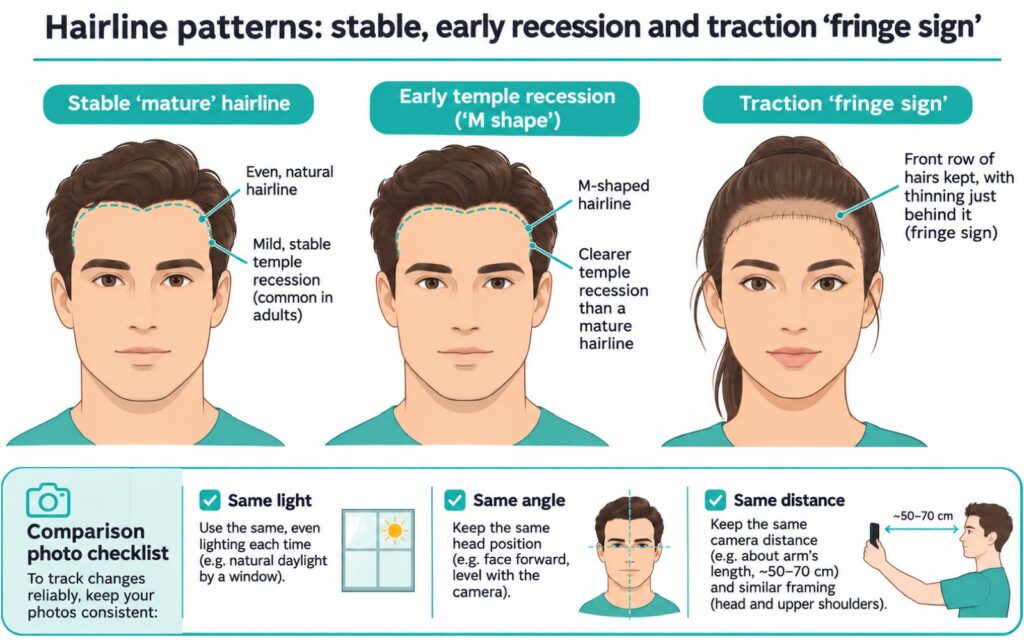
The frontal hairline sits further back than it used to, and the change is rarely even. Most people notice one or more of the following. The corners above the temples deepen, so the hairline forms two shallow bays either side of a central point.
- More forehead is visible, particularly when the hair is pushed back or wet.
- The hairs along the front edge look finer, shorter or lighter than the hair behind them.
- Density immediately behind the frontal line drops, so the scalp shows through in bright or overhead light even where hairs remain. One side has moved more than the other. Asymmetry is common and is not in itself meaningful.
- Old photographs look different from the mirror.
The last of these is usually the one that prompts the search.
Why The Shape Of Your Hairline Tells You Less Than You Think
The M shape gets described online as the signature of a receding hairline, and it is genuinely common, because the follicles at the temples are among the most susceptible in pattern hair loss. But hairline shape varies enormously between individuals for reasons that have nothing to do with hair loss. Plenty of men have had deep temporal points since adolescence. Plenty of women have a naturally high frontal hairline. Neither fact says anything about whether hair is currently being lost.
The useful question is not what shape your hairline is. It is whether that shape is the same as it was two years ago.
A hairline that has looked the same for years is a different situation from one that is visibly retreating over the same period. The two can look identical in a single photograph, but they are not the same thing. Recession is a process, while a photograph only captures a single position in time.
Fine, short hairs mixed in among normal ones at the front edge suggest follicles are producing progressively smaller hairs, which is a more informative sign than the outline itself.
How To Tell If It’s Actually Receding
By comparing photographs taken under conditions similar enough that the comparison means something. This is not a diagnostic test, but it is the only thing you can do at home that produces real information, and it is the thing almost nobody does. To make photographs comparable:
- Use the same lighting each time, ideally daylight from the front rather than overhead lighting, which exaggerates scalp visibility. Use the same angle and the same distance, with the head level rather than tilted.
- Keep the hair at a similar length and styled the same way, and push it back so the whole hairline is visible.
- Take one straight-on shot and one from each side, since temples move before the centre does.
- Keep dry-hair and wet-hair shots separate. Wet hair makes any hairline look worse.
- Date them.
Then leave them alone. Comparing week to week produces noise, not signal, because normal daily shedding, humidity, hair length and lighting all change the picture more than genuine recession does over that timescale.
Photographs can document change. They cannot tell you what is causing it. 2 people with visually identical hairline recession can have entirely different underlying processes, and the difference matters because the management is different. Photographs are useful for a clinician to look at; they are not a substitute for one looking.
What Is More Consistent With A Stable Hairline, And What Suggests Active Recession?
| Feature | More consistent with stable hairline variation | More suggestive of active recession | Limitation |
|---|---|---|---|
| Change over time | Position looks the same across several years of photographs | Frontal edge is measurably further back than in comparable older photographs | Photographs taken under different conditions can create or hide apparent change |
| Hair calibre at the front edge | Hairs at the hairline are similar in thickness to those behind it | Mixture of normal and noticeably finer, shorter, lighter hairs along the front | Difficult to judge without magnification; a clinician uses a dermatoscope |
| Density behind the line | Density behind the frontal edge matches the rest of the top | Scalp increasingly visible behind the hairline, not only at the edge | Lighting and hair length affect perceived density substantially |
| Symmetry | Asymmetry present but unchanged | Asymmetry increasing | Almost nobody has a symmetrical hairline; asymmetry alone means little |
| Scalp appearance | Skin looks normal | Redness, scaling, roughness, or a smooth shiny band where pores are no longer visible | Any of these points away from pattern hair loss and towards something that needs assessment |
| Symptoms | None | Itching, burning, tenderness or pain at the hairline | Symptoms are not part of pattern hair loss and should not be ignored |
This table describes what tends to accompany each situation. It does not diagnose either.
Mature Hairline Or Receding Hairline?
The idea behind the term is reasonable. The hairline many people have as a teenager sits low and straight. In a lot of men, it settles slightly higher and slightly more angled at the temples during their late teens and twenties, then stays there. Describing that as a mature hairline is a fair way of saying: your hairline changed once and then stopped, and that is not the same thing as hair loss. What is not reasonable is the precision with which this is described online.
What The Popular Tests Actually Tell You
“A mature hairline sits about 1 to 2 cm above your highest forehead crease.” This measurement comes from hair restoration surgery, where it is used as a guide for where to place a hairline when planning a transplant on a middle-aged man. It was never established as a threshold for telling hair loss apart from normal variation. There is no published study validating it as one. Foreheads differ in height, and brow creases differ in position, with some people barely having one at all. A figure designed to help a surgeon draw a natural-looking line is not a test you can apply to yourself in a mirror.
“Place a finger above your forehead crease. If the gap is about one finger’s width, it’s mature.” There is no published evidence that this test distinguishes anything. No sensitivity, no specificity, no validation. Fingers vary in width by a factor that comfortably exceeds the distance being measured. It circulates widely and it should not be treated as medical information.
“A mature hairline develops between your late teens and late twenties.” This is a description of what commonly happens, not a rule. Pattern hair loss can begin in the late teens, and a hairline that settled at twenty-two can start moving again at 35. Age brackets cannot separate the two.
The formal classification systems used in dermatology and hair restoration do describe a stage of minimal frontotemporal recession that is not considered baldness, and Norwood’s original description of it does include a measurement (see our guide to the Norwood scale). But that measurement uses a fixed anatomical landmark on the side of the head and is applied by a clinician to standardised photographs as part of a research classification. It is not the same exercise as measuring your forehead.
What The Evidence Says
“Mature hairline” is a descriptive convention, not a formal diagnosis, and it does not appear as a diagnostic category in NHS or British Association of Dermatologists guidance. No validated home test distinguishes a settled hairline from early pattern hair loss. The defensible distinction is between a hairline configuration that has been stable and one showing continued movement or progressive thinning of the hairs at the front. A hairline can do both in sequence. Settling in your 20s does not rule out recession later.
So the honest answer to “is mine mature or receding?” is that appearance alone cannot settle it, and anyone offering you certainty from a photograph is overreaching. What can settle it is a clinician examining the scalp, usually with magnification, and looking at whether the hairs at the front vary in thickness in the way that indicates follicles are shrinking.
Does An M-Shaped Hairline Mean You’re Going Bald?
No, not on its own. An M-shaped hairline is a shape, and shape alone does not establish that hair is being lost. The reason the two get conflated is that in male pattern hair loss the temples are usually affected early, so recession there often produces or deepens an M. But many men have had that outline since their hair finished growing in, and it never changes again. Others have a pronounced central point, sometimes called a widow’s peak, which makes the temples look more recessed than they are.
What separates a naturally M-shaped hairline from one being reshaped by hair loss is the same thing that separates every other version of this question: whether the corners are still moving, and whether the hairs in and around them are getting finer. If the outline is identical to a photograph from five years ago, the M is how you are built. If the bays are deeper than they were and the hair filling them is thinner than the hair behind, something is progressing.
Receding Hairline Or Male Pattern Baldness?
A receding hairline describes what the frontal hairline is doing. Male pattern baldness describes a specific condition that can cause it. One is an observation; the other is a diagnosis. You can see the first in a mirror. The second requires someone to establish that this is what is happening and rule out the alternatives.
In male pattern hair loss, follicles in genetically susceptible areas respond to the hormone DHT by producing progressively finer, shorter and lighter hairs with each growth cycle, until eventually they stop producing visible hair at all. The temples and frontal hairline are among the areas most commonly affected, which is why recession is often the first thing noticed, and the crown is frequently involved as well, sometimes before the front. The British Association of Dermatologists (BAD) describes the usual pattern as a receding frontal hairline together with loss from the top of the head.
How far and how fast that progresses varies substantially between individuals, and there is no reliable way to forecast an eventual pattern from an early one.
What Causes A Receding Hairline?
Only a small number of conditions characteristically change the position or density of the frontal hairline. Most causes of hair loss do not, and lumping them all in here would be misleading rather than thorough.
Male Pattern Hair Loss
The most common explanation in men, for the reasons described above. It is gradual, it is usually symmetrical in broad terms though rarely perfectly so, and the scalp skin looks normal. That last detail matters: BAD notes that in male pattern hair loss the skin on the scalp appears normal on examination. Visible inflammation at the hairline points somewhere else.
Traction On The Hairline
Sustained pulling on the hair damages follicles at the point where the tension is greatest, which is very often the frontal and temporal margin. Tight ponytails, braids, locs, weaves, extensions, wigs attached to the hairline and repeated tight wrapping all do it, and the risk is higher on chemically relaxed hair. Early on it is reversible if the tension stops. Left in place long enough it becomes permanent.
One clinical feature is worth knowing about, because it is the detail that distinguishes traction from a more serious lookalike. In traction alopecia the very front row of hairs is often retained while the hair immediately behind it is lost, leaving a thin fringe along the original hairline. This is described in the dermatology literature as the fringe sign, and in one series it was present in every patient whose traction alopecia involved the marginal hairline. In frontal fibrosing alopecia, by contrast, that front fringe is typically lost along with everything else.
Frontal Fibrosing Alopecia And Other Scarring Conditions
Frontal fibrosing alopecia is a form of scarring hair loss that specifically affects the hair margin at the front of the scalp. Inflammation destroys the follicles and replaces them with scar tissue, and the hairline recedes progressively as a result. It commonly involves the eyebrows, and sometimes the hair near the ears, and it may cause an itchy, painful or burning sensation in a band across the frontal hairline, though in some people it causes no symptoms at all. It occurs mostly in white postmenopausal women, but it also occurs in premenopausal women, in men, and in people of other ethnicities.
It matters here for one reason. Follicles lost to a scarring process do not come back, so the point of assessment is to stop the process while there is still hair to protect. It can also be mistaken for pattern hair loss in its early stages, particularly in men, which delays that assessment.
This is not something to diagnose from a web page, and the great majority of receding hairlines are not this. But a receding hairline that comes with eyebrow loss, or with itching, burning or tenderness in a band across the front, or that has a smooth pale band where the pores are no longer visible, is worth having looked at rather than assumed.
What Does Not Usually Explain A Receding Hairline?
Generic hair-loss articles tend to append iron deficiency, thyroid disease, stress and “hormonal imbalance” to any list of causes. These are real causes of hair loss and they matter, but they characteristically produce diffuse shedding across the scalp, not a hairline moving backwards. If you are shedding noticeably more hair overall, or your parting is widening, that is a different presentation with a different set of explanations, covered in our hair loss guide.
Possible explanations for a changing hairline
| Possible explanation | Typical clue | What this does NOT prove | Appropriate next step |
|---|---|---|---|
| Male pattern hair loss | Gradual temple recession over years, finer hairs at the front edge, often crown thinning too, normal looking scalp skin | That it will progress to extensive baldness, or how far it will go | GP or dermatologist to confirm before starting anything long-term |
| Stable hairline configuration | Same outline across years of comparable photographs, uniform hair calibre | That it will stay stable indefinitely | Photograph and review in a year rather than acting now |
| Traction | Recession where tension is applied, often with a retained fringe at the very front, sometimes tenderness | That the loss is permanent, particularly if caught early | Remove the tension; GP or dermatologist assessment, sooner if it has been going on a long time |
| Frontal fibrosing alopecia or another scarring condition | Band-like recession, eyebrow involvement, itch or burning, smooth skin with no visible pores | That your hair loss is this; it is uncommon | Prompt GP appointment and request for dermatology assessment |
| Female pattern hair loss | Widening parting with the frontal hairline largely preserved | That any hairline change in a woman is pattern loss | GP, with assessment of contributing factors |
None of these patterns is specific enough to diagnose from.
Receding Hairline In Women
A woman noticing her frontal hairline moving back should not assume it is the female version of male pattern baldness, because in most cases it is not. Female pattern hair loss usually shows as thinning across the top of the scalp with the frontal hairline relatively preserved, which is why it tends to be noticed as a widening parting rather than a retreating line. So a genuinely receding frontal hairline in a woman raises a different set of possibilities, and the two that come up most often at that site are traction and frontal fibrosing alopecia.
That distinction has practical consequences. Traction is potentially reversible if the tension is removed early enough. Scarring loss is not, which is why it is worth being assessed rather than waiting to see. Thinning specifically at the temples, which is a common presentation in women, can arise from either. Applying a male staging scale to a woman’s hairline is not useful here, and neither is the assumption that a receding hairline in a woman is simply an unusual presentation of the same condition men get.
When Should You Get A Changing Hairline Checked?
Gradual recession without other symptoms is not urgent, and most of it turns out to be pattern hair loss. But a hairline that is changing should not be self diagnosed as male pattern baldness, because the features that distinguish the more consequential causes are ones people tend to dismiss.
What to watch for
| What you notice | Why it matters and what to do |
|---|---|
| Hair loss that appears suddenly, over days or weeks | Rapid change is not the pattern of androgenetic hair loss. The NHS advises seeing a GP for sudden hair loss. |
| Bald patches, or hair coming out in clumps | The NHS lists both as reasons to see a GP. Neither is typical of hairline recession. |
| Itching, burning, tenderness or pain at the hairline | Pattern hair loss does not cause scalp symptoms. The NHS specifically lists an itching, burning scalp as a reason to see a GP. |
| Redness, scaling or roughness along the hairline | Points towards an inflammatory or scalp condition rather than pattern loss. |
| A smooth, shiny band where the hair follicle openings are no longer visible | Loss of visible pores suggests scarring. This warrants prompt assessment, because scarred follicles do not recover. |
| Eyebrow thinning alongside hairline recession | A recognised feature of frontal fibrosing alopecia. Worth mentioning explicitly to your GP. |
| Hairline recession alongside other new symptoms such as fatigue, weight change or joint pain | The hair is the least important part of that picture. See a GP about the whole of it. |
| You are simply worried about it | The NHS lists being worried about hair loss as a reason to see a GP, and getting a diagnosis before spending money on treatment is the sensible order. |
In the UK a GP is the right first contact. They can examine the scalp, arrange tests where a systemic cause is plausible, and refer to dermatology where the diagnosis is uncertain or a scarring condition is suspected. If you are unsure whether something needs to be seen urgently, NHS 111 can advise.
What Does This Mean In Practice?
Gradual, symptom-free recession is worth investigating, but it is not an emergency.
Anything sudden, patchy, painful, inflamed or accompanied by eyebrow loss should be seen sooner rather than later. Getting a diagnosis first is not a delaying tactic. It determines whether any treatment is worth starting.
Will A Receding Hairline Keep Receding?
That depends on what is causing it, and nobody can tell you with confidence from where it is now. If the cause is male pattern hair loss, it is a progressive condition, so the general direction is continued change without treatment. But the rate varies enormously between individuals, and current appearance is a poor predictor of eventual extent.
Some men recede noticeably in their 20s and change very little for the following 20 years. Others progress steadily. A period of apparent stability is reassuring but does not guarantee permanent stability. If the cause is traction and the tension is removed, recession stops. If it is a scarring condition, the aim of treatment is to halt the process, and how successfully that is achieved varies from person to person.
Does A Receding Hairline Mean You Will Go Bald?
Not necessarily. Recession at the temples is often the first visible stage of male pattern hair loss, and male pattern hair loss is common, affecting up to half of men by the age of 50. But a substantial proportion of men who recede at the temples never go on to extensive baldness, and there is no way to read a final pattern from an early one.
Family history adds context. If close male relatives lost hair extensively and early, that is relevant information. It is not a forecast, because more than one gene is involved and inheritance comes from both sides of the family, which is why relatives with the same background often end up in visibly different places.
Can A Receding Hairline Grow Back?
This depends on why it receded, and on whether the follicles are still there and still capable of producing hair. “Regrowth” gets used online for 4 quite different things, and collapsing them together is where most of the disappointment in this field comes from.
- Holding on to hairs that are shrinking. In pattern hair loss, follicles produce progressively finer hairs before they stop altogether. Medical treatment aims mainly at slowing or halting that, and hairs that were miniaturising can thicken again. This is the outcome most treatment is actually achieving.
- Recovery of loss that was never permanent. Where the follicle survived, as in early traction alopecia once the tension is removed, hair can return without anything being done to it.
- Regrowth where the follicle has been destroyed. In scarring conditions the follicle is replaced by fibrous tissue. Hair does not return, and treatment is directed at preventing further loss.
- Surgical replacement. A hair transplant moves follicles from elsewhere on your own scalp into the hairline. The hair growing there afterwards is relocated, not regrown.
So a hairline that receded through early traction may recover. A hairline that has been miniaturising for a decade may thicken but is unlikely to return to where it started. A hairline lost to a scarring process will not come back on its own. Any page telling you a receding hairline can be fully restored without knowing which of these you have is not in a position to say so.
Can You Stop A Receding Hairline?
Sometimes. The honest version of the answer starts one step earlier: you cannot sensibly choose an intervention until you know why the hairline is changing. Androgenetic alopecia, traction, and inflammatory or scarring disease are managed in fundamentally different ways. A treatment that suits one can be useless, or actively wasteful, for another.
Realistic Options Once You Know The Cause
| Goal | What it means | What may be considered | Main limitation |
|---|---|---|---|
| Slow or stop further loss | Keeping the follicles that are still producing hair | Licensed medical treatment where the diagnosis is pattern hair loss | Works while it is used; benefit is lost after stopping |
| Support regrowth of miniaturising hairs | Thickening hairs that have become fine, where follicles are still active | Same medical treatments, with realistic expectations | Cannot restore follicles that have already stopped producing hair |
| Remove the trigger | Stopping whatever is damaging the follicles | Changing hairstyling practices where traction is the cause | Only works if done before the loss becomes permanent |
| Treat the underlying condition | Controlling inflammation or another medical cause | Dermatology-led treatment | Aims to halt progression rather than recover what has gone |
| Restore the hairline surgically | Moving your own follicles into the hairline | Hair transplantation, in suitable candidates with stable loss | Redistributes hair; it does not treat the process that caused the recession |
Medicines Used For Pattern Hair Loss
Two are relevant where the diagnosis is androgenetic alopecia, and the NHS describes them as the main treatments for male pattern baldness.
Minoxidil is applied to the scalp, is available over the counter in the UK, and is used in both men and women. It acts on the growth cycle rather than on the cause. Its main limitation is that the benefit depends on continued use.
Finasteride is a tablet, prescription-only in the UK, and reduces the hormonal driver of miniaturisation. It is not prescribed to women who are or may become pregnant. The MHRA has strengthened its safety warnings for finasteride, and added precautionary advice for dutasteride, covering psychiatric and sexual side effects including depression, suicidal thoughts and sexual dysfunction that may persist after treatment is stopped. Patient alert cards introduced in 2024 remain in place, and the MHRA advises prescribers to ask about any history of depression or suicidal ideation before prescribing and to monitor for these effects afterwards. This is a conversation to have properly with a prescriber.
Where PRP Sits
Platelet-rich plasma is offered by a number of clinics for thinning hair. Systematic reviews report increased hair density, but on low-quality evidence with substantial variation between studies and no standardised protocol, so it is reasonable to consider as an adjunct and not reasonable to present as an established treatment for hairline recession.
When Does A Hair Transplant Become Relevant?
A hair transplant becomes a reasonable conversation when follicles at the hairline have stopped producing hair and no medical route will bring them back, the diagnosis is established, the loss is stable enough to plan around, and there is enough donor hair on the back and sides to support both this procedure and whatever may be needed later.
Two constraints do most of the work in that sentence. Stability matters because a hairline restored while the hair behind it continues to thin can end up looking isolated. Donor supply matters because it is finite and cannot be replaced.
The most important limitation to understand before considering it: restoring a hairline surgically does not stop susceptible hair elsewhere from continuing to thin. A transplant relocates hair. It does not treat the condition that caused the recession, which is why medical management is usually discussed alongside surgery rather than instead of it. It also does not apply to every cause; active scarring conditions need to be quiet before surgery can be considered at all.
Why A Lower Hairline Is Not Automatically A Better One
People often arrive wanting the hairline they had at eighteen. Experienced surgeons usually advise against it, and the reasoning is worth understanding before the consultation rather than during it.
A hairline has to suit the face it sits on now and still look right in twenty years. Placing it too low uses donor hair that may be needed later, sits oddly as the face changes with age, and can look conspicuous if the hair behind it continues to recede. Natural hairlines are also slightly irregular rather than straight, and the temple points and the way the line meets the sides matter as much as its height. A conservative, well-positioned hairline ages considerably better than a low one.
Can You Prevent A Receding Hairline?
Prevention only means something once you ask: prevent which cause.
- Traction: genuinely preventable. Reducing sustained tension on the hairline, avoiding tight styles worn for long periods, and taking the tension off early where thinning has already started all address the actual mechanism.
- Male pattern hair loss: not preventable through hair care, diet or lifestyle. It is driven by inherited follicle sensitivity, and no shampoo, supplement or scalp routine changes that. What can be done is slowing it once it has started, which is treatment rather than prevention.
- Scarring conditions: not preventable, because the cause is not fully understood. What helps is recognising them early enough for treatment to protect the remaining hair.
Which leaves a short and honest list. Do not keep your hair under tension. Do not spend money on prevention products for a condition they cannot prevent. Photograph your hairline occasionally so that if something does change, you can show someone the evidence.
Good nutrition, sleep and stress management are worth having for their own sake, and severe nutritional deficiency does affect hair. But correcting a deficiency you do not have will not hold a hairline that is receding for genetic reasons, and framing general wellbeing advice as hairline prevention is one of the more persistent pieces of misinformation in this subject.
Receding Hairline Myths
| Claim | Verdict | What the evidence actually supports |
|---|---|---|
| An M-shaped hairline means you are definitely going bald | False | Hairline shape varies naturally. Progression and hair calibre are informative; outline alone is not. |
| You can tell a mature hairline from a receding one with a finger test | False | No published validation, no diagnostic accuracy data. The measurement it derives from is a surgical design convention, not a diagnostic threshold. |
| A receding hairline is always male pattern baldness | False | It is the most common cause in men, but traction and scarring conditions affect the same site and are managed differently. |
| A woman’s hairline does not really recede | False | Frontal fibrosing alopecia is defined by frontal hairline recession and occurs mostly in women. Traction commonly affects the same area. |
| Stress permanently pushes your hairline backwards | Not supported | Significant stress is associated with diffuse shedding, which typically recovers. It is not a recognised cause of progressive frontal recession. |
| Changing your shampoo can stop genetic hairline recession | False | No mechanism and no evidence. Medicated shampoos treat scalp conditions, which is a different problem. |
| Wearing hats causes a receding hairline | False | Loose headwear does not affect follicles. Sustained tension does, which is a different thing. |
| A hair transplant stops future hair loss | False | It relocates follicles. Untreated hair elsewhere continues to be affected by whatever was affecting it. |
| Once you notice recession, extensive baldness is inevitable | Not supported | Progression varies substantially, and early appearance does not reliably predict final extent. |
If you want a professional view on what your hairline is doing, a GP is the right starting point in the UK, and a diagnosis is worth having before you spend anything on treatment.
Longevita is a UK-registered medical tourism facilitator. We do not perform procedures or operate clinical facilities; we arrange access to treatment with accredited independent clinicians, who are responsible for all clinical decisions including whether any treatment is appropriate for you. If you are considering a hair transplant and would like to know what an assessment with an independent clinician involves, contact Longevita through the contact page or book a free Discovery Call with us.
Frequently Asked Questions
Is a receding hairline the same as a high hairline?
No. Some people naturally have a high frontal hairline that has never moved. Recession describes a hairline that has changed position, which is why comparison over time is more useful than judging height in isolation.
Can a receding hairline stop on its own?
It can appear to. Pattern hair loss often progresses in an uneven, stepwise way, and periods of apparent stability are common. That is not the same as the process having stopped, and it does not guarantee it will not resume.
Is a widow’s peak a sign of a receding hairline?
Not by itself. A widow’s peak is a naturally occurring central point in the hairline, present in many people from childhood. Recession at the temples either side of it can make it look more pronounced, which is where the confusion comes from.
How quickly does a receding hairline progress?
There is no standard rate. Pattern hair loss usually develops over years rather than months, and the pace differs considerably between individuals. Rapid change over weeks is not typical and should be seen by a GP.
- Last Updated:

Dr Çağla Alkılıç
Hair transplant specialist (FUE, DHI and Sapphire) · Member of SANATDER and MESTDER
Last reviewed
Dr Cagla earned her medical degree at Trakya University’s Faculty of Medicine in Bulgaria and has almost 6 years of hair transplantation experience. She is a specialist in FUE, DHI and Sapphire hair transplants of the scalp, eyebrows and beard and has performed over 6,000 surgeries. Dr Cagla is multilingual, with fluency in English, Bulgarian and Turkish.
Request A Callback For A Discovery Call
With Longevita, you have the option to discuss your goals with us from the comfort of your couch.
- A UK-registered medical tourism facilitator
- Trusted by over 150,000 clients
- A free, no-obligation discovery call